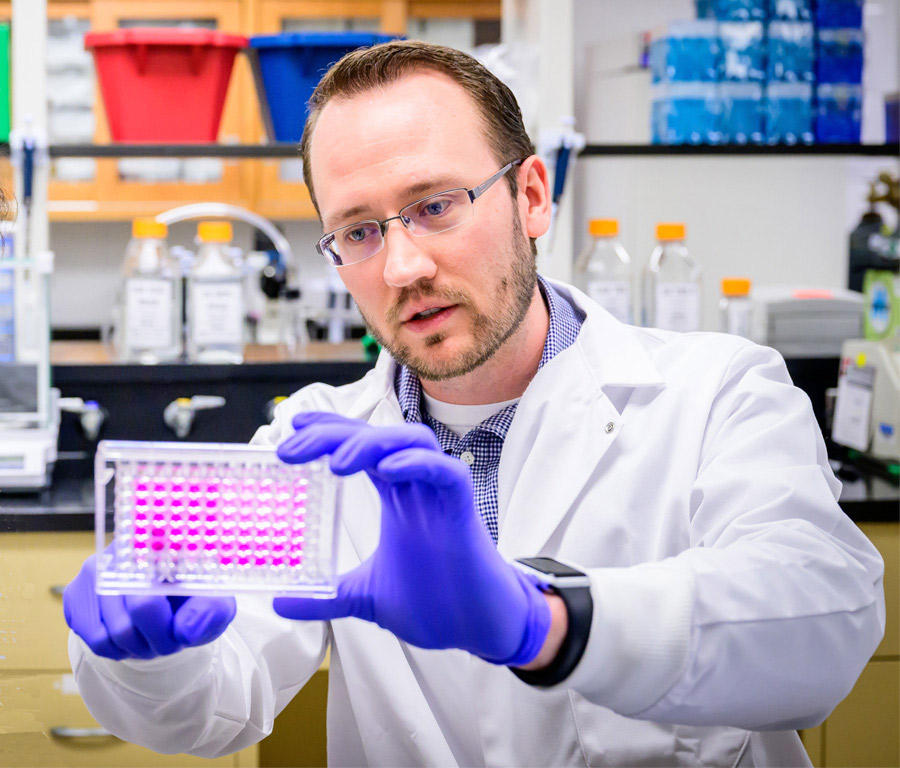
Dr. Matthew Berry, an assistant professor in the Department of Veterinary Clinical Medicine, is an emerging leader in comparative oncology and translational research. He earned his veterinary degree from Illinois in 2017, then stayed on to complete an internship and a combined medical oncology residency and PhD program.
Using about 60 words, how would you explain your main area of research focus to someone sitting next to you on an airplane?
As a veterinary medical oncologist in the comparative oncology field, my research is driven by the pursuit of innovative technologies and anticancer therapies to advance care and improve the outlook for cancer patients. I am particularly interested in the application of immunotherapy. My research aims to bridge the gap between basic science discoveries and clinical practice by leveraging companion animals with cancer.
How will your work impact quality of life and benefit society both locally and globally?
Cancer — a common diagnosis among companion animals and humans — continually poses a threat to the quality and quantity of life. My clinician-scientist perspective enables me to translate real-world oncologic challenges into research questions, generating results with direct implications for daily clinical practice. Moreover, a significant portion of my active research projects carries broad translational potential across many cancer types and could benefit animals and humans alike.
What excites you most about the future of research in your field?
There is growing evidence and acceptance that certain cancers in dogs and cats closely resemble their human cancer counterpart. We are living in the era of immuno-oncology. I am particularly excited to develop novel immunotherapy strategies to treat cancers in animals, because these studies can accelerate clinical translation and refinement of treatments for humans with cancer.
What tools are critical to the work you do?
The participation of dedicated pet owners who are seeking advanced care for their beloved animals is vital to my research program. By enrolling their companions in clinical trials, these compassionate individuals become pivotal partners in driving scientific progress. Their willingness directly fuels the translation of groundbreaking discoveries from the laboratory to the clinical setting, ultimately paving the way to transform the lives of animals and humans facing a cancer diagnosis.
If your work depends on collaborations with people in other fields of study, what are those fields?
Several of my existing research projects are in close collaboration with a basic scientist, assistant professor Hua Wang, in the Department of Materials Science & Engineering. Our current collaborative projects revolve around novel cell-labeling technology and therapeutic cancer vaccine platforms. Furthermore, to broaden the impact of innovative technologies, I have close collaborators in other specialty fields of veterinary medicine, including neurology/neurosurgery and internal medicine.
More about Matthew Berry
Matthew Berry
Assistant Professor
Department of Veterinary Clinical Medicine
Education
- DVM, University of Illinois College of Veterinary Medicine
- PhD, University of Illinois College of Veterinary Medicine
Affiliate Positions
- Associate Member, Cancer Center at Illinois, Cancer Engineering & Biological Systems program