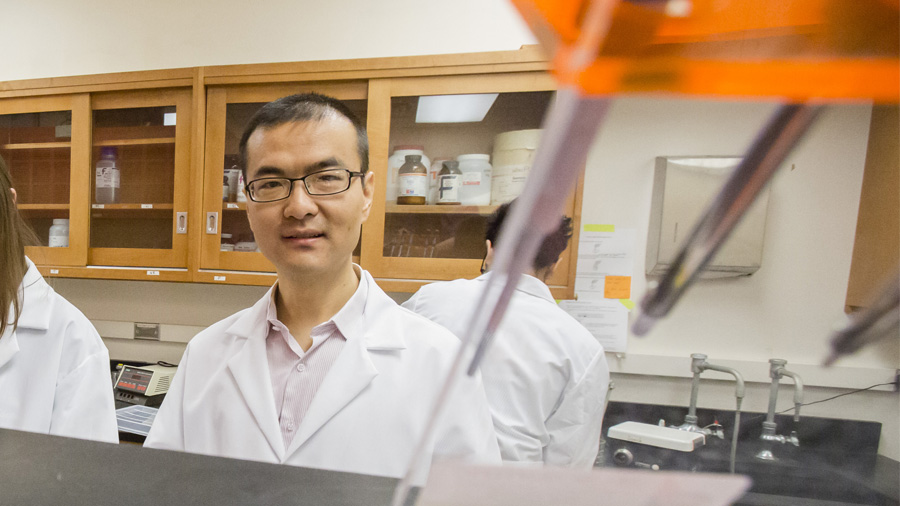
Dr. Joe (Huanyu) Qiao joined the Department of Comparative Biosciences in 2017 and was promoted to associate professor in 2023. He received the 2020 Zoetis Award for Research Excellence from the College of Veterinary Medicine and the 2021 Early Career Toxicologist Award from the Midwest regional chapter of the Society of Toxicology. In 2024, his lab was awarded funding from the Cancer Center at Illinois to explore an innovative method using third-generation sequencing technology to repair damaged DNA strands using sister chromatids formed during the DNA replication process.
Using about 60 words, how would you explain your main area of research focus to someone sitting next to you on an airplane?
My lab studies how life begins at the cellular level, focusing on the development of sperm and eggs (oocytes). We investigate meiosis, a special type of cell division that reduces the chromosome number by half, ensuring proper inheritance when sperm and egg unite. By uncovering how this process works, we aim to understand fertility and reproductive health.
How will your work impact quality of life and benefit society both locally and globally?
Meiosis research is critical because errors in this process are a leading cause of infertility, miscarriages, and genetic disorders such as Down syndrome. By uncovering how sperm and eggs develop correctly, my work advances reproductive health, improves fertility treatments, and informs public health strategies. Locally, this supports families struggling with infertility, and globally, it contributes to addressing population health and sustainable reproduction.
What excites you most about the future of research in your field?
I am most excited about uncovering how DNA repair is regulated during meiosis. This process is remarkably precise, and insights gained from meiotic repair can deepen our understanding of DNA repair mechanisms in cancer. Our lab is using third-generational sequencing technology to investigate DNA repair in both meiotic and cancer contexts.
What tools are critical to the work you do?
We believe that new technologies bring new biological discoveries. Our lab has recently developed several unique tools, including Digital Chromosome Banding, SisterPore-C, Sister-Pore-Repair, Single-Cell Toxicology Approach, Spatial & Temporal Live RNA Sequencing, Subcellular RNA Sequencing, as well as Single-Chromosome and Single-Spindle Micromanipulation.
How has the broader U. of I. research community factored into your success?
I am affiliated with the School of Molecular & Cellular Biology (MCB), the Grainger College of Engineering, the Carl R. Woese Institute for Genomic Biology (IGB), the Cancer Center at Illinois (CCIL), and the Center for Biophysics and Quantitative Biology at Illinois. These vibrant collaborations and the free exchange of scientific ideas provide an unparalleled environment for interdisciplinary research.
If your work depends on collaborations with people in other fields of study, what are those fields?
Collaboration with Dr. Jodi Flaws, my colleague in the Department of Comparative Biosciences, has led us into the field of toxicology, significantly broadening the scope of our research. Together, we have published several papers on reproductive toxicology. This interdisciplinary partnership has opened new opportunities to explore how environmental exposures impact meiosis and reproductive health.
More about Joe Qiao
Joe (Huanyu) Qiao
Associate Professor
Department of Comparative Biosciences
Education
- PhD, Molecular Plant Biology, Colorado State University, Fort Collins
- Postdoctoral Research, HHMI (Howard Hughes Medical Institute) and University of California, Davis
Visit the Qiao Laboratory Website
Affiliate Positions
Department of Bioengineering
Department of Molecular & Integrative Physiology
Center for Biophysics and Quantitative Biology
The Carl R. Woese Institute for Genomic Biology
Cancer Center at Illinois