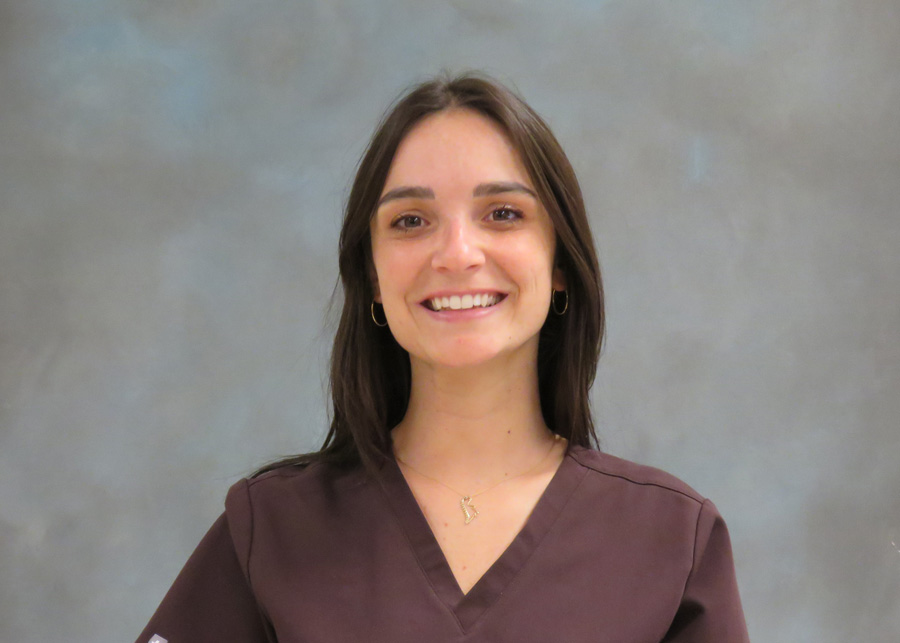
Dr. Gelendi is a clinical assistant professor in the small animal emergency and critical care service.
Tell us about your background.
I was born and raised in northern Italy, where I obtained my veterinary degree from the University of Padua. In 2019, I left my country with one dream: to become a veterinary criticalist. That dream took me to the United Kingdom, where I completed a rotating internship in a private referral hospital in England, followed by a specialty internship in Small Animal Emergency and Critical Care at the University of Edinburgh in Scotland.
From there, I moved to the United States to pursue advanced training at Auburn University in Alabama, where I completed my ECC residency and master’s degree. I’m now thrilled to have joined the University of Illinois as a clinical assistant professor in small animal emergency and critical care.
The journey hasn’t been easy, but it’s been the most rewarding adventure, one that shaped who I am both as a clinician and as a person.
How did you become interested in emergency and critical care?
Early in my career, I realized how much I was drawn to the intensity and purpose of critical moments. ECC combines everything I love about veterinary medicine: fast thinking, physiology, teamwork, and compassion. It challenges both your intellect and your empathy every single day.
I’ve always been fascinated by how quickly situations can change and how small decisions can make all the difference. There’s something uniquely fulfilling about stabilizing a patient on the edge and watching them recover. It’s science and humanity at their rawest form. That sense of urgency and meaning is what made me fall in love with ECC and what continues to inspire me every day in the ICU.
Tell us about one of your favorite cases.
It’s hard to choose just one, because what I find most meaningful in ECC isn’t tied to a single patient; it’s those moments when a critical case begins to turn around. The dog in septic shock that finally lifts its head, the cat that starts grooming again after days of supportive care, the toxin patient whose parameters slowly normalize. Those quiet milestones always stay with me. What makes them special isn’t just the recovery itself, but everything that leads to it: the physiology behind each decision, the coordination of the team, and the persistence it takes to get there. Those moments remind me why I love this field.
ECC is humbling, complex, and profoundly human. It keeps me curious, grounded, and grateful. Every patient teaches something new about medicine, resilience, and the privilege of being part of their fight to recover.
What are your special interests inside or outside of the clinic?
Inside the clinic, I’m particularly interested in fluid therapy and all things physiology. I love the challenge of translating complex mechanisms into real-time decisions that can change a patient’s outcome. I also enjoy teaching and mentoring students and residents, helping them find structure, confidence, and curiosity in the often-chaotic world of ECC.
When I’m not in scrubs, you can usually find me at the gym or out dancing with friends. And if I suddenly disappear, there’s a good chance I’m catching up on sleep with a much-needed Power Nap.