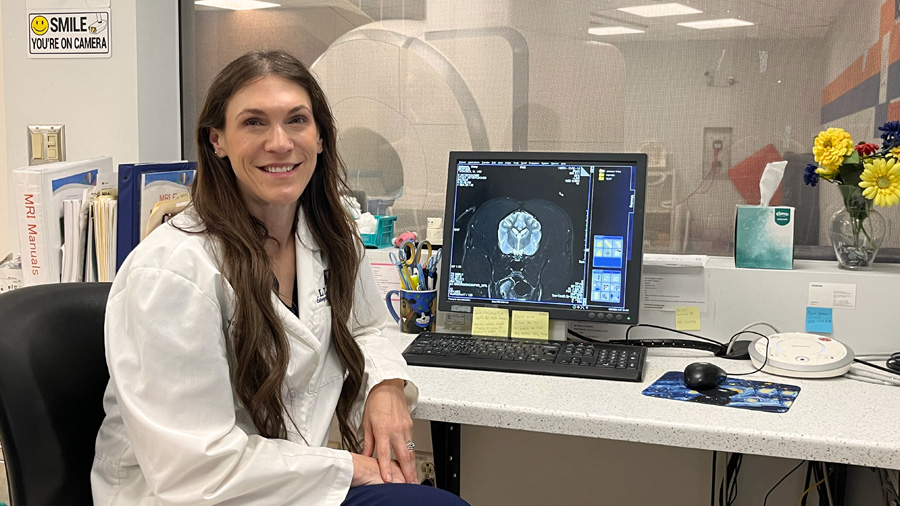
Dr. Kari Foss earned her veterinary degree at the University of Illinois in 2008 and gain board certification in veterinary neurology from the American College of Veterinary Internal Medicine. In 2016, after working in private practice, she returned as a faculty member. In addition to advanced imaging techniques, her research interests have also included the role of the microbiome in dogs with spinal cord injury and the intramuscular delivery of the anticonvulsant levetiracetam in an ER setting.
Using about 60 words, how would you explain your main area of research focus to someone sitting next to you on an airplane?
I study how advanced MRI techniques can be applied to the canine brain to better understand various canine diseases, particularly brain tumors and epilepsy. These technologies take us beyond simply seeing what the brain looks like to learning how it functions, which can help improve diagnosis, guide treatment decisions, and ultimately improve the quality of life for our patients.
How will your work impact quality of life and benefit society both locally and globally?
My research aims to improve how we diagnose and monitor neurologic diseases in dogs, helping veterinarians make more informed treatment recommendations and giving owners greater confidence in their decisions for their pets. Because many brain diseases in dogs closely resemble those seen in people, both in appearance and behavior, these studies may also contribute to advances in human medicine. By combining clinical care with innovative imaging technologies, our work has the potential to improve patient outcomes while strengthening collaborations between veterinary and human health researchers.
What excites you most about the future of research in your field?
What most excites me is seeing the shift from using MRI solely to visualize anatomy toward using it to understand disease biology and predict outcomes. Advanced imaging techniques are increasingly allowing us to identify biomarkers, monitor treatment response in real time, and potentially predict which therapies are most likely to benefit individual patients. This moves us closer to more tailored medicine in veterinary neurology and opens new opportunities for translational discoveries that assist both animals and people.
What tools are critical to the work you do?
Advanced MRI technology is central to my research, particularly access to high-field MRI systems and specialized imaging sequences that allow us to study brain structure, function, metabolism, and biomechanics. Equally important are the collaborations that make this work possible.
Through partnerships with colleagues at the Beckman Institute and across campus, we have brought imaging techniques developed at the University of Illinois into veterinary medicine, creating new opportunities for both clinical care and research.
How has the broader U. of I. research community factored into your success?
The collaborative environment at U. of I. has been a major factor in my success. Working with researchers at the Beckman Institute for Advanced Science and Technology and colleagues across multiple disciplines has allowed me to pursue research questions that would not be possible within a single field. These partnerships have expanded both the scope and impact of my work and have created opportunities to translate advances in imaging science into veterinary and comparative medicine.
What publication are you most proud of?
One publication I am especially proud of is “Establishing an MRI-Based Protocol and Atlas of the Bearded Dragon (Pogona vitticeps) Brain.” While much of my research focuses on advanced neuroimaging in dogs, this project addressed a significant knowledge gap in veterinary medicine by creating a resource for an increasingly popular companion species.
It was a highly collaborative effort that brought together expertise from multiple disciplines and demonstrated how advanced imaging can improve our understanding of animal health. The project generated considerable interest within the veterinary community and even inspired an educational video that received a regional Emmy Award nomination, making it especially rewarding to see the work reach audiences beyond academia.
If your work depends on collaborations with people in other fields of study, what are those fields?
My research is highly interdisciplinary. I collaborate with bioengineers and imaging experts who develop and optimize advanced MRI techniques, veterinary diagnostic imaging specialists who help implement these approaches clinically, and physician-scientists, including neurosurgeons, who bring valuable perspectives from human medicine. These collaborations are essential for advancing translational imaging research that benefits both animal and human patients.
More about Kari Foss
Kari Foss
Associate Professor
Department of Veterinary Clinical Medicine
Education
- MS, The Ohio State University
- DVM, University of Illinois
Other Positions
- Staff Neurologist, MedVet Medical and Cancer Center for Pets, Cincinnati, Ohio