Like a diligent dog owner, when you notice that your pet begins coughing after moments of excitement or after dinner, you concernedly call your veterinarian to schedule an appointment. At the clinic, the doctor diagnoses your dog with tracheal collapse, a progressive disease that requires lifelong management.
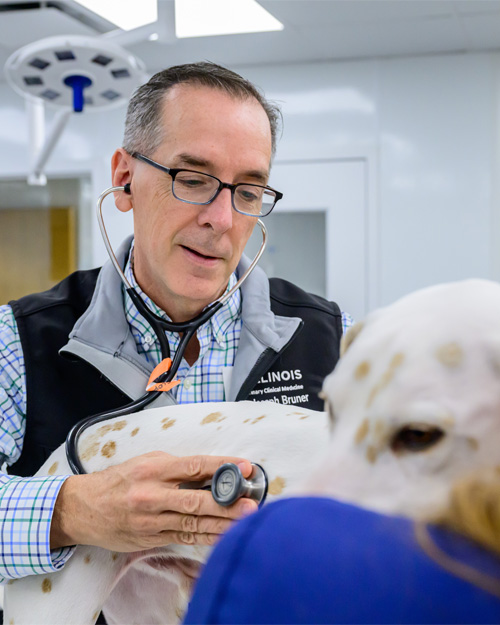
But what really is tracheal collapse, and what can we do about it? Dr. Joseph Bruner, a veterinarian specializing in small animal internal medicine at the University of Illinois Veterinary Teaching Hospital in Urbana, explains this condition and how it is treated.
Defining Tracheal Collapse
Dogs, cats, humans, and other mammals have a trachea, or airway, which connects the outside world to the lungs. The trachea is composed of rings of cartilage and soft tissue. These cartilaginous rings, however, are not fully connected, but instead are c-shaped and held together by a soft tissue membrane.
In many of our domestic species, such as dogs, cats, horses, and livestock, the trachea withstands the daily demands. But not always.
“For many of our toy dog breeds,” says Dr. Bruner, “a genetic predisposition leaves them vulnerable to these tracheal rings losing rigidity and to their connecting membrane stretching over time.”
This, in turn, leads to the trachea collapsing in on itself, or tracheal collapse.
Signs of Tracheal Collapse
Tracheal collapse is seen most often in middle-aged to older small breed dogs. It can, however, be identified in dogs as young as 6 months old as well as, though not commonly, in large and giant breed dogs.
The classic sign of tracheal collapse is persistent coughing, which is usually brought about by excitement, eating, or drinking. The coughing is dry and often characterized as a “goose honk” sound.
Tracheal collapse is a progressive disease, meaning it takes time for the trachea to lose enough rigidity for it to collapse in on itself. Coughing is the only way these animals can open their trachea back up. But since this is a gradual disease, their trachea will continue to collapse, and at an increasing rate, without medical intervention.
Diagnosing Tracheal Collapse
When it comes to diagnosing tracheal collapse, some approaches are more definitive than others. Radiographs, which are more commonly referred to as X-rays, of the neck and chest, for example, may miss the problem because the trachea “collapses and expands depending on whether the patient is inhaling or exhaling at the exact moment the radiograph is taken. Therefore, it can appear normal if you were unlucky enough to take the radiograph at the wrong time,” Dr. Bruner explains.
Bronchoscopy involves sending a camera into the trachea to watch how the trachea moves. The downside of a bronchoscopy is that the procedure requires the dog to be sedated, which can alter the way an animal normally breathes, and thus can mask the severity of the problem.
Dr. Bruner prefers using fluoroscopy, “which is like a video X-ray,” to diagnose tracheal collapse. Fluoroscopy is typically done while the patient is awake, allowing veterinarians to watch the movement of the trachea. In dogs with tracheal collapse, the trachea will collapse down either on inhalation, which isolates the problem to the neck region, or on exhalation, which isolates the problem within the chest.
“The use of fluoroscopy is becoming the standard for diagnosing tracheal collapse,” Dr. Bruner states.
Medical Management of Tracheal Collapse
Once a veterinarian diagnoses a dog with tracheal collapse, the most common next step is medication. The medications typically prescribed include:
- a cough suppressant
- a short-term steroid to reduce the inflammation in the airways
- an anti-anxiety medication to calm the animal down
- in some cases, a bronchodilator, which increases the diameter of the lower airways
Weight loss is also a key factor in treating this disease because obesity can make it even harder for the dog to breathe.
The combination of medications depends on the severity of the disease, but the majority of dogs with tracheal collapse will respond to medical management. Unfortunately, though, medical management is just that, management. None of the prescribed medications help to return rigidity to the tracheal rings. Because this is a progressive disease, eventually medical management will not be enough.
Tracheal Stents
When medical management alone fails to alleviate the signs of tracheal collapse, tracheal stents are here to save the day. A tracheal stent is similar to a mesh tube. It is rigid enough to hold the trachea open but flexible enough to allow for normal movement.
Modern tracheal stents are made of nitinol, a nickel-titanium alloy, which is more comfortable for the patient, has anti-microbial properties, and has decreased the problems commonly associated with older designs. Dr. Bruner recommends placement of a stent as soon as medical management begins to fail.
The process of implanting a stent is non-invasive. Often, radiographs will be taken to determine the size of the stent needed, but fluoroscopy can also be used to do this. General anesthesia is required for the procedure, and the entire process is done through the dog’s mouth.
The veterinarian feeds the stent into the trachea in a collapsed form. Once the stent is properly aligned within the trachea, the veterinarian allows it to expand. After the procedure, the animal will stay in the hospital for an additional 24 hours to ensure everything is going well.
Tracheal stents are a lifesaver, but they are not a cure. Stents provide rapid relief from respiratory distress, but Dr. Bruner stresses that “stents do not replace medical management.”
Tracheal stents are only part of managing this chronic condition. The combination of stent and medication provides the key to a long, happy life for these dogs.
By Catherine Haenni