Indolent ulcerations, also known as spontaneous chronic corneal epithelial defects (SCCEDs) or “boxer ulcers,” are a common, frustrating cause of non-healing corneal ulcers in dogs. Although they can occur in any breed, they are frequently diagnosed in middle-aged to older dogs and are overrepresented in breeds such as boxers and French bulldogs.
What Is an Indolent Ulcer?
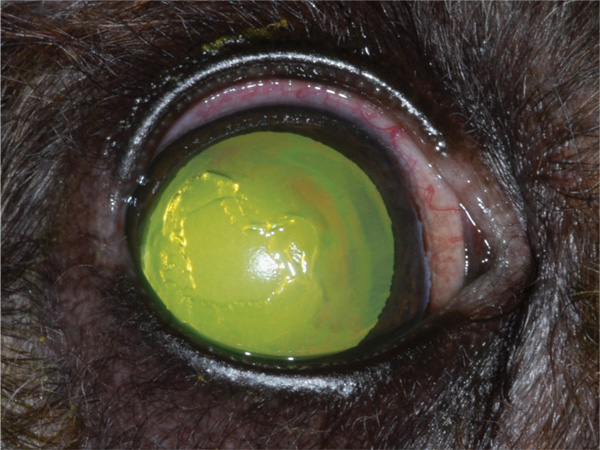
Photo of an indolent ulceration, provided by Dr. Todd Marlo.
When an ulceration fails to heal within a week, one of three things has occurred. Either the ulceration has become infected, you have not found the underlying cause (i.e., entropion, ectopic cilia, or distichia), or the ulceration has become indolent. If the ulceration has remained superficial and the animal is older, overwhelmingly the cause is that the ulceration has become indolent.
On fluorescein staining, these ulcers often have a characteristic “halo” of stain that extends under the surrounding epithelium. If the staining reveals a deep ulceration or is indicative of a descemetocele, the ulceration is not indolent and needs to be treated differently.
Why Do They Occur?
The exact cause is not always clear, but several mechanisms are implicated:
- Defective epithelial adhesion due to abnormal basement membrane formation
- Age-related corneal changes
- Underlying corneal degeneration
- Minor trauma that fails to heal appropriately
Clinical Signs
Dogs with indolent ulcers are often painful, though the severity varies. Common signs include:
- Blepharospasm
- Epiphora
- Conjunctival hyperemia
- Cloudiness or dullness of the corneal surface
- Robust corneal neovascularization/granulation tissue
Because these ulcers linger, owners may report temporary improvement followed by recurrence after discontinuing topical medications.
Diagnosis
Diagnosis is based on:
- History of a non-healing superficial ulcer (ulceration persisting past 1 week)
- Ophthalmic examination
- Fluorescein staining demonstrating epithelial undermining
- Absence of stromal loss or deep ulceration
- Animal age (remember, this hap-pens in older animals ,typically greater than 6 years of age)
A complete eye examination is essential to rule out complicating factors such as dry eye (keratoconjunctivitis sicca), eyelid abnormalities, or infection.
Treatment Options
Topical antibiotic therapy alone is insufficient because the underlying problem is epithelial adhesion failure. Topical blood serum does not improve healing in these ulcerations. Effective treatment focuses on removing non-adherent epithelium.
Common therapies include:
- Epithelial debridement – Removal of loose epithelium with a sterile cot-ton-tipped applicator. (Normally combined with either a grid or burr)
- Grid keratotomy – A controlled pattern of superficial corneal scratches to pro-mote adhesion. (Required sedation)
- Diamond burr keratectomy – A burr gently removes abnormal basement membrane.
At the University of Illinois Veterinary Teaching Hospital, we normally place a soft contact lens following these procedures. Topical antibiotics are continued prophylactically, and oral pain medications are prescribed.
Prognosis
Once the appropriate therapy has been performed, indolent ulcerations have a greater-than-90% success rate at healing in 2 to 4 weeks. Rechecking the animal before 2 weeks is not advised, as it does not allow the epithelium time to heal or attach and the diamond burr or grid should not be repeated that soon.
When to Refer
Referral to the Veterinary Teaching Hospital’s ophthalmology service is recommended if:
- The ulcer has not improved after 7 to 10 days of standard therapy
- There is concern for infection or stromal involvement
- The dog experiences recurrent ulcers
Key Takeaways
Indolent ulcerations are superficial but persistent corneal defects caused by poor epithelial adhesion. While they can be uncomfortable and frustrating for both owners and clinicians, they generally carry excellent prognosis with proper procedural treatment.
Early recognition and appropriate intervention help minimize pain, reduce healing time, and prevent unnecessary prolonged medical therapy. Just remember that if an ulceration has not healed within a week’s time, change your diagnosis not your drugs, as you are often missing something.
By Todd Marlo, DVM, MS, DACVO