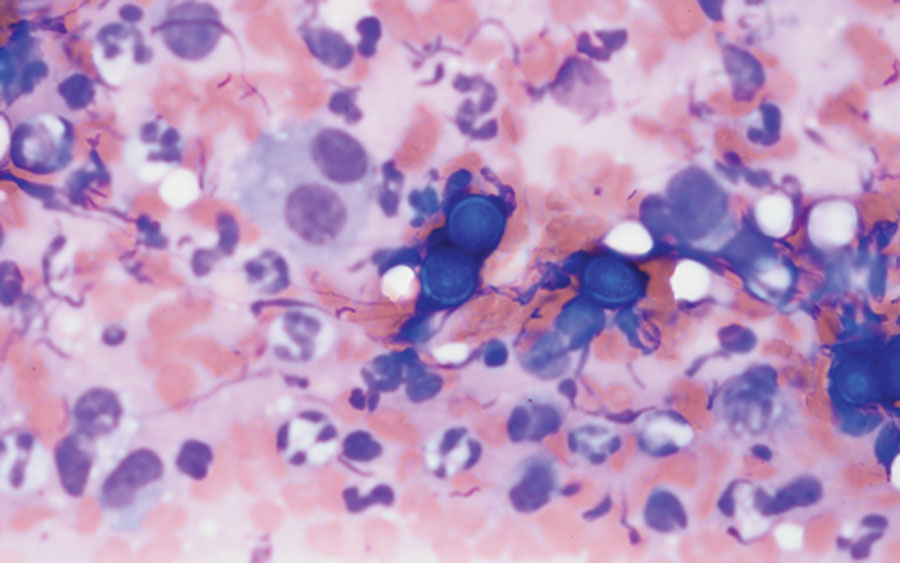
Cytology slide showing Blastomyces. Image courtesy of Dr. Amy Schnelle.
Azole antifungals are the first line and mainstay therapy for most systemic mycoses in small animal medicine. These drugs inhibit lanosterol 14α-de-methylase (CYP51), a key enzyme in the synthesis of ergosterol, which is required to maintain the fungal cell membrane.
Although ketoconazole, an imidazole, was widely used in the past for systemic fungal infections, it has largely been replaced by itraconazole and fluconazole. These first-generation triazole antifungals are more effective, less toxic, and have a broader spectrum of action compared to ketoconazole.
The choice between itraconazole and fluconazole is guided by multiple factors, but many times comes down to clinician preference and cost.
Antifungal Spectrum
Consideration of the antifungal spectrum is of utmost importance. Specifically, fluconazole has poor efficacy against most mold infections, and Aspergillus spp. are intrinsically resistant. Acquired resistance to fluconazole may be increasing for other fungal species; a recent survey of veterinary Histoplasma spp. isolates showed high fluconazole minimum inhibitory concentrations in 25% of samples, consistent with resistance (1).
In general, itraconazole tends to be a more potent antifungal agent than fluconazole, requiring less drug present at the site of infection to have a fungistatic effect.
Bioavailability
Serum itraconazole concentrations can be quite variable due to erratic absorption. This is particularly true for the capsule formulation, which is best absorbed in an acidic environment and so should be administered with food and without antacid medications. Therapeutic drug monitoring of itraconazole may be useful in optimizing the dose for individual animals.
In contrast, fluconazole is reliably absorbed with near complete gastrointestinal bioavailability and so does not require therapeutic drug monitoring. Its enhanced absorption is due to a smaller, more water-soluble molecular structure.
Site of Infection
The physiochemical properties that enhance fluconazole absorption also facilitate its penetration into protected sites, including the eyes and brain. This has led some authors to recommend fluconazole over itraconazole for fungal infections involving these locations. However, the higher potency of itraconazole combined with the inflammatory breakdown of the blood-brain and blood-aqueous barriers makes itraconazole a reasonable therapeutic choice. Itraconazole has excellent bone penetration, so it may be particularly useful for treating fungal osteomyelitis. Fluconazole, however, is generally preferred for treating susceptible infections of the urinary tract because it is eliminated unchanged in the urine.
Studies
Retrospective studies have directly compared itraconazole and fluconazole efficacy for the treatment of canine blastomycosis (2), canine histoplasmosis (3), and feline histoplasmosis (4). Although remission rates were higher for itraconazole in all three studies, none of these differences were statistically significant.
The adverse effect profiles of these drugs are similar and include gastrointestinal signs, hepatotoxicity, and, rarely, cutaneous eruptions. These effects, particularly hepatic changes, may be more common for itraconazole.
By Jennifer M. Reinhart, DVM, PhD, DACVIM (SAIM), DACVCP. This article is excerpted from a presentation Dr. Reinhart made at the 2021 American Vet Convention.
References
- Hanzlicek AS, KuKanich KS, Cook AK, Hodges S, Thomason JM, DeSilva R, Ramachandran A, Durkin MM. Clinical utility of fungal culture and antifungal susceptibility in cats and dogs with histoplasmosis. J Vet Intern Med. 2023;37(3):998-1006. doi: 10.1111/jvim.16725.
- Mazepa ASW, Trepanier LA, Foy DS. Retrospective comparison of the efficacy of fluconazole or itraconazole for the treatment of systemic blastomycosis in dogs. J Vet Intern Med. 2011;25(3):440-445. doi:10.1111/j.1939-1676.2011.0710.x.
- Wilson AG, KuKanich KS, Hanzlicek AS, Payton ME. Clinical signs, treatment, and prognostic factors for dogs with histoplasmosis. J Am Vet Med Assoc. 2018;252(2):201-209. doi:10.2460/javma.252.2.201.
- Reinhart JM, KuKanich KS, Jackson T, Harkin KR. Feline histoplasmosis: fluconazole therapy and identification of potential sources of Histoplasma species exposure. J Feline Med Surg. 2012;14(12):841-8. doi:10.1177/1098612X12452494.