When you seek medical attention for your vomiting pet, your veterinarian may explore causes ranging from infectious diseases to toxic exposure to mechanical obstructions. But what if it turns out to be “none of the above”? Bilious vomiting syndrome, a condition generally diagnosed by exclusion of other diagnoses, may be the culprit.
Dr. Canaan Shores, the veterinarian who oversees the urgent and convenient care service at the University of Illinois Veterinary Teaching Hospital, explains this syndrome and ways to diagnose and treat it.
What Is Bilious Vomiting Syndrome?
The gastrointestinal tract of a dog or cat functions much like that of a human. Food flows from the esophagus to the acidic environment of the stomach, then moves into the small intestine, where the gallbladder secretes bile. The function of bile is to break down fats.
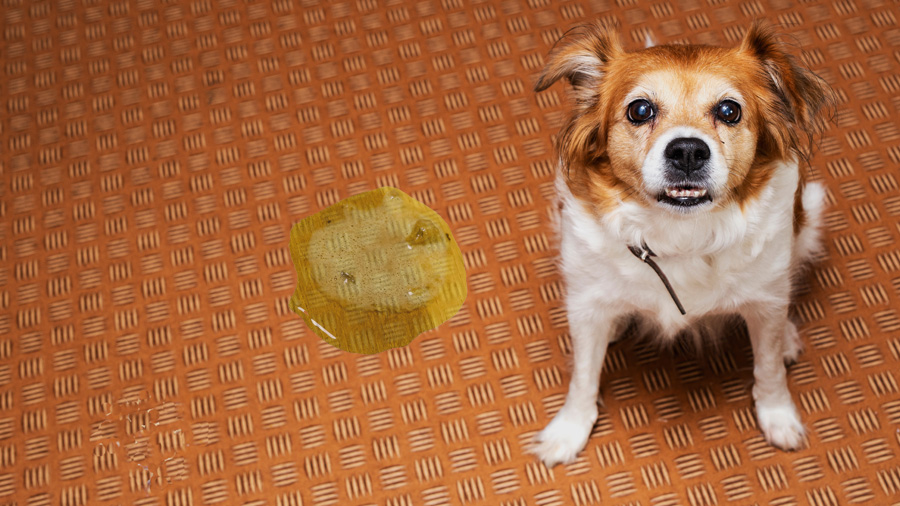
Bile looks yellow or greenish and sometimes has a foamy or mucus-like consistency.
“Bilious vomiting syndrome is suspected when a patient has recurrent episodes of vomiting bile early in the morning,” Dr. Shores explained. “It is thought to occur when bile refluxes—or moves backward—from the intestines to the stomach, leading to irritation and subsequent vomiting.”
Bilious vomiting syndrome is diagnosed more commonly in dogs than in cats. As Dr. Shores points out, it occurs in people as well.
“In human medicine, bilious vomiting, or bilious emesis, most frequently occurs in newborns, where it indicates an intestinal obstruction that often requires emergency surgery. For the most part, the condition is not considered an emergency in dogs.”
Diagnosing Bilious Vomiting Syndrome
For pets with intermittent vomiting, possible diagnoses include parasitic infection, foreign body, partial intestinal obstruction, chronic pancreatitis, and cancer of the stomach. Veterinarians may order diagnostic tests, including fecal testing, bloodwork, and imaging such as X-rays or ultrasound, to rule out these other conditions.
For bilious vomiting syndrome to be a strong consideration, pets should have no other clinical signs besides intermittent vomiting of bile in the early morning. Sometimes the patient’s signs so clearly indicate bilious vomiting syndrome that extensive diagnostics may not be needed.
“The difficulty comes when cases present with confounding clinical signs that require some degree of work up to further assess,” says Dr. Shores.
“In most cases of bilious vomiting syndrome, the dog is either fed once daily in the morning, or its last meal is in late afternoon or early evening. This schedule results in the dog’s stomach being empty in the early morning hours.”
Nevertheless, Dr. Shores wants pet owners to know that the feeding schedule associated with this condition does not cause it.
“If a dog is not displaying clinical signs associated with this condition, there is no evidence to support changing your pet’s diet to ‘prevent’ bilious vomiting syndrome,” he says. “Many dogs eat only once daily and do not develop this condition.”
Treatment for Bilious Vomiting Syndrome
Treatment focuses on lifestyle change and medication.
“Many patients that are presumptively diagnosed with bilious vomiting syndrome respond well to changes in the feeding schedule, especially offering a small meal late in the evening, typically right before bedtime,” says Dr. Shores. “If a change in feeding schedule doesn’t work, transitioning to a different diet may prove beneficial.”
Diets proposed for this condition include hydrolyzed diets, in which the protein source has been broken down into the tiniest possible particles, and high-fiber diets.
“Sometimes changes in feeding schedule and diet suffice to manage the problem,” says Dr. Shores. “If the condition doesn’t improve with these measures, however, veterinarians may recommend medications to address the gastric irritation and delayed gastric emptying time.”
Examples include antacids such as famotidine and omeprazole; prokinetics such as metoclopramide, cisapride, and erythromycin; and mucosal barrier drugs such as sucralfate.
“Most dogs with a reasonably certain diagnosis of bilious vomiting syndrome respond well to some combination of adjusting feeding schedule, changing the diet, and medical management,” says Dr. Shores.
These treatments, however, should be considered management tools to reduce the frequency of vomiting, according to Dr. Shores. They do not address an underlying condition. Unfortunately, there is limited information available on whether this syndrome will resolve or persist.
By Lauren Bryan