Some diseases are loud and obvious. Others are quiet, vague, and easy to dismiss…until they aren’t.
Addison’s disease, also known as hypoadrenocorticism, is one of the quiet kinds. It’s often called the “great pretender” because its symptoms can mimic many other, far more common problems.
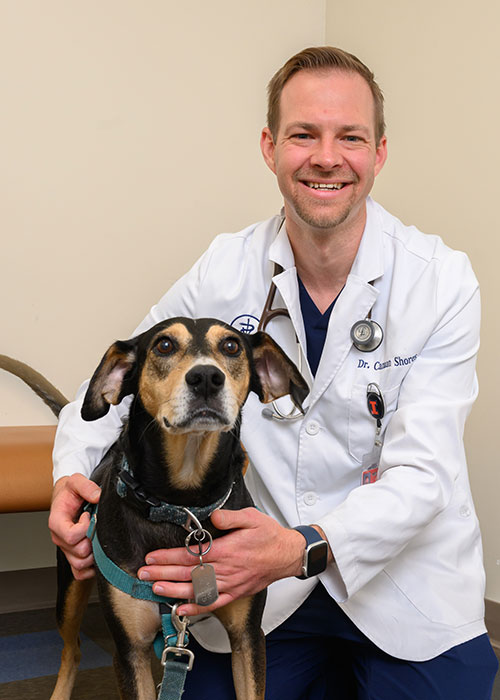
“Hypoadrenocorticism means a lower amount of hormones are being produced by the outer portion of the adrenal glands,” explains Dr. Canaan Shores, a small animal urgent care veterinarian at the University of Illinois Dr. John A. Coyne South Clinic.
Nonspecific Signs of Addison’s Disease
The outer portion of the adrenal glands produce two essential hormones: cortisol and aldosterone.
Cortisol, often called the stress hormone, helps regulate blood pressure, blood sugar, and gastrointestinal function. Without it, dogs can become weak and develop vomiting or diarrhea, especially during times of stress.
Aldosterone helps balance sodium and potassium levels in the body. “Without aldosterone, sodium levels decrease, and potassium levels increase to dangerous levels,” says Dr. Shores, “which can lead to severe, even fatal, abnormal heart rhythms.”
One of the biggest challenges with Addison’s disease is how nonspecific the signs can be.
“The clinical signs are vague, can be intermittent, and resemble other common problems,” Dr. Shores explains. Lethargy, weakness, vomiting, and diarrhea are among the most common signs; however, these can also point to dozens of other conditions.
Early signs are often described as “waxing and waning,” meaning they come and go. A dog may have occasional gastrointestinal upset, decreased appetite, or low energy that seems to resolve on its own. Stress—such as boarding, travel, or a change in routine—can worsen clinical signs.
“At least initially, the signs may be mild and could even resolve without veterinary intervention,” Dr. Shores explains. “So, the owner is left thinking it’s nothing major, or maybe that the pet just has a ‘sensitive stomach.’”
Addisonian Crises
Unfortunately, many dogs are not diagnosed until they experience an Addisonian crisis.
An Addisonian crisis is a severe, sudden decline that leads to shock. This occurs due to dehydration, dangerous electrolyte imbalances, low blood sugar, and low blood pressure.
“Once the dog is in a crisis, the situation can become life-threatening within hours to a day,” Dr. Shores explains.
Dogs in crisis may present as profoundly weak, collapsed, trembling, or severely dehydrated. Elevated potassium levels can cause abnormal heart rhythms, and blood pressure is often dangerously low.
“With dogs in an Addisonian crisis, testing and treatment typically occur simultaneously,” says Dr. Shores. Intravenous fluids, correction of electrolyte abnormalities, heart-protective medications, and steroids are often started immediately.
Diagnosis of Addison’s Disease
Addison’s disease is more commonly diagnosed in young to middle-aged dogs. Certain breeds, including standard poodles, Portuguese water dogs, Great Danes, and Rottweilers, are predisposed. Standard poodles are the most common breed associated with this disease, with a prevalence of around 8%. For the general dog population, prevalence is much lower: less than 0.5%.
In typical Addison’s, both cortisol and aldosterone are deficient, often resulting in low sodium and high potassium on routine bloodwork. A screening cortisol test may raise suspicion. The gold standard for diagnosis—the ACTH stimulation test—measures cortisol levels in the blood before and after administration of an injection of synthetic adrenocorticotropic hormone (ACTH).
Early Detection, Treatment Yields Good Outlook
The good news? Addison’s disease is very treatable.
Once the patient is stabilized, long-term management of the disease involves replacing the deficient hormones. Most dogs receive daily prednisone to replace cortisol. Dogs with typical Addison’s also require a monthly injection of a mineralocorticoid medication, most commonly desoxycorticosterone pivalate (DOCP).
“With appropriate medication and veterinary monitoring, dogs with Addison’s disease have an excellent quality of life and a good prognosis,” Dr. Shores emphasizes.
Monitoring is especially important early on as medication doses are adjusted. Because these dogs lack normal stress hormone reserves, owners should work with their veterinarian to develop a plan for temporarily increasing medications during illness or stressful events.
While Addison’s disease can be serious, particularly during a crisis, it is manageable long term. Early recognition is key.
If your dog has recurring gastrointestinal upset, waxing and waning lethargy, or simply doesn’t seem quite right, it’s worth starting the conversation with your veterinarian. Addison’s may be the “great pretender,” but with proper diagnosis and treatment, it does not have to define your dog’s future.
By Julia Bellefontaine