Many people experience temporary cognitive impairment immediately after surgery. In people over age 60, however, about one in 10 continues to experience deficits in learning, memory, and executive function for more than three months after the surgery, a condition associated with increased morbidity and reduced quality of life.
In a paper recently published in the British Journal of Pharmacology, researchers from the Department of Comparative Biosciences at the University of Illinois Urbana-Champaign and elsewhere demonstrate that a compound designed to increase the activity of α5-GABAA receptors in the brain was able to prevent the cognitive deficits that typically occur as a result of surgery under general anesthesia in aged mice.
First author Jinrui Lyu, who completed her PhD this month, and Dr. Uwe Rudolph, professor and head of the Department of Comparative Biosciences in the College of Veterinary Medicine, shared an overview of the design and significance of their study. Both are also part of the Neuroscience Program at the University of Illinois.
What led you to conduct this study?
Our lab is interested in why the aging brain is especially vulnerable to persistent cognitive problems after surgery. In older patients, these postoperative deficits can last for weeks or months and are associated with major consequences for independence, quality of life, and long-term health. We want to understand the biology behind this vulnerability so that more targeted therapies can be developed.
Previous work suggested that microglia, the brain’s resident immune cells, play an important role in postoperative cognitive decline. Our lab wanted to probe the role of α5-GABAA receptors, which are receptors for the neurotransmitter GABA in the hippocampus, a brain region intimately linked to learning and memory functions. These receptors are located on the surface of nerve cells (neurons). GABAA receptors are generally involved in inhibition of neuronal activity.
In young animals, reducing α5-GABAA receptor activity has been shown to improve memory, but in aged animals the opposite appears to be true: increasing their activity supports cognition. That age-dependent difference made this receptor system especially interesting in the context of surgery.
How did your study explore this receptor system and its relationship to surgery-induced cognitive deficits?
One of our co-authors, James Cook, a distinguished professor emeritus at the University of Wisconsin-Milwaukee, and his colleagues had developed the compound MP-III-022, which enhances the function of the α5-GABAA receptor. We designed a study to see if this compound could reduce microglial activation and neuroinflammation after surgery and thus prevent postoperative cognitive deficits.
We worked with two populations of mice, one that was chronologically aged (21 to 24 months old) and a second group (a hippocampal aging model) that was 4 to 5 months old but had been cognitively aged by ablating a specific population of inhibitory neurons in of the hippocampus. That second model reproduces several features of hippocampal aging and allowed us to ask whether loss of inhibitory control contributes to postoperative vulnerability.
The mice in the experimental groups received MP-III-022 (or a vehicle control) via drinking water three days before they underwent surgery (a laparotomy) and continuously throughout the study. A series of standard behavioral tests assessing different types of memory, e.g., working memory, object memory, fear memory, and spatial memory, was performed to assess cognition. We also examined the brains of the mice at the end of the study to assess microglial markers and dendritic spine density in the hippocampus, which is known to correlate with cognitive functions
What did you learn?
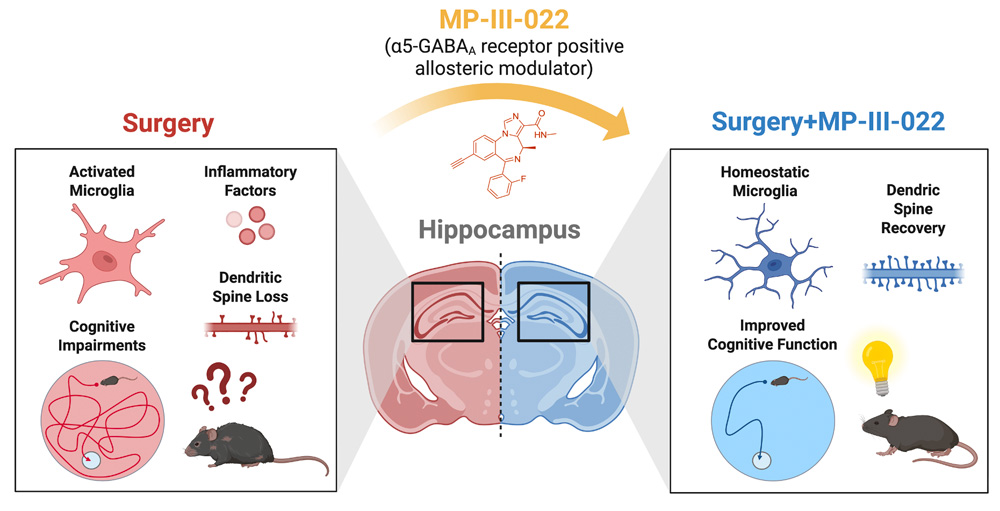
In both the aged mice and the hippocampal aging model, surgery impaired performance in several cognitive tasks. However, in the mice that received MP-III-022, MP-III-022 largely prevented surgery-induced cognitive deficits.
Looking at the brains, we found that the treatment also reduced the surgery-associated microglial activation and prevented the surgery-associated loss of dendritic spine density. Overall, the results indicate that enhancement of the activity of α5-GABAA receptors can protect the aging brain from behavioral and structural consequences of surgery.
An important aspect of the findings is that the treatment did not simply make the mice more (or less) active or change their behavior in a general way. This supports the interpretation that the drug was affecting cognition-related and neurobiological outcomes rather than producing a broad change in the activity level.
Why are microglia important in this context?
Microglia are immune cells that constantly monitor the brain’s environment. After surgery, they can shift into an activated state and contribute to neuroinflammation. In our study, surgery increased several microglial activation-associated measures, but the administration of MP-III-022 strongly reduced the severity of those changes. This suggests that the drug may help stabilize neuronal circuits in a way that prevents or limits the inflammatory response associated with postoperative cognitive dysfunction.
We do not yet know whether MP-III-022 acts via α5-GABAA receptors on microglia or α5-GABAA receptors on neurons, or both. But either way, the data support a strong link between enhancement of α5-GABAA receptor function, reduced neuroinflammatory signaling, and improved cognitive outcome after surgery.
What is the potential relevance of your findings to human medicine?
Long-lasting cognitive impairment after surgery is a major clinical problem in older adults, and there are currently no mechanism-based therapies specifically designed to prevent it. Our findings identify activation of α5-GABAA receptors as a promising strategy for protecting hippocampal function after surgery in aged mice.
The work is also timely from a translational standpoint. While MP-III-022 is an experimental compound, another compound that also enhances α5-GABAA receptor function, alogabat, has advanced into Phase 2 clinical studies to treat Angelman syndrome, a rare neuro-genetic disorder that impairs nervous system function, causing severe developmental delays and intellectual disability, and other autism spectrum disorders. In principle, based on our findings, it would make sense to test alogabat in clinical studies aimed at alleviating cognitive dysfunction in aged human patients.
Thus, the α5-GABAA receptor subtype is currently attracting substantial clinical interest, and novel drugs enhancing the activity of this receptor may support novel therapeutic concepts.
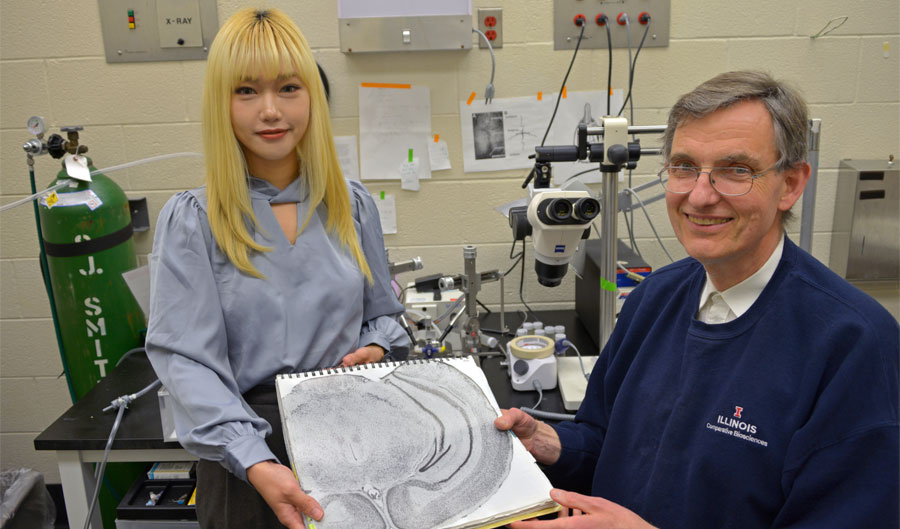
In the featured photo, first author Jinrui Lyu and senior author Uwe Rudolph hold an illustration of a mouse hippocampus, the brain region central to learning and memory that was the focus of the study. The curved layers in the drawing represent hippocampal structures where the team examined surgery-related inflammation and changes in neuronal connections.