This message will appear in the Chicago Veterinary Medical Association Bulletin.
Every veterinarian has an origin story.
Some of us grew up on farms and watched in fascination when the veterinarian visited to assist a difficult delivery of a calf or foal. Others nursed a beloved pet through an illness and realized how impactful the veterinarian’s care could be.
Quite a few were among the millions of preschoolers who answered the inevitable “What do you want to be when you grow up?” with “veterinarian,” and then stuck with their dream through 20+ years of education and expense.
But there’s also the role one takes on after achieving one’s DVM: becoming the person who inspires and encourages the next generation of practitioners.
Dr. Karen Terio’s Mentor: Jane Goodall
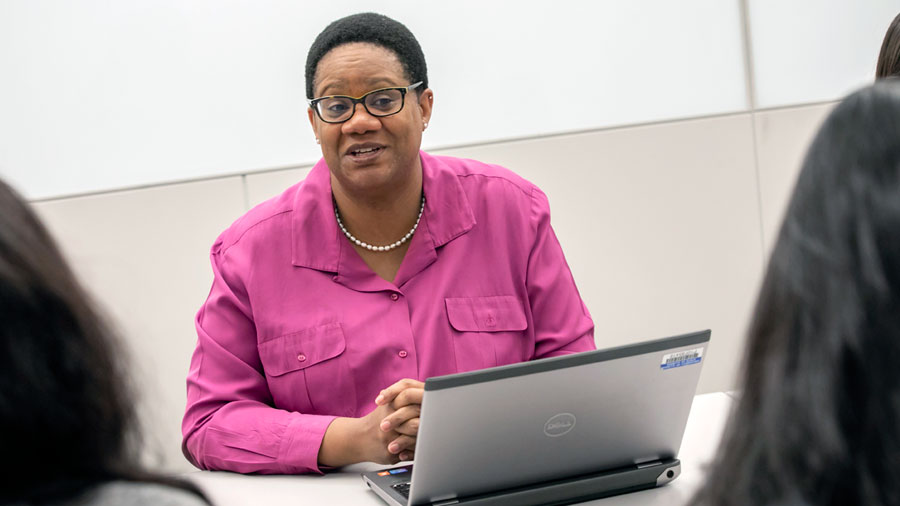
Dr. Karen Terio, who heads the Zoological Pathology Program, part of our college’s Veterinary Diagnostic Laboratory, recently shared her origin story as part of the Women in Science Lecture Series sponsored by the University of Illinois Archives. Bookending her talk, which featured three remarkable wildlife pathology discoveries from her career, she spoke about those who sparked her passion for what she does and about the veterinarians she has mentored in her current role.
As a child, Dr. Terio recalls being thrilled by TV documentaries about Dr. Jane Goodall and her work with wild chimpanzees in Tanzania and by Goodall’s book about the chimpanzees, In the Shadow of Man.
“I got to see somebody who looked sort of like me as a woman out there in the wild doing amazing research,” says Dr. Terio. “That inspired me to think that this was a possibility for a career for me.”
Dr. Karen Terio’s Mentor: Dr. Linda Munson
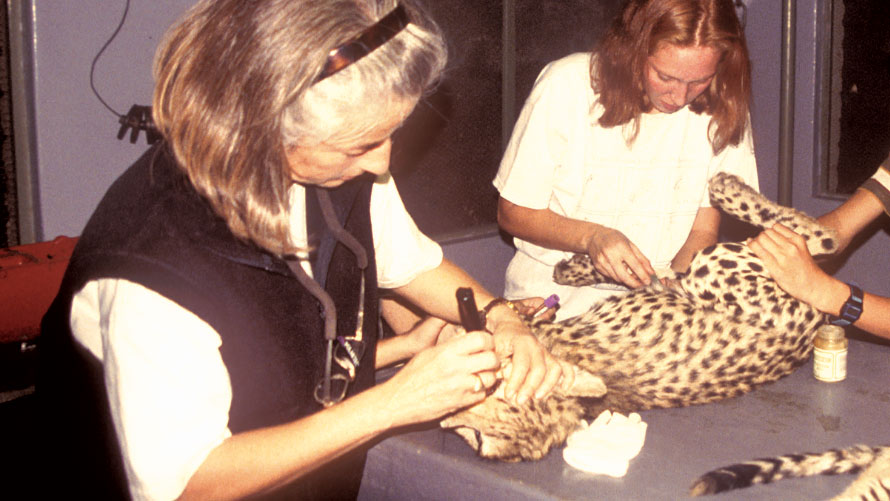
After earning her bachelor’s degree from Bowdoin College and her DVM at Tufts, she headed to the University of California-Davis, where she studied under Dr. Linda Munson. (Dr. Terio shared the photo above of herself as a resident, on the right, conducting a necropsy with Dr. Munson.) A trailblazer like Goodall, Dr. Munson, an expert on diseases of wildlife, showed Dr. Terio a career path that could make a real difference in veterinary medicine on a global scale.
When Dr. Munson died in 2010, Dr. Terio co-wrote a memorial article lauding her mentor. “Dr. Munson was passionate about training veterinary pathologists, and she had a profound influence on a generation of veterinary pathologists from around the world,” they wrote. “She recruited, taught, nurtured, harangued, and prepared them for success.”
Serendipitously, Dr. Terio’s career also intersected with that of Jane Goodall, who died last fall at age 91. Goodall devoted more than 60 years to studying the behavior of chimpanzees and being a global ambassador of human rights and environmental care. Since 2006, Dr. Terio has worked with veterinarians and wildlife biologists in Gombe National Park, home base for Goodall’s research with chimpanzees.
Empowering the Next Generation of Veterinarians
In fact, Dr. Terio was part of a large team of animal behaviorists and scientists in Tanzania and the U.S. who were the first to show that simian immunodeficiency virus (SIV), the precursor of HIV-1 in humans, could cause disease in chimpanzees. Dr. Jane Raphael, a wildlife veterinarian trained by Dr. Terio, conducted the necropsy on the chimpanzee that had died prematurely because of SIV infection. Before this finding, scientists had thought chimpanzees were immune to the virus and experienced no symptoms of infection.
Dr. Raphael is among the dozens of veterinarians Dr. Terio has mentored over the years, creating her own legacy within her field. The work is needed, and the number of specialists in this area is small.
“Wildlife pathology is not taught in most veterinary schools. The U. of I. Zoological Pathology Program at the College of Veterinary Medicine is one of the few programs in the world to offer this specialized training,” notes Dr. Terio.
Dr. Terio sums up her work this way: “My ultimate goal is to conserve species and preserve healthy ecosystems by understanding disease risks through research and empowering others by providing specialized training in veterinary pathology.”
I encourage each of us to consider what we can do to empower future generations of veterinarians. So many opportunities exist, from speaking at career fairs in schools, to joining the outreach committees of CVMA or ISMA, to encouraging aspiring veterinarians to attend our college’s annual Open House. (This year it will be Sunday, October 4, from 10 a.m. to 4 p.m.) The compassionate care you deliver every day for animals and their families may be all it takes to inspire someone to explore our profession.
Thank you for all you are doing.