The National Institutes of Health (NIH) is funding University of Illinois Urbana-Champaign researchers to study risk factors for autism spectrum disorders using magnetic resonance imaging in a mouse model.
Drs. Howard Gritton and Paul Bonthuis, both professors of Comparative Biosciences at the College of Veterinary Medicine, and Dr. Jozien Goense, professor of psychology at the College of Liberal Arts and Sciences, are working to better understand the relationship between phthalate exposure on the developing brain and consequences for social behavior in connection with autism spectrum disorders.
The team recently received a $2.7 million NIH grant for the study, drawing on findings from a 2024 study funded through a seed grant from the Beckman Institute for Advanced Science and Technology. That grant went to Drs. Gritton and Goense, along with Beckman collaborators Benjamin Auerbach and Brad Sutton, to investigate the genetic basis of altered behavior and brain function related to autism spectrum disorder.
Seed Grant Laid the Foundation
A key component of the seed funded project was using functional MRI in mice to image neural circuits and whole brain function in response to gene alterations that eventually cause downstream behavioral changes. Data collected from the original project proved to be instrumental in demonstrating feasibility for the NIH application and award.
“The seed grant was involved in establishing functional imaging in mice and collaborations between Jozien, the Biomedical Imaging Center, and myself,” Dr. Gritton said.
Using the methods and knowledge established during the seed project, Drs. Gritton, Goense, and Bonthuis, along with other Illinois collaborators, will now focus on the relationship between exposure to endocrine-disrupting compounds and nervous system alterations during fetal development. These alterations may ultimately contribute to abnormal changes in social behavior and communication, which are often markers of autism spectrum disorder.
New Study Focuses on Phthalates
“The NIH grant is about using our prior imaging framework to look at an autism model associated with environmental toxins,” Dr. Gritton said. “In this case the toxicants are phthalates, a type of plasticizer that makes plastic flexible and are widely present in our environment and in our bodies.”
Phthalates are pervasive in the environment and can be found in vinyl flooring, shower curtains, food and beverage containers, children’s toys, and various other plastic products and fragrances. Because they mimic hormones and can bind to hormone receptors, phthalates are classified as endocrine-disrupting compounds that may have potentially profound impacts on neurodevelopment.
Prior studies have shown that pregnant women are exposed to phthalates throughout pregnancy and that phthalate concentrations are highest in children 6 to 11 years old. Other studies have shown that individuals exposed to phthalates during fetal development also show higher incidences of autistic traits, including impaired social behavior and communication.
“During pregnancy, everything is timed, the right hormones must signal at the right time and in the right amount. If something disrupts that timeline, we want to know if it causes changes in the brain that lead to eventual changes in behavior which are linked with autism,” Dr. Goense said.
Seeking Anatomic and Functional Brain Changes
The team will use functional MRI to track changes in the mouse brain after exposure to different levels of phthalates. They will examine changes to anatomical connections that exist within the brain as well as changes to functional networks or the way those connections communicate with one another. The team will be able to relate that information to downstream behavioral changes such as social behavior, avoidant behavior, and anxiety.
“There is a correlational relationship between plastic exposure during development and autism, and we want to look into that in more detail,” Dr. Gritton said. “We’re looking at dopamine and glutamate signals in different regions of the brain that we know are important for the expression of social behavior in another aim of this grant that is informed by the MRI work.”
To visualize changes in the brain, Dr. Goense and Illinois graduate students will operate the Bruker 9.4 Tesla MRI scanner in Beckman’s Biomedical Imaging Center. The scanner gives researchers the ability to closely look at circuit function in various brain structures.
“In addition to running the scanner, we also work on image analysis and developing data analysis pipelines for image post-processing,” Dr. Goense said.
Changes at the Genomic Level
One advantage to using MRI is that the images will provide the team with a brain-wide measure of alterations after exposure to phthalates. This allows the researchers explore connections to an observed behavior at the whole brain level, within specific brain regions, at the level of relevant neural circuits, and ultimately to the genomic level by looking at gene expression.
Dr. Bonthuis, having expertise in genome function and genetics, will focus on gene expression patterns in the brain in response to phthalate exposure and its effects on social behaviors. The goal is to identify neural circuits affected by phthalates that regulate specific aspects of sociality.
“Research shows that exposure to endocrine-disrupting toxicants can alter neural development and produce long-lasting changes in gene expression in the brain,” Dr. Bonthius said. “Through our multidisciplinary and complementary approaches, this collaboration will enable us to identify the affected neural circuits, uncover cell type–specific gene expression changes, and map these alterations onto the relevant brain circuits.”
Autism spectrum disorder is inherently complex, and there is no singular identifiable cause or solution. By taking a closer look at the mechanisms at play and at various levels, from gene expression to neural circuits and brain connectivity, the team will begin to unravel the disorder’s complexity.
“It is simply a pressing issue in our society, and we are doing our best to understand its mechanisms,” Dr. Gritton said.
Condensed from an article by Elizabeth Bello
Editor’s Notes
Research reported in this press release was supported by the National Institutes of Health under award number 1R01ES036997-01A1. The content is solely the responsibility of the authors and does not necessarily represent the official views of the National Institutes of Health.
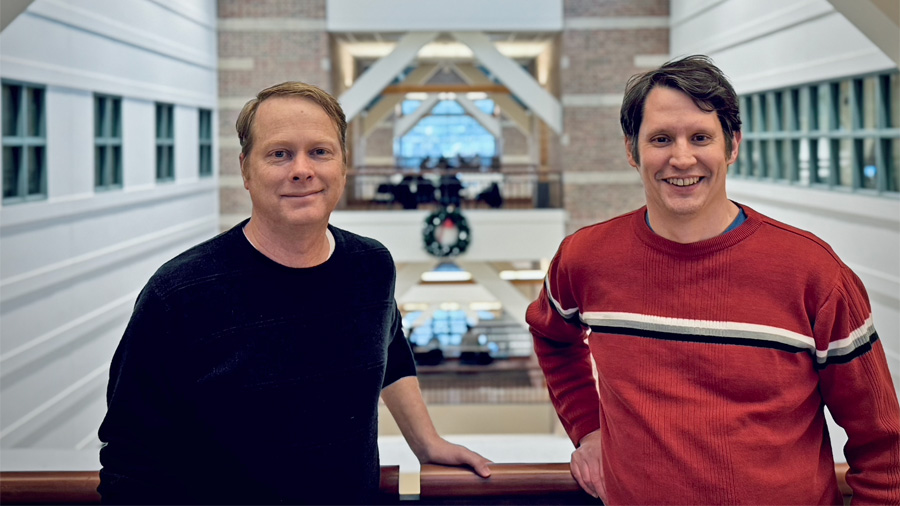
Feature photo: Drs. Howard Gritton (left) and Paul Bonthuis at the Beckman Institute. Jozien Goense not pictured. Credit: Elizabeth Bello, Beckman Communications Office.