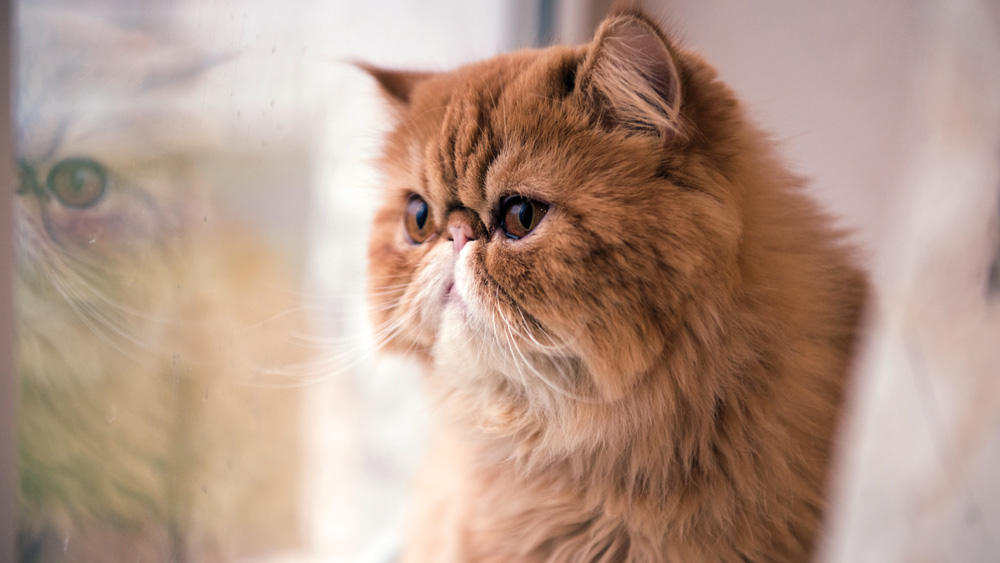
Although brachycephalic (BC) cats have long held appeal with breeders and owners, concerns have only recently been raised regarding problems of brachycephaly in cats. A feline BC syndrome has newly been described to include numerous respiratory, gastrointestinal, sleep, and activity-related signs and behaviors.
Primary conformational abnormalities of BC dogs include stenotic nares and nasal vestibules, elongated and thickened soft palate, hypoplastic trachea, aberrant nasal turbinates, and macroglossia; cats are mostly affected by stenotic nares and nasal vestibules. Skin fold as well as ocular, oral, and dental abnormalities have also been reported.
Clinical signs are attributed mostly to stenosis of the nasal entrance and include sneezing, snoring, open-mouth breathing, nasal discharge, coughing, dyspnea, increased breath sounds during sleep, diminished activity, prolonged recovery from activity, and variably reported gastrointestinal signs.
The objectives of this study were to describe ala vestibuloplasty in cats with sufficient detail to permit widespread reproducibility and to report long-term outcomes in 27 cats using owner responses to a structured, quality-of-life questionnaire.
An additional objective was to evaluate the impact of recall bias on owners’ responses for a subset of 13 cats in this cohort that were also enrolled in a previous questionnaire-based study reporting real-time preoperative clinical signs.
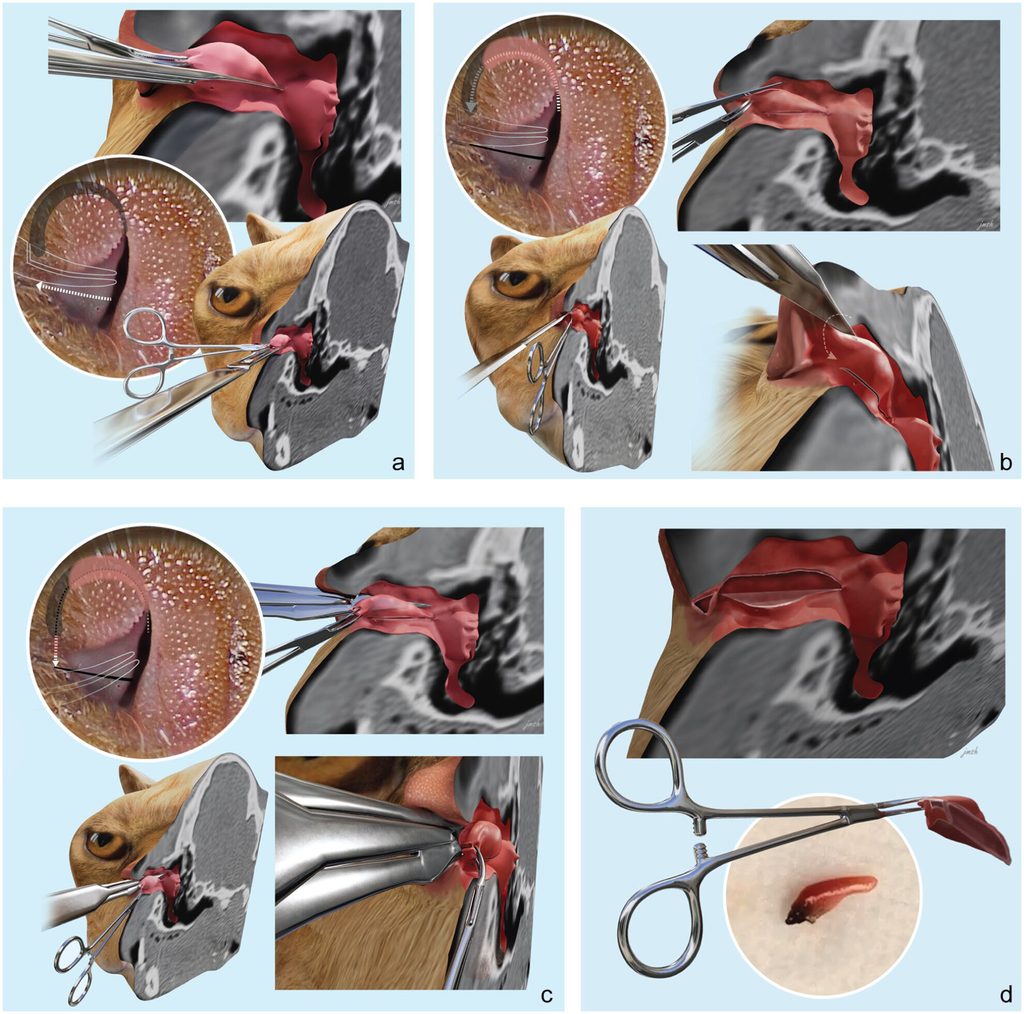
(b) The scalpel is then repositioned dorsally in the nasal entrance with the cutting surface directed ventrolaterally at a 45° angle to the horizon, and the rostral attachment to the alar wing is transected. The photo inset shows the trajectory of the scalpel blade in the nasal vestibule, the rostral attachment to the alar wing (pink shaded area) and the lateral recess
(gray shaded area). The scalpel is inserted (white dotted line) medial to the dorsal alar fold, transects (pink dotted line) the rostral attachment to the alar wing and is positioned (gray dotted line and arrowhead) ventrally in the lateral recess.
(c) The cutting surface of the blade is now dorsal to the lateral attachment of the alar fold in the vestibule. A final incision is made in the lateral vestibule from dorsolateral to ventromedial to divide the lateral attachment, meet the horizontal incision and converge caudally to release the alar fold. The photo inset shows the scalpel incision in the lateral recess lateral to the alar fold transecting (pink dotted line) the lateral attachment of the alar fold and meeting (white dotted line and arrowhead) the horizontal incision.
(d) The alar fold is entirely resected to the point where the plica alaris branches into the ventral nasal concha, opening the nasal vestibule. The photo inset shows the completely resected alar fold.
Characteristics of the Cats
A total of 45 cats underwent ala vestibuloplasty for clinical signs of BC syndrome at the University of Illinois Veterinary Teaching Hospital between May 2019 and June 2023. Owners of 27 cats returned completed questionnaires. Of the 27 cats, 15 were Persian, six were Scottish Fold, three were Exotic Shorthair breeds, one was Himalayan, and one was Burmese. One cat was recorded as domestic longhair but met the criteria for brachycephaly. There were 10 spayed female and 17 castrated male cats. Median age and body weight at surgery were 1,583 days and 3.5 kg, respectively.
Preoperative physical examination revealed stenotic nares and nasal vestibules in all cats (27) and inspiratory stertor in 20, nasal discharge in 6, ocular discharge in 14, and increased abdominal effort of breathing in 16. Results of complete blood count, serum biochemistry, and/or venous blood gas analysis before surgery were clinically unremarkable.
Of the 27 cats, 14 underwent preoperative head, neck, and thoracic CT; all cats had stenotic nares and mild (n = 3), moderate (n = 4), or marked (n = 7) nasal vestibular stenosis from contact between the alar fold and nasal septum.
Owner Responses
To improve reliability of owner responses regarding a variety of clinical problems in BC cats and response to surgical intervention, we utilized a structured, quality-of-life questionnaire with objective questions regarding respiratory and gastrointestinal signs, sleep and activity-related behaviors, and ocular, aural, and dental health before and after surgery. Response options were scored and individual scores summed to give a total clinical severity score for each cat (range 0–129).
A median short-term improvement in clinical severity score of 30 points was reported in the earlier cohort of 13 cats. The median long-term improvement in clinical severity score from pre- to postoperative in this larger cohort was 31 points, indicating that improvements after ala vestibuloplasty are both immediate and sustained.
Importantly, all clinical parameters that improved in the short term in the previous study remained improved in the long term. However, several variables, such as coughing and frequency of upper respiratory infections (URIs), showed long-term improvement only. As feline URIs are part of a chronic syndrome with mixed etiology, the short-term follow-up was likely insufficient to note improvement.
Ours is the first study to report both vomiting and regurgitation as consistent signs in BC cats reliably alleviated long-term by a nares-altering procedure. Variable reporting of gastrointestinal signs in BC cats may be related to species-specific pathophysiology or reporting biases. As occasional vomiting or regurgitation may occur in healthy cats, owners of BC cats may not discern clinically relevant vomiting or regurgitation.
BC cats also commonly exhibit subtle signs of gastrointestinal distress, such as hovering or fidgeting over food or water without intake, difficulty prehending or chewing food, and messy eating and drinking. These signs all improved in the long term after ala vestibuloplasty. Our findings underscore a need to closely scrutinize gastrointestinal signs to determine whether medical and surgical interventions may be warranted to improve gastrointestinal health in BC cats.
Cats in this cohort showed sustained increased frequency and duration of activity, reduced frequency of dyspnea during activity, and reduced breath sounds while sleeping.
Discussion
Procedures for the correction of feline brachycephaly have only recently gained attention in the veterinary literature. Although most authors agree the nasal entrance is likely the only site of airway obstruction in cats, opinions differ on pathoanatomy and surgical approach.
Three components comprise stenosis of the nasal entrance in BC animals. An enlarged or collapsed alar wing contacting the philtrum compromises the entire external naris. Further in the nasal entrance, an anatomically enlarged and rigid alar fold is also functionally immobile, compressing the nasal vestibule across its entire length, obstructing a significant depth of airway. As our airway examination and CT findings corroborate obstruction of both the naris and nasal vestibule by the alar wing and fold, respectively, we feel ala vestibuloplasty as described in this study most effectively addresses obstruction of the nasal entrance in BC cats.
Our study affirms that BC cats suffer most from a single site of airway obstruction at the nasal entrance, making BC cats ideal for the study of reduced airway resistance attributable to a single surgical intervention, as opposed to dogs, where multilevel surgery is most often required to address multiple areas of airway obstruction. Future prospective studies comparing different nares-altering procedures that utilize objective measures such as whole-body barometric plethysmography or pre- and postoperative CT volumetric analysis could more definitively characterize contributors to nasal stenosis to guide surgical recommendations.
Limitations of the Study
Use of a questionnaire for outcome assessment in this study potentially imposed limitations. Owner questionnaires rely heavily on owners’ abilities to accurately recognize and consistently report pets’ clinical signs and behaviors. The questions in this study have been published twice in peer-reviewed articles describing feline BC syndrome. Although multiple attempts were made to maximize owner participation regardless of satisfaction with the procedure, it is possible that owners more pleased with outcomes were more likely to respond.
Conclusion
Owners of clinically affected BC cats reported substantial and sustained improvements in respiratory, gastrointestinal, sleep, activity-related, aural, ocular, and dental signs up to 5 years after ala vestibuloplasty, which was performed safely without major complications. Ala vestibuloplasty should be considered for effective treatment of the described clinical signs of feline BC syndrome.
Excerpted from an article by Drs. Daniel Shinsako, Annette McCoy, Jonathan Samuelson, Audrey Billhymer, and Heidi Phillips in the August 2026 issue of Journal of Feline Medicine and Surgery, doi.org/10.1177/1098612X261465216. See full study for references and details on the surgery.