Do you have neurophobia?
If you’ve ever felt your heart rate increase when a seizuring patient walks through the door, you’re not alone.
The term “neurophobia” describes the anxiety many medical students and clinicians experience when faced with neurologic cases. Studies in human medicine suggest that one-third to one-half of trainees experience this phenomenon, and recent work in veterinary medicine has found similar levels of uncertainty.
Few neurologic conditions challenge our confidence more than epilepsy. Seizures are stressful for owners, often occur unexpectedly, and generate a long list of questions about diagnostics, medications, prognosis, and long-term management.
To make matters even more confusing, you can ask three different neurologists how they would manage the same epileptic patient, and you might receive three different—yet entirely reasonable—answers.
That’s because successful seizure management is driven by clinical principles rather than a single rigid algorithm.
A New Way to Build Confidence
Learning these principles is easiest when you can apply them to realistic cases. While textbooks and review articles provide an excellent foundation, confidence often comes from making decisions, seeing the consequences, and refining your clinical reasoning in a low-stress environment.
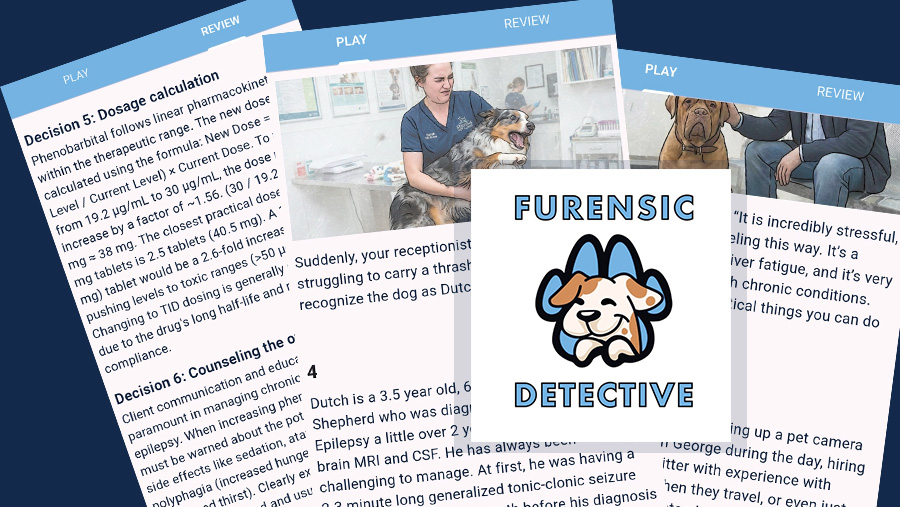
With that goal in mind, I partnered with the medical education developers at Medical Joyworks to develop a veterinary clinical reasoning app called Furensic Detective. The app is designed for veterinary students, practitioners, and anyone looking to build confidence in neurology case management.
Furensic Detective is available free through both the Apple App Store and Google Play. Because seizure management generates many of the questions we receive from our referring veterinarians, the first series of cases focuses on epilepsy and will always remain free to access.
In our veterinary students, we’ve seen meaningful improvements in both confidence and clinical decision-making after working through these cases. My hope is that practitioners in the referral community will find them equally useful—not because they provide a single “right” answer, but because they encourage the reasoning process behind good clinical decisions.
The case library will continue to expand with additional structural and reactive epilepsy cases, clinical calculation exercises (ideal for both veterinarians and technicians), and eventually a wide range of neurologic disorders. Over time, our vision is for Furensic Detective to become a comprehensive clinical reasoning resource spanning multiple veterinary specialties and species.
If you have questions, suggestions, or ideas for future cases, I’d love to hear from you. Please feel free to contact me at krupka@illinois.edu.
After all, the goal isn’t simply to treat seizures—it’s to help all of us become a little less neurophobic.
By Rose Krupka Peters, DVM, CVA, DACVIM (Neurology)