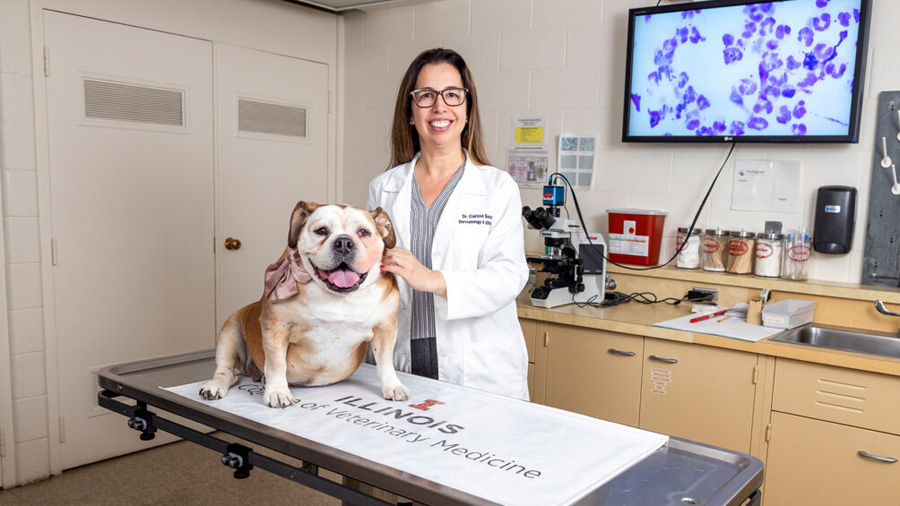
A new report outlines the dangers to dogs and cats from the New World screwworm, a parasitic infestation that was once eradicated in North America but has recently returned. One of the authors of the report, Clarissa Pimentel de Souza, a professor of veterinary clinical medicine at the University of Illinois Urbana-Champaign, spoke with News Bureau life sciences editor Diana Yates about the danger to dogs, cats and other companion animals.
What is the New World screwworm?
The New World screwworm, Cochliomyia hominivorax, is a fly whose screw-shaped larva feeds on the living tissue of animals and humans. A female fly lays eggs in open wounds and the larvae, called maggots, hatch from the eggs and start feeding on the skin.
We most often hear about NWS larvae infesting livestock. What other animals are susceptible to this parasitic fly?
All warm-blooded animals including dogs, cats and wildlife can be affected by this pest.
Are there many reports of NWS infestation in companion animals?
There are multiple reports in companion animals in different countries in the Americas. The NWS was eradicated from the United States in the 1960s but was recently reintroduced in some southern U.S. states. So far there are three cases of NWS infestation reported in dogs in Texas and New Mexico.
What are the clinical signs of infestation in dogs and cats?
NWS flies can lay their eggs in any skin lesions such as scratches, oozing inflamed areas, bite wounds and surgical incisions. Pet owners should monitor any lesions that seem to worsen or fail to heal and pay attention to excessive licking or chewing on an affected area, a foul odor that smells like decaying tissue, or visible maggots.
Are some parts of the body more susceptible than others?
Potentially. When compiling information from published reports, it was observed that the head, thorax and posterior limbs in dogs, and the head and neck in cats are the most common body sites for NWS infestation.
Which pets are most at risk of NWS infestation?
Stray dogs and cats are at higher risk of NWS due to fighting injuries, complications associated with giving birth or recent spay/neuter procedures. Pets may be at increased risk if they have skin lesions or spend time outside where injuries may occur or if they are not receiving parasite preventatives recommended by a veterinarian.
How can pet owners protect their animals from NWS?
The first step is to make sure the animals are healthy and don’t have any condition that could attract flies such as cuts, scrapes, matted hair that may be hiding lesions, oozing wounds, urine accumulation on the skin or smelly discharge from the ears.
How is infestation with the NWS treated once discovered and how effective is the treatment?
NWS is an insect infestation, not an actual disease; when the maggots are removed, the animal should recover. If a pet owner suspects NWS infestation in their dog or cat, they should promptly seek veterinary care. The early identification and treatment will greatly improve the likelihood of a successful resolution.
The U.S. Food and Drug Administration has conditionally approved several antiparasitic products that prevent and treat NWS in different animal species. A comprehensive list of antiparasitics can be found in the article “Health impacts and clinical management of New World Screwworm infestation on dogs and cats in a reintroduction scenario in the United States,” which is available online. DOI: 10.1093/jme/tjag101
Prepared by Diana Yates, News Bureau life sciences editor; featured photo by Fred Zwicky
To see the original post, please visit: How might the New World screwworm affect dogs and cats?