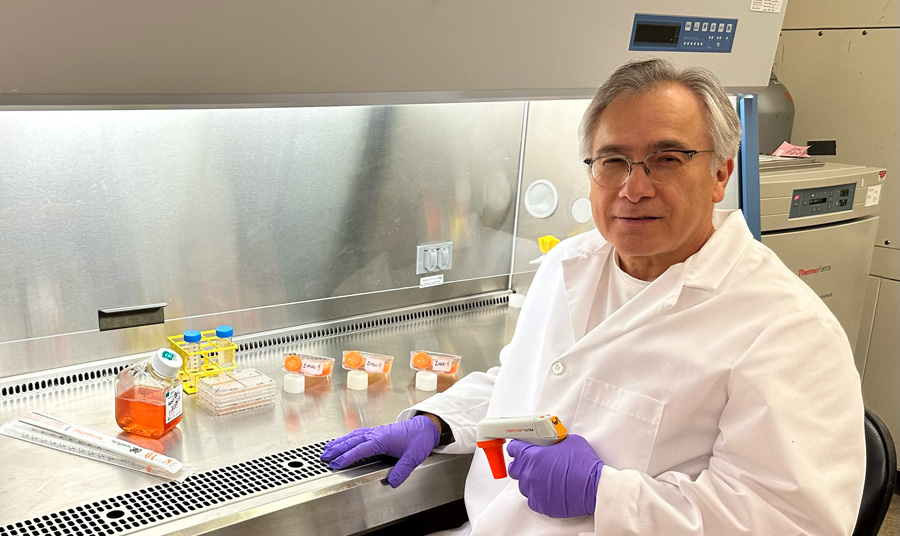
Dr. Federico Zuckermann joined the College of Veterinary Medicine faculty in 1989. He has authored over 90 scientific publications and is the founder of Aptimmune Biologics and the inventor of nine patents. He has served as president of the American Association of Veterinary Immunologists and has been recognized with college awards for research excellence several times.
Using about 60 words, how would you explain your main area of research focus to someone sitting next to you on an airplane?
My current research seeks to elucidate the mechanisms underlying the substantial increase in levels of virulence exhibited by porcine reproductive and respiratory syndrome (PRRS) virus in swine farms. Using the pig alveolar macrophage cell line ZMAC-4, we are characterizing the biotype of PRRS viruses isolated from sow farms that experienced either severe or mild reproductive loses during a PRRS outbreak.
How will your work impact quality of life and benefit society both locally and globally?
Determining the biotype of PRRS virus may provide an early predictor of disease severity of an emergent outbreak. This information could help guide pork producers and their veterinarians to implement management strategies that minimize animal losses and reduce the economic impact of PRRS.
What excites you most about the future of research in your field?
This research project is exciting because it tests the novel hypothesis that highly virulent PRRS virus strains possess a distinct biotype characterized by a faster rate of replication and accelerated death of alveolar macrophages as compared with less virulent strains. A rapid rate of macrophage death is known to trigger excessive inflammation due to impaired efferocytosis, thereby exacerbating disease severity.
What tools are critical to the work you do?
Porcine alveolar macrophages are the natural host cells for the PRRS virus, making them indispensable for the study of the pathogenesis of this virus. Hence, a key tool for this work is the porcine alveolar macrophage cell line Zuckermann macrophage (ZMAC)-4, developed in my laboratory, which is uniquely permissive to PRRS virus infection and enables reliable characterization of viral biotypes isolated from clinical isolates. Notably, the ZMAC-4 cells are also permissive to the replication of African swine fever virus.
How has the broader U. of I. research community factored into your success?
The research community at the University of Illinois, particularly its strengths in swine medicine and production as well as entrepreneurship, has played a pivotal role in my success. Collaborations with experts in porcine viruses and swine medicine have helped shape my research that addresses major challenges facing the pork industry.
The most compelling example of this collaborative environment was the development of a vaccine against PRRS based on a naturally non-virulent strain isolated in 1990. This vaccine is being used in Mexico with tremendous success.
The rich entrepreneurial ecosystem at EnterpriseWorks in the University of Illinois Research Park facilitated my ability to establish Aptimmune Biologics, Inc., in 2010.
What publication are you most proud of?
The publication that I am most proud of is the one in which we characterized the nature of the unconventional CD4 and CD8 double positive porcine T cells present in the peripheral blood of swine, Functional and phenotypic analysis of porcine peripheral blood CD4/CD8 double-positive T cells. This publication is highly cited and established my reputation as a first-class porcine immunologist.
If your work depends on collaborations with people in other fields of study, what are those fields?
My work has benefited greatly from collaborations with virologists, immunologists and biochemists. I am very privileged for having collaborated with Richard M Binns, a British immunologist at the Babraham Institute in Cambridge. Dr. Binns is widely regarded as one of the founders of porcine immunology. Another rewarding collaboration has been with Dr. Stephen G. Sligar at the Department of Chemistry at the University of Illinois. By applying his innovative nanodisc technology, we developed a broadly protective vaccine against influenza A virus, illustrating the power of interdisciplinary research to address important challenges in animal health.
More about Federico Zuckermann
Federico Zuckermann
Professor
Department of Pathobiology
Education
- PhD (Immunology), University of Texas Southwestern Graduate School of Biomedical Sciences, Dallas
- MVZ (with honors), School of Veterinary Medicine, Universidad Nacional Autonoma de Mexico (UNAM), Mexico City, Mexico
Other Academic Positions
- Research Assistant Professor, College of Veterinary Medicine, National Autonomous University of Mexico
- Research Associate, Vanderbilt University School of Medicine Visiting Associate Professor, University of Minnesota, Minneapolis (sabbatical leave)