
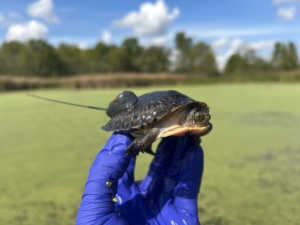
Headstart Blanding’s with transmitter
What’s cuter than a Blanding’s turtle? A baby Blanding’s turtle! Our recent blogs have discussed how we are collecting Blanding’s turtle eggs, but what is the point of doing that? We are trying to give them a head start on life with a conservation technique known as “headstarting”. This involves raising young animals in captivity during their most vulnerable early life stages, then releasing them into the wild once they are large enough to evade predators and survive environmental threats.
Headstarting has been a crucial part of conservation with species similar to the Blanding’s due to their slow maturity and high young mortality. This practice started in 1960’s in Florida and on Grand Cayman Island, where facilities began collecting eggs to bolster declining green sea turtle populations (Barbanti et al., 2026). Additionally, freshwater turtle headstarting proved to be a success in the Northern Red-bellied Cooter Headstart Program in Massachusetts, and has since expanded to numerous other imperiled species like the Blanding’s and wood turtles (Wilder et al., 2024). Headstarting has traditionally been used for birds and reptiles however, has expanded into mammals as the technique was successfully adapted for land-based mammals in Australia in 2015 to protect young bridled nailtail wallabies from predators (Ross et al., 2021). Thus, with proven success across taxa and a growing concern for the Blanding’s population’s longevity, Kane County has turned to headstarting as a tool to aid conservation efforts and protect the local Blanding’s population.
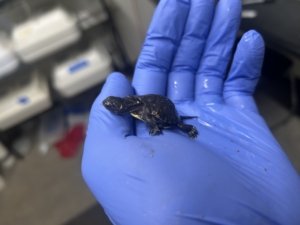
Hatchling Blanding’s turtle
Another part of our job here in Kane County involves caring for the 74 headstart Blanding’s currently in captivity. These individuals were collected as eggs last summer and cared for until they hatched, and are now continuing to grow until at least 60 grams when they can be released. Many of them are already over 60 grams as they are the good eaters, while others have fallen a little behind and are not growing quite as fast. Caring for these turtles involves daily feedings of turtle gel and pellets, which consist of all the required nutrients essential for growth and proper development. They also get the occasional special treat of bloodworms, meal worms, and brine shrimp.
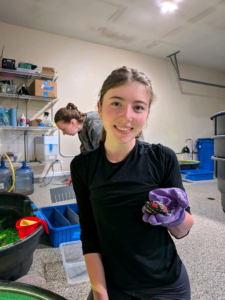
Sophia with headstart during morning feedings
Another requirement the turtles must meet prior to release is a negative Emydomyces test result. Emydomyces is an emerging fungal disease that can cause detrimental shell disease in freshwater aquatic turtles. This disease has not been detected in wild populations, thus we would like to keep it that way. The goal for the headstart program in Kane County is to release at least 60 headstarts every year into the wild population. While it would be great for all of them to survive, many of them will unfortunately fall victim to the many predators, such as raccoons and muskrats. There are other predator control efforts being made, especially at sites with higher numbers of Blanding’s turtles.
With the continued population monitoring combined with headstart efforts and predator control, hopefully we can keep the Illinois icon of the Blanding’s turtle around for many, many more years to come.
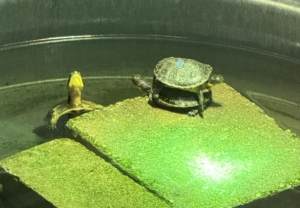
Normal baby Blanding’s behavior
Sources:
Barbanti, A., Ortega, A., & Williamson, S. (2026). Head-starting and translocation: Lessons from decades of experiences. SWOT Report, 21. Sea Turtle Status article
Ross, A. K., Lawes, J. C., Elphinstone, A., Stutsel, S., & Letnic, M. (2021). Headstarting as a cost-effective conservation strategy for an endangered mammal. Current Biology, 31(10), R465-R466.
Wilder, E. R., McElroy, C. L., Kamm, M. D., Berkholtz, J., & Windmiller, B. S. (2024). Schools as conservation partners: lessons learned from over a decade of headstarting turtles. Northeastern Naturalist, 31(sp12), E43-E58.
