
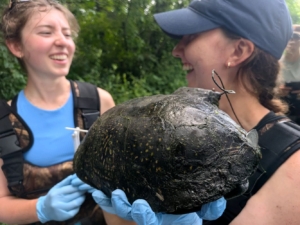
This week in Kane County was an example of how turtle work is not always full of happiness, excitement, and well, turtles. One of our sites this week only produced one Blanding’s turtle. This turtle is an adult female that we were able to track via radiotelemetry, and she is the only Blanding’s turtle known to be left at this location. This brings our discussion this week to be less exciting but still of great importance: What is happening to the Blanding’s population?
Here in Illinois, the Illinois Endangered Species Protection Act places animals and plants into two separate categories, endangered or threatened, based on their level of threat to long-term survival. The label ‘Threatened’ refers to any species that is likely to become an endangered species in the wild in Illinois in the future. On the other hand, ‘Endangered’ refers to a plant or animal species that is at risk of extinction throughout all or a significant portion of its range in Illinois.
From these classifications, the Blanding’s turtle is classified as endangered in the state of Illinois. Many factors can lead to a species reaching the endangered class. In the case of the Blanding’s turtle, the primary drivers of this classification are severe habitat loss and fragmentation, combined with high road mortality and heavy nest predation.
A compounding threat to this vulnerable species is habitat fragmentation. As natural landscapes are taken by roads, cities, and agriculture, wetland habitats that were once connected become isolated patches. For Blanding’s turtles, this connection is valuable as these turtles depend on freely moving between wetlands for feeding, mating, and finding suitable nesting sites. With fragmentation, individual populations become cut off from one another, reducing genetic diversity and limiting the ability of turtles to recolonize areas. Fragmented habitats also make it harder for the species to adapt to environmental changes, as turtles cannot shift their range in response to drought, flooding, or habitat degradation.
Being a semi-aquatic species, Blanding’s turtles make dangerous migrations, traveling up to a mile upland to reach nesting grounds. In this migration, traveling turtles are forced to navigate human-altered landscapes, often facing busy roads and railroad tracks. This puts the species at high risk of mortality as vehicle strikes are frequent during nesting season and prevent females from laying or hatchlings from surviving the journey back to the marsh. The loss of a single breeding female can severely impact a local population due to the Blanding’s turtle’s exceptionally long maturity time. In the wild, they typically take 14 to 20 years to reach sexual maturity!
While many Blanding’s successfully lay their eggs, only half the challenge is complete. Due to the expanding urban developments and agriculture, fragmentation of these habitats has increased subsidized predators, like raccoons, skunks, and foxes. These species predate Blanding’s turtle’s unprotected nests, leaving very few hatchlings able to make it to adulthood.
At our site this week, the Blanding’s population has severely declined, mostly due to drought. While there is a significant amount of water present at this moment, especially with the amount of rain we have been getting recently, this will eventually dry up, and the turtles will have a small area to try to survive in. Predators capitalize on this as well. We do still have one female left there; however, there are no known males, so the population has no way to grow. Headstart efforts have been made in the past by releasing juveniles in this area, but the success at this point is unknown. Oftentimes, we may not see released headstarts for 5+ years post-release, so a lack of capture success could be that, or it could be that the success rate for those released is very low.
While this discussion may not have been an exciting one, we can end on a happy note as we do have some exciting news coming out of another site. This week, during night shifts, the biologists found not one, but two new adult females with eggs! One of them has not been seen in 10 years! These girls now have transmitters on them so they can be followed in upcoming seasons. This is promising as we now know of two new adult female Blanding’s turtles that can contribute to growing the population for this site. We also recently found a new juvenile Blanding’s turtle at this same site that has never been seen before. This means there are wild born turtles out there, which shows a promising future for this species.
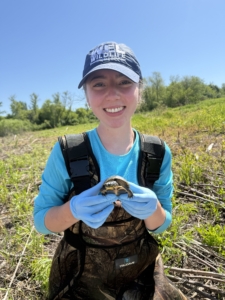
Sophia with new wild-born juvenile Blanding’s turtle
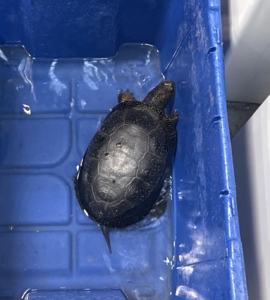
New adult female Blanding’s turtle awaiting transmitter placement
