
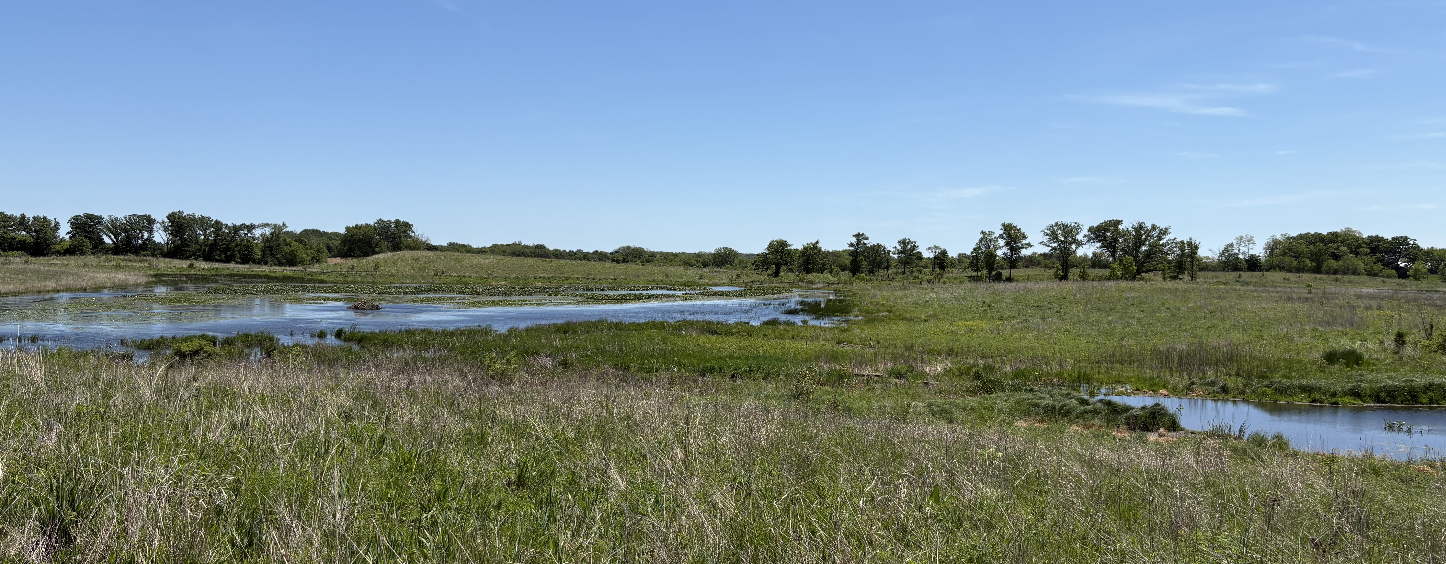
Since Jenna is away on vacation this week, you get a purely Sathvik post (for better or worse!). This week, we swapped field sites to one of the release sites for Lake County’s Blanding’s turtle headstart programs. Luckily, we caught two turtles that were part of the headstart program! To understand the importance of the headstart program, we need to discuss why the Blanding’s turtle has become endangered in Illinois.
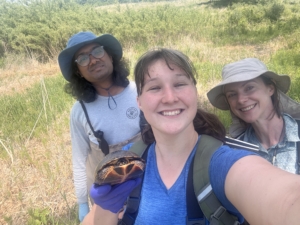
A “shell-fie” with our recaptured headstart turtle!
The Blanding’s turtle can be found largely throughout the lower Great Lakes and Upper Mississippi region. There are also additional populations in New York and coastal regions of Massachusetts, New Hampshire, and southern Maine. These turtles are found in highly vegetated and muddy wetlands, often near upland habitat. Blanding’s turtles may travel up to a mile to find suitable land for nesting. Historically, ideal nesting habitat was typically rocky outcrops and areas with exposed soil. Today, this nesting habitat can look like road shoulders, logged land, agricultural fields, sand pits, or construction sites as well. Female Blanding’s turtles are slow to reach sexual maturity, usually taking 20 years to lay their first eggs. Each female may lay 4-17+ eggs each year. Adult Blanding’s may live as long as 70-80 years.
To understand why Blanding’s turtles are so vulnerable, let’s do a little math (yuck!). Studies from the Lake County population of Blanding’s have demonstrated that juvenile survival for Blanding’s turtles increases as the turtles age. Before age 1, their survivorship is very low, approximately 30% according to a study done in Massachusetts. At age 1, wild juvenile turtles have a 71% survival rate. After their 6th year, this increases to 98%. This is on the higher end of adult freshwater turtle survival rates of other species which range from 45-99%.
For the Blanding’s turtle population to remain stable, each female turtle must produce 2+ offspring (of which at least one is a female) that survive to reach sexual maturity. Female Blanding’s turtles are the limiting factors of population growth since the number of eggs produced depends on the number of female turtles, not males. Regardless of the number of males in the population, population growth can only be increased by increasing the number of females. Doing some rough math and using the assumptions from above, we work out that approximately 6.8% of eggs reach sexual maturity. Of those eggs, approximately half are females, meaning 3.4% of eggs reach sexual maturity and are also female.
1.0 * 0.30 *0.71 * 0.755 * 0.80 *0.845 *0.89 *0.935 *0.98^14 = 0.068 sexually mature individuals per egg (IPE)
0.068/2 = 0.034 sexually mature females per egg (FPE)
In any given year, an adult female Blanding’s may have a clutch of 4-17+ eggs with older females generally having larger clutches. This means it may take 7-8 young Blanding’s turtles with clutches of 4 eggs to produce a single sexually mature female (and male) turtle each year. In comparison, 2 older Blanding’s turtles with clutch sizes of 17 eggs could produce a single sexually mature female (and male) turtles each year. According to this rough math, it is essential for Blanding’s population stability that there be a robust population of older female turtles to maintain the population. For older female turtles to exist, juvenile and adult survivorship must be high, making this turtle species particularly sensitive to factors that impact survival. This is in contrast to other species of turtle which may reproduce younger, mature faster, or be less prone to factors impacting survivorship.
# of egg-laying females * clutch size (eggs per female per year) * FPE = # of sexually mature female offspring per year
(1/0.034)/4 = 7.35 young adult females to produce 1 sexually mature female per year
(1/0.034)/17 = 1.73 older adult females to produce 1 sexually mature female per year
*Important to note that the math above does not account for reproductive success, % of mature females that reproduce, egg predation, disease, and many other factors! The true numbers of population recruitment (the process by which new individuals are added to a population) are likely not precisely accurate to these calculations. Calculations also assume a linear change in survivorship from age 1-6.*
So why are Blanding’s turtles declining despite their naturally high adult and juvenile survivorship?
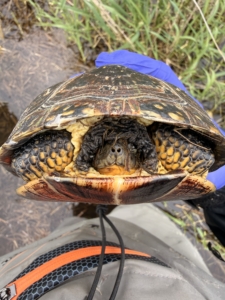
Blanding’s Turtle – Emydoidea blandingii
The simple answer is people! Habitat destruction from farming and development have severely reduced the number of wetlands and resources available to Blanding’s turtles. Roads can also fragment habitats, posing obstacles for this highly mobile turtle species and especially gravid females looking for nesting habitat. Dangers posed by cars, roads, logging equipment, and recreational ATVs can result in decreased adult survival. The recruitment of new Blanding’s turtles to the population is also impacted by the reduction of available open nesting habitat either through habitat destruction or invasive plant intrusion.
Egg predation also reduces reproductive success which is typically linked to a phenomenon in human-dominated habitats called mesopredator release. Put simply, human-dominated habitats tend to remove large apex predators (like wolves or mountain lions) from the ecosystem, allowing mesopredator (predators located in the middle of the food chain like raccoons) populations to grow unchecked. These mesopredator populations reduce egg, hatchling, juvenile, and even adult survivorship!
Unfortunately, these threats occur across much of the Blanding’s turtles’ former range in the midwest. As our rough math above demonstrated, any reduction in adult or juvenile survivorship could result in large population decline. Some studies in Nebraska have demonstrated that adult survival can reduce to 69%, largely due to female mortality on roads and rail lines. If we redo our math with this survivorship, we find that that approximately 0.05% of eggs reach sexual maturity, assuming there is no nest predation. This means it would take 2000 eggs to produce a single sexually mature individual. A single female animal producing 17 eggs per year from age 20-70 would only produce 850 eggs. It would take 2+ females a lifetime to produce just one sexually mature individual. In a species like the Blanding’s turtle, this kind of reduction in survivorship spells extinction!
1.0 * 0.30 *0.71 * 0.755 * 0.80 *0.845 *0.89 *0.935 *0.69^14 = 0.0005 sexually mature individuals per egg (IPE)
# of individuals / IPE = # of eggs
1/0.0005 = 2000 eggs
(17 eggs/year) * 50 years = 850 eggs
So what is the solution? Many of the threats facing these turtles are difficult to solve. We can’t easily move major roads or reclaim developed land, but we can augment the survivorship of these turtles in other ways like mesopredator control or headstarting.
The goal of headstarting is to increase juvenile survivorship, thereby increasing overall population recruitment. This is done by incubating eggs and rearing young turtles in captivity, eventually releasing these animals to the wild once they’ve advanced past their most vulnerable life stages. This changes the 0-1 year survivorship to nearly 100% as opposed to the typical 30%. A study in Lake County has demonstrated that headstarted turtles post-release have a survivorship of 63% during the first year and 90% at 6 years in the wild. Though the statistical analysis demonstrated no significant difference between headstart and wild survivorships, for the sake of our math we will use these numbers.
1.0*1.0*0.63*0.684*0.738*0.792*0.846*0.90*0.98^14 = 0.128 sexually mature individuals per egg (IPE)
0.128/2 = 0.064 sexually mature females per egg (FPE)
(1/0.064)/4 = 3.90 egg-laying females
(1/0.064)/17 = 0.92 egg-laying females
Using our math from above with these new numbers and assumptions, we can determine that headstarting should result in 12.8% of eggs reaching sexual maturity as opposed to 6.8% without headstarting. This means that just 8 eggs are needed to produce one sexually mature individual. For young females with a clutch size of 4 eggs per year, it would only take 4 females to produce one sexually mature female (and one male) each year. With older females with a clutch size of 17 eggs per year, each female could produce a new sexually mature female (and male) each year assuming all eggs were headstarted. Being able to so significantly increase juvenile recruitment is what makes this program at Lake County so important!
Our headstart recapture turtle on their way to continue saving their species!
Which is why it was so exciting to catch two headstarted turtles this week in Lake County! Just like all of our other turtles, we conducted a health assessment, took blood and swab samples, and some demographic information to ensure this vital program is working as it should. The headstart calculation above makes several assumptions about the population in question, so it is up to us to ensure those assumptions are true and there aren’t any other health, reproductive, or demographic factors affecting these turtles in captivity or in the wild. Hopefully, with the data we’ve gathered from these two turtles, we can help answer these questions and ensure a future for Blanding’s turtles in Illinois!
Sources and additional reading:
Growth and Survival of Wild and Head-Started Blanding’s Turtles (Emydoidea blandingii)
Reintroduction and Head-starting: Tools for Blanding’s Turtle (Emydoidea blandingii) Conservation
