
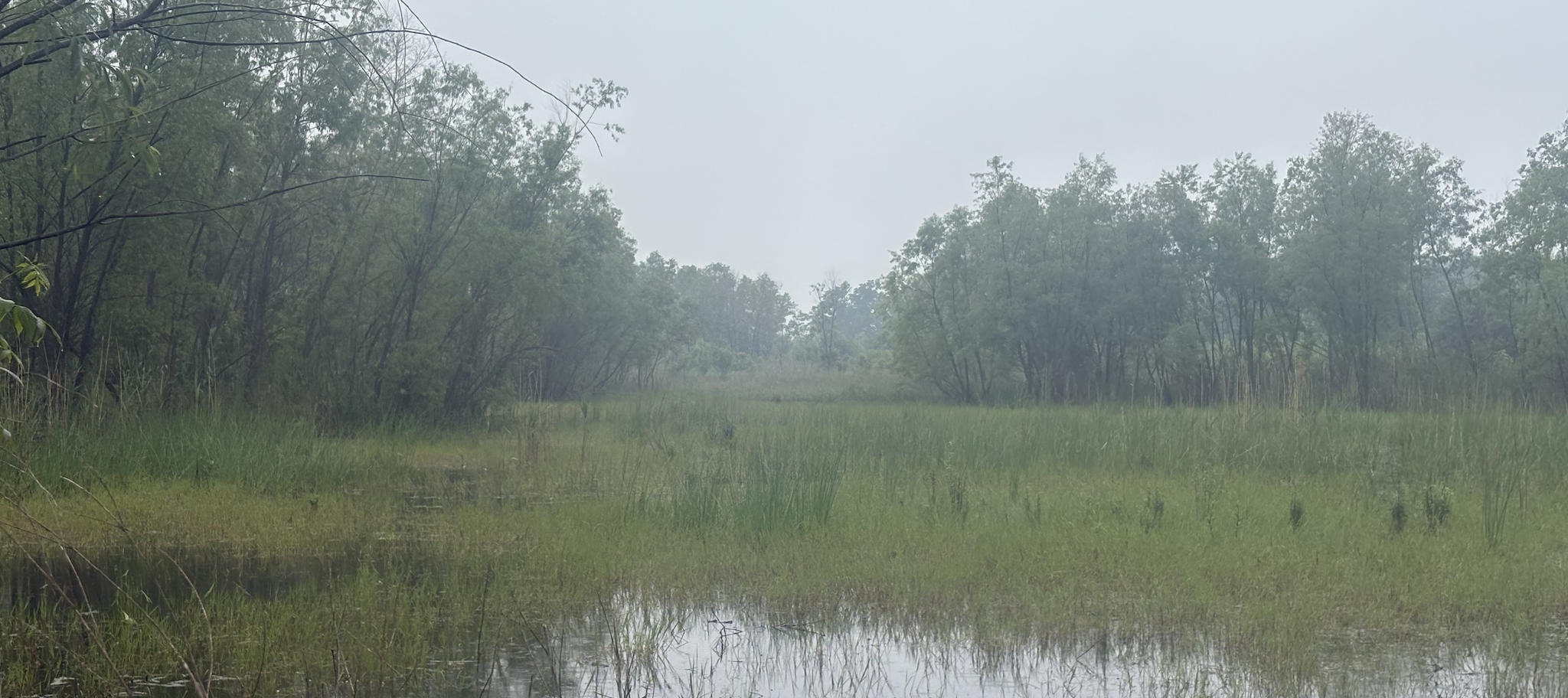
Seeing as Dr. Allender is away on vacation with no service, we are taking the rare opportunity to talk about something other than turtles (gasp!). Here in Lake County, we don’t just catch turtles in our traps (and we care about EVERYTHING we catch… except molluscs, insects, etc). Using our database mECO, we log every species we catch in our traps to help Lake County Forest Preserve understand what is living in our waters. Thanks to Jenna’s wonderful guide last week for turtle trapping, you should have a pretty good idea of how this works!
One of the most common animals that we find in our traps are crayfish (unsurprising considering our traps resemblance to crayfish traps)! In our time here, we have found a couple species of crayfish (or crawfish if you prefer): white river crayfish, calico crayfish, digger crayfish, and northern plains mudbug.

White River Crayfish Image from Dan Johnson, iNaturalist
White river crayfish are certainly the most common crayfish that we find here and fairly easily identifiable! They have relatively thinner claws, a dark stripe down their tail, and small areola. The areola is the space between the plates of the exoskeleton along the back of the crayfish. This species is native to the southern Great Lakes region and burrows into mud for protection. They are also commonly used for bait which has resulted in spread to areas in the USA where they are not native.

Calico Crayfish Image from Astacoides, Wikimedia Commons
Calico crayfish are a native species that can be found in slow-moving turbid waters with muddy bottoms (sounds like our field sites!). They can be identified by their bright orange-red tipped claws and a paler stripe down the abdomen. I have yet to see an adult of this species so I will be keeping my eyes out!
Northern plains mudbug and the Digger crayfish are the two scarier looking species (in my opinion!). These are large, dark crayfish with very thick claws. One difference is whether there is a hole through the claws (like a nutcracker) when they close. If there is a hole, it is a Digger crayfish. If there is no hole, it is a Northern plains mudbug. Another difference is the presence of a suborbital angle, a small protrusion of the shell under the eye. Mudbugs have the angle, but digger crayfish do not.
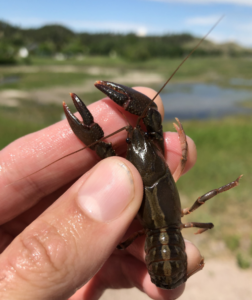
Great Plains Mudbug Image from mgglon, iNaturalist
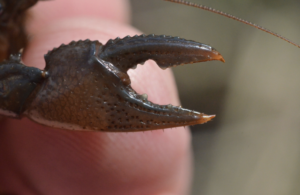
Digger Crayfish claws Image from Carl-Adam Wegenschimmel, iNaturalist
It is also important for Lake County Forest Preserve’s data to determine the sex of adult crayfish. It’s honestly super easy! If it is a female, there will be a small dot between the last few legs. If it is a male, there will be a V-like structure extending from the abdomen cranially to between the last few legs.
Another common find in our traps are tadpoles! Though you may be used to their hoppy versions, we are gradually getting more acquainted with tadpole identification. Species we have caught so far include Green frogs, American Bullfrogs, Boreal Chorus frogs, and Northern Leopard frogs.
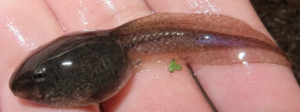
Green Frog tadpole
Image from Mila C., iNaturalist
Unfortunately for us, Green frogs, American Bullfrogs, and Northern Leopard frogs look incredibly similar in the tadpole stage. Green frogs can be best identified by their more splotchy tail pattern, mottling on belly, and eyes situated on the side of the head. American Bullfrogs have more clearly demarcated dots on their tail and more medial eyes. Northern Leopard frogs have visible intestines at the location where the tail meets the body and typically have a creamy-bronze belly color with no mottling.
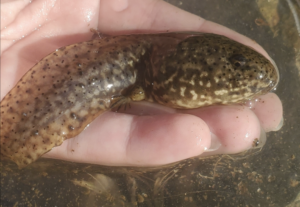
American Bullfrog tadpole
Image from Ghostomelon, iNaturalist
As adults, these species are much easier to identify! American Bullfrogs are the largest frog we find and can look remarkably similar to Green Frogs. The key difference is whether the dorsolateral skin fold extends towards the hind or wraps around the tympanum. In bullfrogs, it only wraps around the tympanum. In Green frogs, it extends to the hind of the animal. Northern Leopard frog adults are very easy to identify with their bright lime green colors!
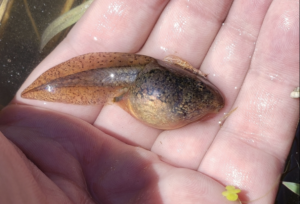
Northern Leopard Frog tadpole
Image from Kenny Long, iNaturalist
Boreal chorus frogs are the smallest frog we’ve been encountering, which makes them especially easy to identify! We have yet to find an adult, but we see plenty of the tadpoles swimming around.
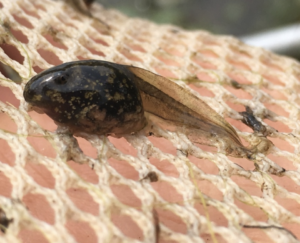
Boreal Chorus Frog tadpole
Image from Shalana Gray, iNaturalist
Just like crayfish, it is important we know the difference between male and female frogs! For American bullfrogs and green frogs, the males have larger tympanums than the females. In Northern leopard frogs, males have enlarged thumbs for breeding. In boreal chorus frogs, the males have a darker throat than the females.
-
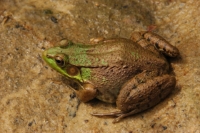
- Green Frog (Image from Derek Ramsey, Wikimedia Commons)
-
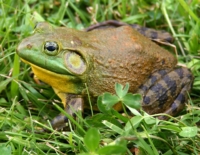
- American Bullfrog (Image from Carl D. Howe, Wikimedia Commons)
-
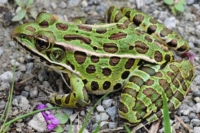
- Northern Leopard Frog (Image from Mykola Swarnyk, Wikimedia Commons)
-
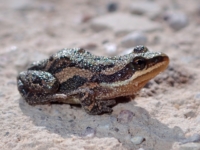
- Boreal Chorus Frog (Image from Dan Schofield, Wikimedia Commons)
The last group of animals we typically catch in our traps are fish! Depending on the location or pond we are trapping we can get quite the variety of fish species, but so far we have caught grass pickerel, central mudminnow, three spine stickleback, and green sunfish.
Grass pickerel are a member of the Esox genus which includes the larger and more popular game fish: northern pike and muskellunge. Though they are much smaller, grass pickerels are still predatory fish that are typically found in slow-moving streams and pools with clear water and thicker vegetation. They may prey on crayfish, aquatic invertebrates, and smaller fish. They have the typical pike body plan with a dark line under their eye.
Central mudminnows are a common find in many of our traps. They prefer the slow, sluggish, muddy water that we often place our traps in. They are a very hardy fish that can tolerate low oxygen and highly acidic water, making them very adaptable to ephemeral pools. They can be identified by their minnow-like body plan, mottled brown coloration, and scaled head.
Three spine stickleback are aptly named for the three spines along their dorsal fin! Unlike the other fish mentioned, they are a non-native species that was introduced to Lake Michigan. The dorsal fin Males of this species build nests held together by secretions from their kidneys. This species is also only found in the northern part of Illinois. They can be easily identified by the three spines along the back. Males of this species also have blue eyes. The native species of stickleback have more spines and a more mottled coloration.
Green sunfish are another species that is well adapted to the ephemeral wetlands that we often trap in. This species is more well-adapted for changes in oxygen, temperature, turbidity, and flow than other sunfish species. Other sunfish species like bluegill, crappies, largemouth bass, or smallmouth bass are common game species for anglers. The green sunfish has a similar body plan to the bluegill. Compared to other sunfish, this species is characterized by its large mouth and stocky body. It has a dark “ear patch” with a drab colored tip. There are also turquoise streaks across the fish’s face and body. This species of fish also constructs nests and preys on aquatic invertebrates like crayfish. Like the stickleback, they also have spines so be careful getting them out of traps!
-
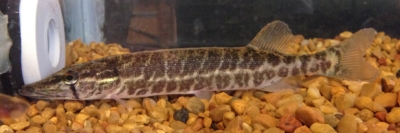
- Grass Pickerel (Image from Fredlyfish4, Wikimedia Commons)
-
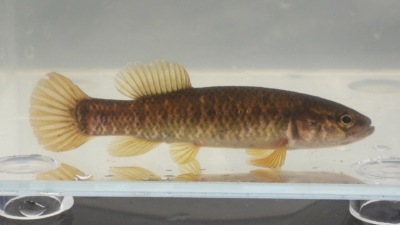
- Central Mudminnow (Image from Dan MacNeal, iNaturalist)
-
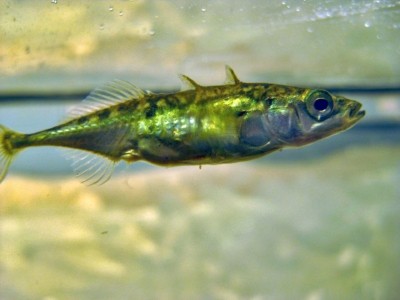
- Three-spined Stickleback (Image from JaySo83, Wikimedia Commons)
-
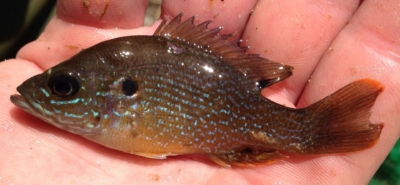
- Green Sunfish (Image from Fredlyfish4, Wikimedia Commons)
We hope this guide has been helpful if you ever find yourself in the position to check turtle traps here in Lake County! Though these are just a few of the species we’ve been trapping, there’s plenty more to find here in Lake County. We’ve also seen gray tree frogs, Virginia rails, soras, green herons, American toads, great egrets, sandhill cranes, white-tailed deer, beaver dams, and much more! Though it may be hard to picture, having a good understanding of the biodiversity of a system can help us get a good picture of wildlife health across many species. Healthier ecosystems tend to host more species which in turn help create healthier ecosystems.
