
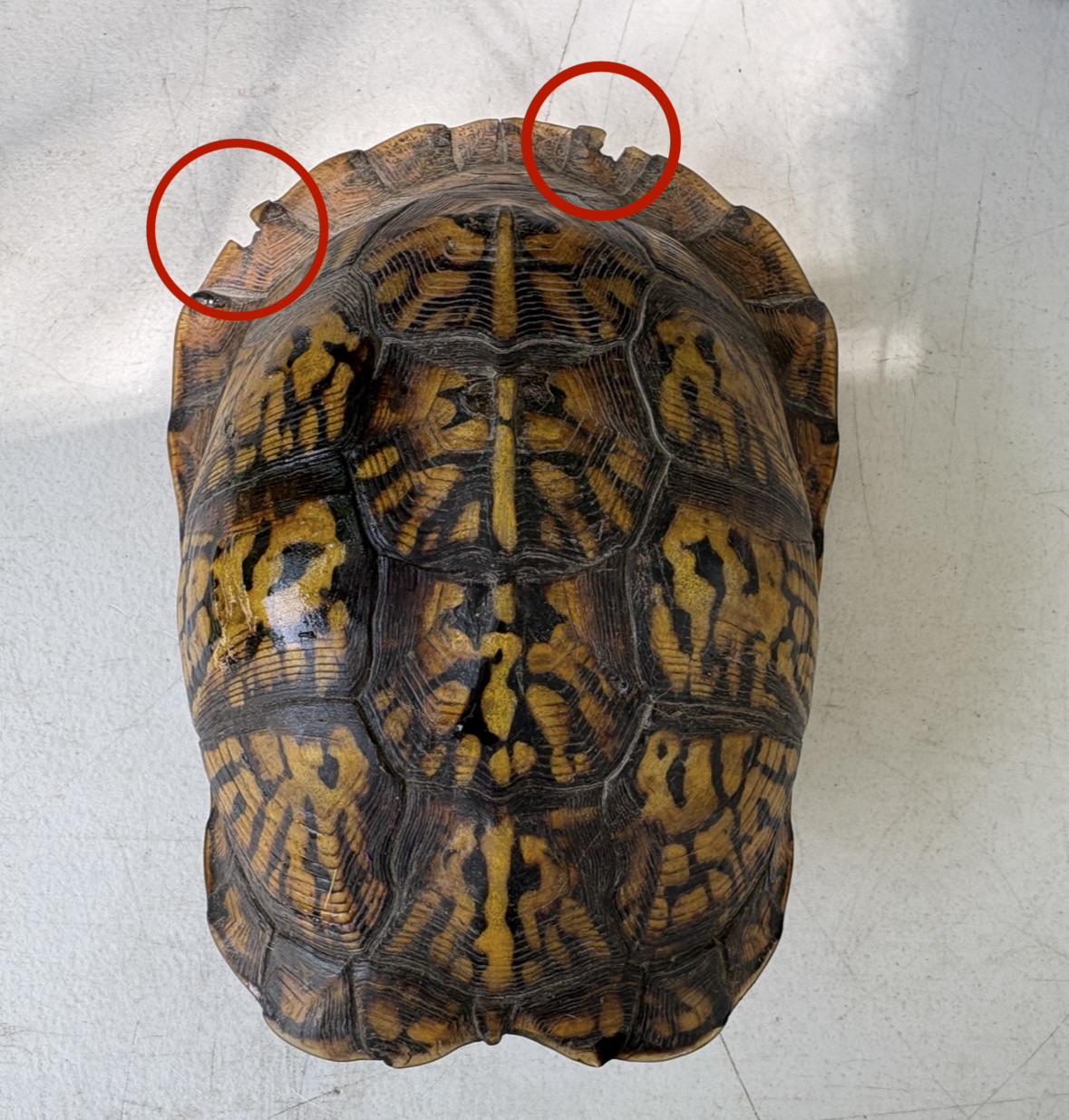
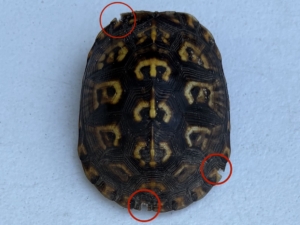
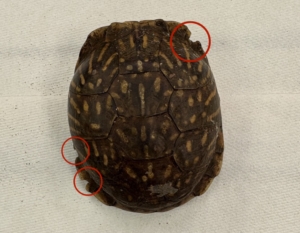
If you’ve ever looked closely at a turtle’s shell during one of our field seasons, you may have noticed a series of tiny notches along the edge of its shell. At first glance, they might look like random markings…but they’re anything but random.
Those tiny notches are actually one of the most powerful tools in wildlife research. For long-lived species like turtles, identifying individuals is essential. Without knowing whether a turtle has been seen before, every encounter becomes an isolated moment instead of part of a much larger story.
A Lifetime ID Card
A notch code is a permanent identification system that gives every turtle its own unique “fingerprint.”
Researchers create tiny notches on the marginal scutes, the outermost ring of keratin-covered scutes around the edge of a turtle’s carapace (top shell). Each marginal scute corresponds to a specific numerical value, and by combining different notches, researchers can generate thousands of unique identification patterns.
No two turtles at a study site share the same code.
Unlike paint, stickers, or temporary shell markings that eventually fade away or change, notch codes often remain visible for the turtle’s entire life. Since turtles are incredibly long-lived animals, this means an individual can be recognized not only years later—but sometimes decades after it was first encountered.
Before assigning a new notch code, researchers always examine the turtle carefully to determine whether it has already been marked. Every existing code is cross-referenced with long-term records to ensure that each turtle maintains one permanent identity throughout its lifetime.
Once a turtle receives its code, researchers photograph its shell, record detailed measurements, collect GPS coordinates, perform a physical examination, and often collect biological samples. That single notch code permanently links every future observation back to that individual’s growing life history.
Does Notching Hurt the Turtle?
This is one of the questions we hear most often.
Fortunately, the answer is reassuring.
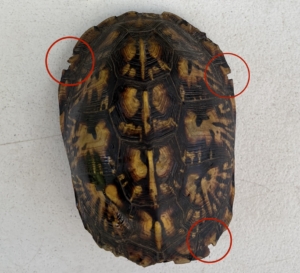
A turtle’s shell is composed of living bone covered by a layer of keratin—the same material that makes up our fingernails. Researchers remove only a very small section of the keratin-covered marginal scute using a specialized notching tool or triangular file.
When performed by trained researchers under approved animal care and use protocols, the procedure is quick, causes minimal stress, and has been used safely in turtle conservation for decades. The notch does not interfere with the turtle’s movement, growth, or ability to survive in the wild.
For the turtle, it’s a tiny mark.
For science, it’s a lifetime of information.
Why Long-Term Identification Matters
Imagine meeting someone once every few years for the next twenty years. Each time you see them, you notice they’ve grown older, recovered from injuries, changed where they live, or started a family.
Wildlife researchers do exactly that with turtles.
Without permanent identification, every turtle captured would appear to be a brand-new individual. Researchers would never know whether it had been seen before or what had changed since its last encounter.
By recognizing individuals over time, scientists can answer questions that would otherwise be impossible:
- How long do turtles survive in the wild?
- How fast do they grow?
- Do they stay in the same home range throughout life?
- How often do they move between habitats?
- How do environmental changes affect turtle health over time?
- Which habitats support the healthiest populations?
- How successful are restoration efforts?
- How frequently do turtles reproduce?
- How do diseases spread through wild populations?
These are questions that cannot be answered during a single field season. They require years—and often decades—of repeated observations.
Every recapture adds another chapter to an individual’s story while simultaneously strengthening our understanding of the entire population.
Two Decades of Turtle Stories at WEL
At the Wildlife Epidemiology Laboratory, we’ve been tracking Eastern Box Turtles for more than two decades, building one of the longest-running datasets for these populations.
Since 2012 alone, our researchers have collected over 2,400 Eastern Box Turtle samples, creating an extraordinary long-term dataset that continues to grow every field season.
This isn’t simply a collection of numbers.
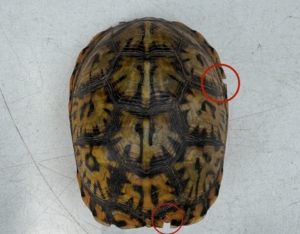
It’s thousands of individual snapshots that, when connected together through notch codes, become complete life histories.
Current DVM student Becca Chenoweth is using this remarkable dataset for a retrospective research project, analyzing patterns that simply couldn’t be detected from a single summer of fieldwork. Long-term datasets allow researchers to identify gradual trends in health, disease, survival, and population dynamics that only emerge after years of consistent monitoring.
Every Turtle Has a Different Story
One of the most exciting parts of long-term wildlife research is discovering that no two turtles follow the same path.
Some individuals become familiar faces.
One Eastern Box Turtle in our database has been encountered in 2012, 2015, 2018, 2020, and 2022. Because of its permanent notch code, researchers have been able to follow that turtle’s life for over a decade.
With every recapture, new questions can be answered:
- How much has it grown?
- Has it remained healthy?
- Has it developed or recovered from injuries?
- Has it tested positive for different pathogens over time?
- How has its health changed alongside environmental conditions?
Instead of isolated observations, we now have a timeline spanning ten years.
Other turtles surprise us in different ways.
One individual was captured twice during the 2022 field season and then encountered again in 2023, providing valuable insight into seasonal movements and habitat use within a relatively short time.
Some turtles appear almost every year.
Others disappear.
And that’s part of wildlife research, too.
Some turtles are encountered only once despite years of continued surveys. That doesn’t necessarily mean they died. They may still be thriving somewhere within the landscape…we simply haven’t crossed paths again. Even a single encounter contributes meaningful scientific information by documenting the turtle’s location, health, size, age class, and environmental conditions at that point in time.
Sometimes the unanswered questions become just as fascinating as the answered ones.
Looking Ahead
Long-term wildlife research depends on consistency. Every notch code, field observation, health assessment, and recapture contributes to a dataset that becomes more valuable with time. Questions about survival, disease, movement, reproduction, and population change often cannot be answered in a single season, or even over a few years. Instead, they emerge through decades of careful monitoring and collaboration.
As WEL’s dataset continues to grow, each new capture and recapture strengthens our understanding of turtle ecology and provides additional opportunities to investigate how these populations respond to changing environments. What may seem like a small notch on the edge of a shell represents a permanent connection between an individual turtle and years of scientific research, allowing every future encounter to build upon the last.
For researchers, those small notches are much more than identification marks, they are the foundation of long-term ecological studies that inform conservation, improve our understanding of wildlife health, and help guide management decisions for years to come.
