
Understanding the health of an animal can be done in many ways: a visual assessment, physical examination, imaging, bloodwork, etc. Another method that is standard in health assessments for the wild turtles we encounter is performing COS and COSS swabs. COS is an oral-cloacal swab, and COSS is a cloacal-oral-shell swab.
Depending on the type of swab we are collecting, we prioritize 2 (COS) or 3 (COSS) sites on a turtle. With a sterile cotton-tipped swab, we always start by swirling it around their mouth, ensuring that we rub it against the tongue, roof of the mouth, and choana. The choana are two little slits on the roof of a turtle’s mouth, closest to their nose.
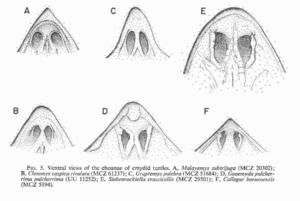
While not readily visible without looking in the mouth, this internal structure connects the nasal cavity to the oral cavity. Including it as a point of focus can help detect pathogens associated with respiratory diseases.
The second stop for the swab is the cloaca. This anatomical structure sits on the underside of the tail and serves as the site for multiple functions: urination, bowel movements, and reproduction. Since the cloaca is a shared point for these actions, inserting and swirling the swab here make it an excellent source for the detection of various diseases and infections. Another important piece of information we can tell from the cloaca is the sex of the turtle. Its positioning is typically a reliable method for determining if the turtle is male or female, though species and age of a turtle may be an exception to this. Closer to the shell or body of the turtle usually indicates a female, and farther away, or closer to the tip of the tail, often indicates a male. 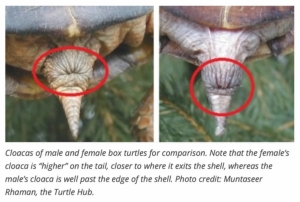
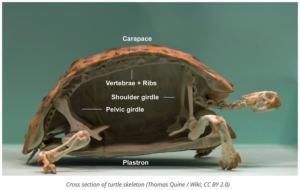
Those two sites complete the COS swab, but if a COSS swab is being performed, the next and last stop is the shell! The shell of a turtle is a wondrous anatomical structure. It is not something that a turtle just lives in and sheds or can regrow; it is part of a turtle’s skeletal structure. Their spine is actually fused to it! The shell not only protects the turtle from predators and provides structure for their body, but it also helps them regulate temperature, and it contains veins, capillaries, and nerves.
Their shell has two distinct aspects: the carapace and the plastron. The carapace is the top or domed part, and the plastron is the flat piece that has contact with the ground and other surfaces. Swabbing the shell can help us detect bacterial and fungal pathogens on a turtle. In this final step, we apply firm pressure and essentially scrub the entirety of both the carapace and plastron.
A cotton-tipped swab may be a simple tool, but it is significant in our lab. It is what makes contact with the animal and exfoliates cells onto it. If the turtle has a disease or infection, the cells collected should contain genetic material from the virus, bacteria, or fungi affecting them. We can extract the DNA and RNA in the lab to run them in different types of diagnostic tests.
Since not all diseases outwardly show symptoms, these swabs help to tell us a little bit more about what is affecting individuals. By sampling multiple turtles at a site, we can better understand how widespread a disease is within a population. This is crucial for disease surveillance and outbreak monitoring within a population.
References:
Thomas S. Parsons. 1968. Variation in the choanal structure of Recent turtles. Canadian Journal of Zoology. 46(6): 1235-1263. https://doi.org/10.1139/z68-173
Quine, T. (n.d.). Cross section of turtle skeleton. Welcome Wildlife. photograph. Retrieved from https://www.welcomewildlife.com/all-about-box-turtles/.
Windmiller, B. (2022, April 15). Is that Baby Turtle a Girl or a Boy? Zoo New England. https://blog.zoonewengland.org/2022/04/15/is-that-baby-turtle-a-girl-or-a-boy/
