
While we obviously have a special place in our hearts for turtles, it’s Kane County’s turn to talk about something other than turtles. This week was an eventful week full of slithery little snakes. Another part of our work here involves checking previously set snake boards at various sites around the county. Snake boards are either slabs of wood, carpet, or metal placed in a prairie that over time create a secure, moist, and cool environment for snakes to hang out in. We often check boards in the mornings while it is still cool out and grass is still wet to increase our chances of finding snakes. So what happens when we get a snake? We take weight and length measurements, do a brief physical exam, note any lesions, and then take skin swabs to later be tested for Ophidiomyces, or snake fungal disease.
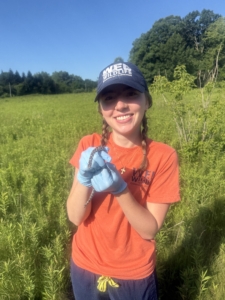
Sophia with Milksnake
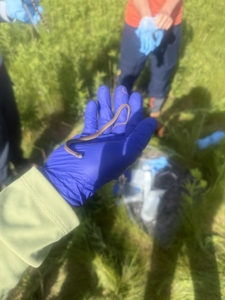
2 gram Dekay’s Brown Snake
The most common species we encounter are the Common Garter and the Dekay’s Brown Snake. This week, we had the honor of finding a Milksnake, and while it was only a 40 gram juvenile, its bite was slightly more painful than expected with its small, needle-like teeth. Most of the snakes we find are juveniles and range from a wee 2 grams to a larger 80 grams. But we did incidentally encounter a much larger beast of a Common Garter, however, it swiftly slithered away before we could capture. We are hoping to one day find a Smooth Green Snake, which is listed as a species in greatest need of conservation in northern Illinois.
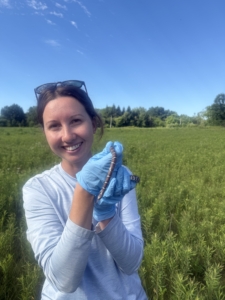
Grace with Milksnake
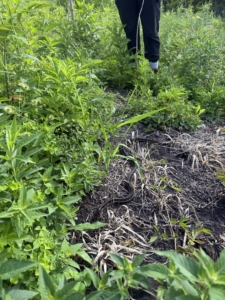
Escapee Common Garter
While the only species we do any sampling on includes snakes and turtles, we also frequently have run-ins with other wildlife, including an abundance of different birds, frogs, fish, and crayfish. The notable special guests of the past few weeks have been multiple nests of Least Bitterns, which is incredibly exciting as they are a state-threatened species in Illinois! We have had the honor of seeing the adults and babies while we are out in the marsh looking for turtles. We have made a point to not set traps near the nests so that we do not disturb the babies or have one accidentally end up in a trap not meant for them.
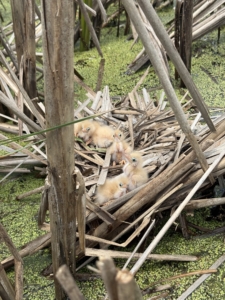
Nest of Least Bitterns
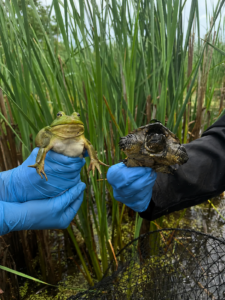
Large frog vs. tiny snapper
Getting to witness a variety of wildlife out in their natural environment is a highlight of our summer!
