
Services Contacts
Small Animal Emergency Care
(dogs, cats, exotics) Specialty Services
1008 W. Hazelwood Drive, Urbana
217-333-5300
Equine/Large Animal
Emergency Primary Care
1102 W. Hazelwood Drive, Urbana
217-333-2000
Medication Dispensary
Prescription Refill Form
217-333-5329
Primary Care (dogs, cats, exotics)
2100 S Goodwin Ave, Urbana, IL 61801
217-244-2555
On Farm Services for Horses
309-928-2127
(Midwest Equine)
Farrier Services on Farm and in Clinic
217-300-7222
On-Farm Services for
Farm and Food Animals
217-333-7232
For appointments, call
Monday to Friday, 8 to 5.
Emergency services are provided
24 hours a day, 365 days a year.
A Medical Center for Animals
The University of Illinois Veterinary Teaching Hospital is a full-service hospital that provides outstanding, compassionate treatment for dogs and cats, horses, zoological companion animals, and farm animals.
The Veterinary Teaching Hospital offers emergency services 24/7/365, specialty services for cases when your veterinarian refers you to us, and primary care for routine veterinary appointments. Learn what to expect at your hospital appointment.
Veterinarians who wish to refer a patient, please read the steps on our Referral Services page.
Directions
From Interstate 74, take the Lincoln Avenue exit south and travel about 3.1 miles until you reach Hazelwood Drive. From Interstate 57, take the Curtis Road exit east; turn north on Route 45 (Dunlap Avenue), east on Windsor Road, and north on Lincoln Avenue one-half mile to Hazelwood Drive.
Parking
Small Animal ClinicFree parking is available for clients in the spots marked “Client Parking.” If a “Client Parking” spot is not available, please park at a meter and ask one of our client services staff members for a hang tag for free short-term parking. Trailer parking is available for large animal clinic clients.
Primary Care
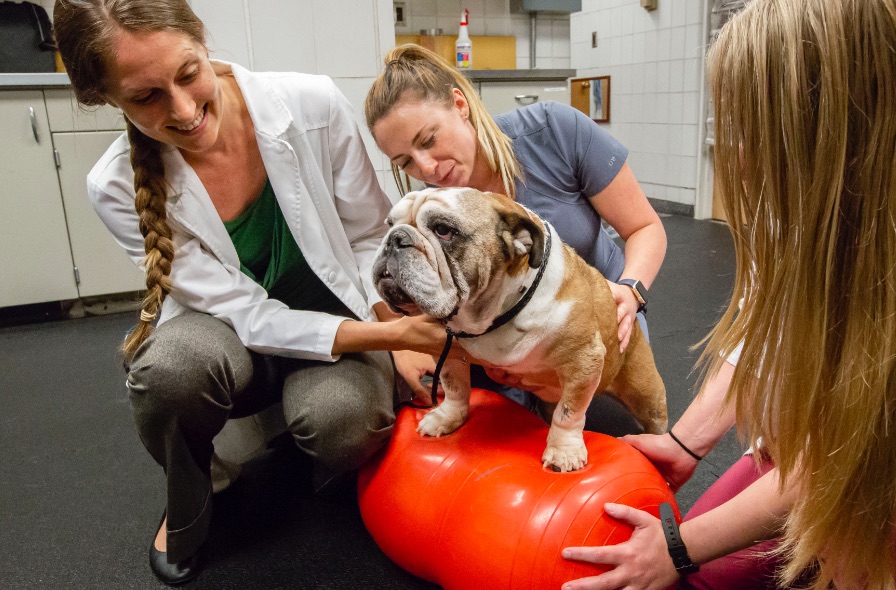
Full-service primary care for cats and dogs. Featuring safe, low-stress handling and separate waiting areas for cats and dogs. The Primary Care Service operates on a model similar to most private small animal practices. Fourth-year veterinary students play an active role as they prepare to enter practice.
Clinical Trials and Studies
Clinical trials are research studies designed to answer specific clinical questions about new therapies and drugs. Often clinical trials offer cutting-edge treatments at a reduced cost to the animal owner. Trials are a fundamental part of research that advances animal and human medicine.
Connect With Us

Share Your Experience
If you’d like to share feedback on a recent visit to one of our locations or services, please complete our client experience survey.


About Us
Each year more than 20,000 animal patients from across Illinois and beyond visit the Veterinary Teaching Hospital.
Most are referred by their primary care veterinarian for specialty care, but animal owners can also directly access our services for routine health care, rehabilitation, 24-hour emergency service and intensive care, horse hoof care, or on-farm animal care provided through an ambulatory service.
With more than 100 veterinarians on staff, including more than 40 faculty specialists plus interns and residents, the hospital has experts in fields from anesthesia to zoo medicine.
As the name indicates, “teaching” is one of the primary missions of the hospital. Veterinary students from all four years of the curriculum learn through active engagement in the care of animal patients.
Between 2016 and 2021, our full-service, 230,000 square-foot facility was extensively renovated and enlarged to provide comprehensive, compassionate care for all kinds of animals.
Simply put, the hospital is dedicated to improving lives: by providing exceptional patient care, by serving animal owners and veterinarians, by advancing veterinary education, and by developing innovative health solutions.
![[A ewe and her lambs, with veterinary students and instructors in the background]](https://vetmed.illinois.edu/wp-content/uploads/2021/05/vth-ewe-lambs-1024x393.jpg)