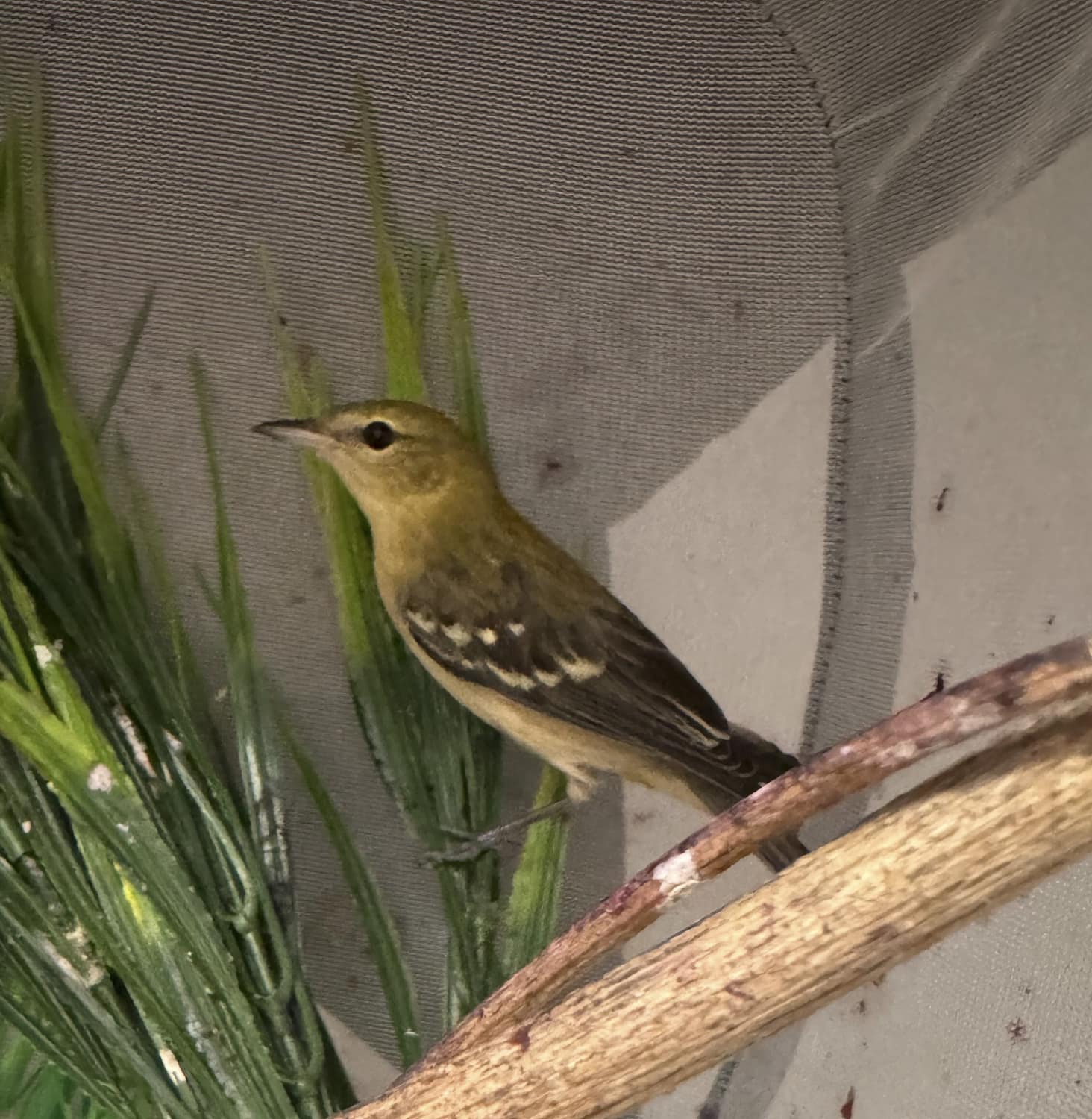
Species Background
The pine warbler (Setophaga pinus) is very fittingly named after its preferred habitat: pine trees. These Passerines spend most of their time in pine or mixed-pine deciduous forests, foraging for caterpillars, arthropods, pine seeds, and sometimes fruit. Interestingly enough, Pine Warblers are the only wood-warblers that are known to regularly consume seeds, although their diet is thought to vary between the warm months and cold months. They have even been spotted visiting backyard bird feeders, which is an uncharacteristic behavior for warblers! Pine warblers permanently reside and breed in the Southeast U.S., although they also migrate through certain states of the Midwest (notably Illinois) and breed in parts of the northeastern U.S. and southeastern Canada.
Intake Examination
PIWA 26-2378 was an adult female or immature male Pine Warbler that arrived at the Wildlife Medical Clinic (WMC) on September 25, 2026, after being found on University of Illinois Urbana-Champaign main campus, unable to fly. Upon intake, the patient presented with a left wing hike, meaning she was holding her left wing unnaturally higher than the right wing. During the physical exam, crepitus was appreciated over the furcula. In birds, the furcula is formed by the fusion of the two collarbones (clavicles). The furcula, along with the coracoid bones and scapulae, collectively form the pectoral girdle. This specialized bone structure supports the wings and serves as a mechanical system that helps power flight. The left wing hike, coupled with the crepitus over the furcula, led us to suspect a pectoral girdle fracture.
Treatment Plan
Pectoral girdle fractures are an extremely common presentation we see at the WMC, especially in Passerines. The patient was placed on Meloxicam, an anti-inflammatory pain medication, and prescribed strict cage rest to stimulate healing of the fracture site. Subcutaneous fluids were also administered to mitigate dehydration, and the patient was placed on brief supplemental oxygen to mitigate the stress of handling. She was then set up in an enclosure and provided a diet of mealworms, fruit, and seeds. Thus allowing her to begin her healing journey!
Outcomes
Meloxicam was discontinued after 3 days in order to mitigate the risk of worsening the injury as well as to avoid unnecessary stress associated with handling the patient. She continued to heal well throughout her entire 10-day stay at the WMC. On October 5, 2026, she successfully passed her flight test, and crepitus over the furcula was no longer appreciated, meaning this tiny bird was ready for release! Off to the southeastern U.S. she goes!
A Note About Window Strikes
Although we usually never know the entire story behind our patients’ injuries or how they ended up at the WMC, we do know that pectoral girdle fractures are common consequences of window strikes. Over 1 billion birds are estimated to die from window strikes each year in the U.S. alone. Windows reflect surrounding foliage or the sky, making it hard for birds to differentiate between glass and the environment. Additionally, artificial lights at night can attract migrating birds into urban areas, drawing them away from their migration routes.
How You Can Make A Difference!
- Turn off nonessential lights at night
- Apply window decals, stickers, or a one-way transparent film to your windows
- Apply mosquito screen on the outside of your windows
- External awnings and sunshades can also block the reflection of sunlight on windows
If we all do our part to protect migratory birds from window collisions, we can prevent unnecessary deaths!
Written by: Claudia P., Class of 2029
Sources:
https://www.allaboutbirds.org/guide/Pine_Warbler/overview
https://birdsoftheworld.org/bow/species/pinwar/cur/introduction?_gl=1*x0o6tp*_gcl_au*MTQz
https://abcbirds.org/news/bird-building-collisions-study-2024
https://www.allaboutbirds.org/news/why-birds-hit-windows-and-how-you-can-help-prevent-it