Order Lagomorpha
Rabbits are often misidentified as rodents, but they actually belong to the taxonomic order Lagomorpha. Within this group are two families: Leporidae, which includes rabbits and hares, and Ochotonidae, which includes pikas. Among these animals is a species closely tied to winter landscapes in the northern United States due to its remarkable seasonal transformation. Today, I want to highlight the snowshoe hare, an animal whose biology and ecology make it both fascinating and vulnerable.
Snowshoe Hare Information
Snowshoe hares inhabit boreal forests across Alaska and Canada, as well as the Rocky and Appalachian mountain ranges in the United States, with populations extending as far south as Minnesota, Michigan, and Montana. These herbivores are named for their disproportionately large hind legs and feet, which are covered in thick fur increasing surface area allowing them to move efficiently atop deep snow. They breed throughout the spring and summer, with a gestation period of about one month, and can produce up to four litters per year with as many as eight young per litter. Unlike rabbits, which have altricial kits, snowshoe hare young, known as leverets, are precocial and are born fully furred and capable of running shortly after birth. As crepuscular animals, they are most active at dawn and dusk, relying heavily on acute hearing and camouflage to avoid predators.
Seasonal Color Change Makes Identification Tricky
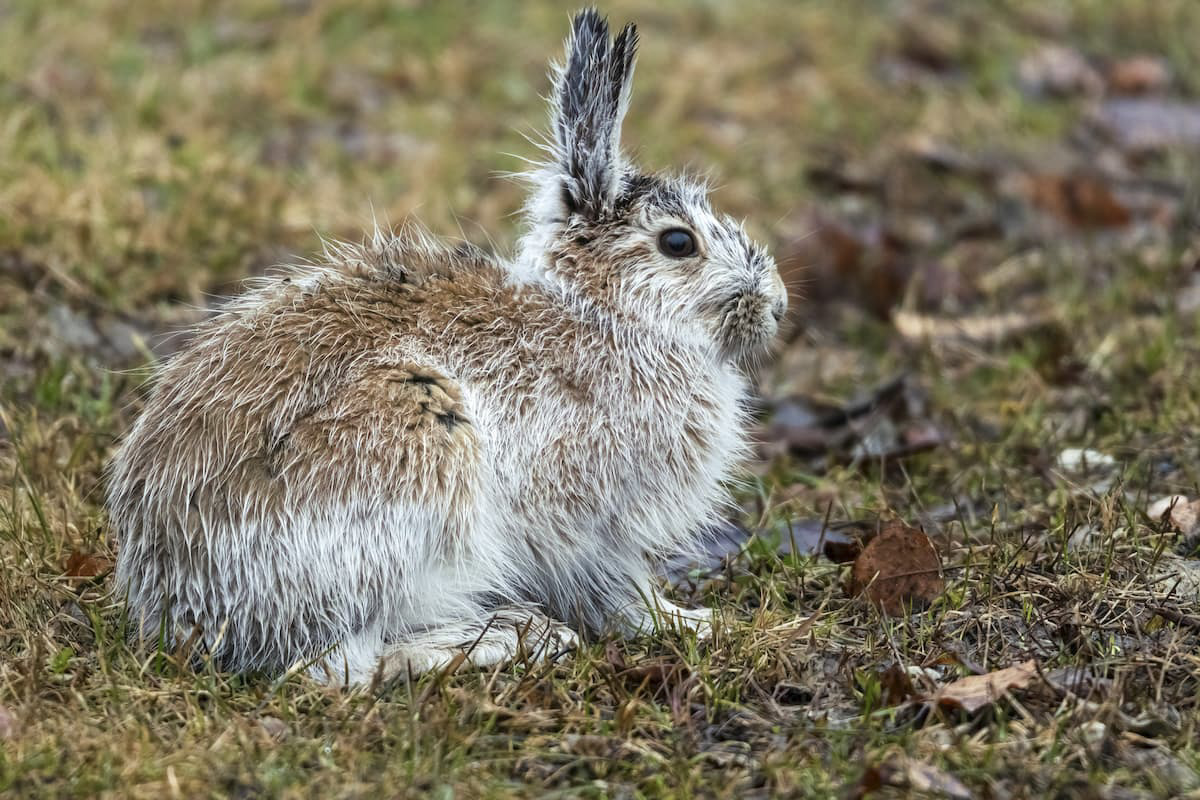
One of the most striking features of the snowshoe hare is its seasonal pelage. During most of the year, their coat is a brown agouti color, but in winter it turns white, while the black tipped ears and white ventrum (belly) remain year round. This molt is triggered by changes in photoperiod and temperature, typically beginning in late September through October. The transition is gradual, and hares are often seen with a mixed, patchy coat for about a month. During this period, well intentioned members of the public sometimes mistake molting hares for abandoned domestic rabbits. Although the concern is understandable, capturing or handling these animals can cause significant stress and pose serious risks to their health. It is important for the public to recognize that a mixed coat during seasonal change is normal and that these animals should be left undisturbed in their natural habitat.
Troubling Findings from Recent Research
Recent research has added another layer of concern. A study spanning 44 years and nearly 4,500 hares, conducted by a collaboration between the University of Florida IFAS wildlife ecology and conservation department and ecologists in Canada’s Yukon Territory, suggests that snowshoe hares are beginning their molts later in the year. As climate change warms the environment and reduces snowfall in many regions, hares may no longer be fully white when snow arrives, increasing their visibility to predators. This is particularly troubling because snowshoe hares are considered a keystone species, supporting numerous predators especially during winter months when other protein sources are scarce. If their populations decline, the effects could ripple throughout the ecosystem, underscoring how closely their survival is tied to a changing climate.
Sources
https://www.nwf.org/Educational-Resources/Wildlife-Guide/Mammals/Snowshoe-Hare
Written By: Toni K., Class of 2027