
Hello all! Sorry about the brief hiatus, but we have been hard at work in Lake County. After the last few weeks of craziness with Blanding’s Bowl and the Reinke lab, these two weeks have been relatively relaxed. I realized that we haven’t really given a good idea of what we do in a typical day/week, particular in the field lab.
Each week, we have a couple responsibilities. On Monday, we typically set our turtle traps, usually in new spots each week. This involves hiking out to trapping sites with our hoop traps, bait, and flagging tape. We flag and bait each trap we set, ensuring we can find it the next day. We also ensure the traps are secure, in adequate amounts of water, and away from raccoon-accessible locations. Unfortunately, raccoons frequently raid our traps so it is important to keep them hidden. From Tuesday through Thursday, we check our traps for turtles, crawfish, or anything else we might find. On Friday, we check our traps for the last time and remove our traps. We also disinfect our traps each week after removing them, ensuring that we don’t participate in any known or unknown disease transmission. We also need to radio-track each of our 12 telemetry turtles each week, taking measurements to ensure our turtles are healthy and doing ok!
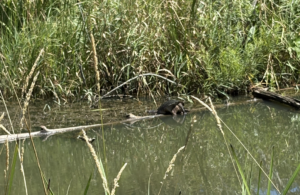
Sometimes we see turtles out and about as well! This is one of our larger snapping turtles that we saw basking on a log
In a typical day, we start as early as we feasibly can! Getting to the field early hopefully means leaving the field early, ensuring we aren’t outside for the hottest part of the day. We start our day at Turtle Town, our homebase where we gather our supplies and perform labwork. Once we’ve got our supplies together, we head out to our field site which is typically a 20 minute drive. At the field site, we park our cars and get into our waders. In a perfect world, our waders would keep us 100% dry, but that rarely happens. In reality, I think they’re more useful for keeping you safe from thorns or sharp grass.
Getting to our trapping locations can be difficult at times, but by this time of year we have several trails through our field sites that help us out. Once we reach our traps, we tend to leap-frog through them, letting biologists work ahead of the vet team when necessary. For each trap set, we note data like distance from shore, canopy cover, shrub cover, and other variables. Traps that have been grabbed by a raccoon or other animal are typically removed from the set for that week.
If we end up trapping any Blanding’s turtles, our target species, we typically do full work ups as long as they haven’t been caught in the last month. This includes an exam, blood sampling, swabbing, and measurements. Once we return to Turtle Town from the field, we begin processing these samples.
Using our bloodwork, we run several different tests including packed cell volume, erythrocyte sedimentation rate, total solids, and white blood cell counts.
Packed cell volume (PCV) is a way to measurement the amount of red blood cells present in blood. We get a PCV by sucking some blood into a microhematocrit tube via capillary action. When we spin that tube down, the red blood cells separate from the plasma via centrifugal force, allowing us to measure the PCV using our chart. Low or high PCVs can indicate several different health issues including anemia, nutritional deficiencies, or chronic health issues.
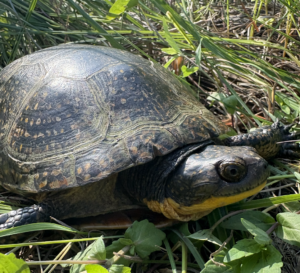
We do it for the turtles
Total solids (TS) measures the amount of protein, electrolytes, or other substances present in plasma (part of the blood not including red and white blood cells. Different factors including serum color can also help interpret TS results. Like PCV, TS can be influenced by many factors including dehydration, hyper/hypoproteinemia, and other disease processes. By using both PCV and TS readings, we can compare both to better understand what is happening inside our turtles. TS can be read by placing some plasma on a refractometer, then reading where the blue line is present.
White blood cell counts can be read by placing some stained blood in a hemacytometer to perform a leukocyte count under a microscope. Hemacytometers have 3×3 grids printed on the slide. When filling a hemacytometer, a specific amount (just enough to fill the slide) is placed. The grid and the consistent amount of blood pipetted allows us to accurately count and compare the amount of white blood cells present under a slide. In a typical veterinary clinic, there are machines that can automatically count white blood cells, but these typically only work for mammals and only really provide accurate results for domestic species. Since white blood cells play large roles in the body’s immune system and inflammation response, they can be a vital part of understanding any animal’s health, including turtles.
The final test that we perform is an erythrocyte sedimentation rate (ESR). An ESR is measured by filling a microhematocrit tube with blood and allowing it to sit upright for one hour. The ESR measures the distance that red blood cells (erythrocytes) settle in the tube over an hour. An ESR is a common test in human medicine for measuring inflammation present in the body. Elevated fibrinogen, a vital part of the body’s clotting and healing function, is linked to chronic inflammation. Fibrinogen in blood creates rouleaux formations, aggregations of red blood cells. These rouleaux formations have increased mass and density, resulting in increased sedimentation. Thus, higher ESRs correlate to higher inflammation. ESRs have also been used in veterinary medicine, particularly in cetaceans. Certain papers have validated its use in Gopher Tortoises in Florida, hence why we take this measurement in our turtles!
Lastly, we store additional serum for several other tests that we perform back at our lab in Urbana-Champaign at the UIUC Veterinary School. Serum and plasma can be often used interchangeably online, but they are different. Serum is the non-erythocyte (red blood cell) component of blood after it has clotted. Plasma is the non-erythrocyte component of blood that hasn’t clotted, meaning it still contains clotting elements like fibrinogen. For our banked samples used for chemistry panels and electrophoresis, we typically save serum. We pull serum out of blood by using serum separator tubes (SSTs). These tubes contain a special clotting additive and a gel that moves under high speeds like in a centrifuge. When spun down, clotted blood moves through this gel and is separated in the bottom of the tube via centrifugal force. What remains not trapped by the gel is the serum.
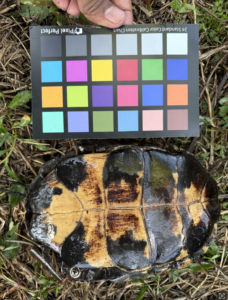
Another new addition to our routine this year has been our colleague’s work looking into color morphology of Blanding’s turtles. We help them with their project by taking pictures of Blanding’s plastrons with color cards like this!
We save serum for two major reasons: electrophoresis and chemistry panels. Chemistry panels are a common aspect of veterinary health assessments. These panels measure solutes in the serum to assess kidney function, liver function, nutritional deficiencies, and other disease/health factors. Electrophoresis is a common laboratory technique to separate macromolecules like protein or DNA by charge. Electrophoresis can be used to better isolate and analyze different kinds of blood proteins or create “DNA-fingerprints” for certain pathogens depending on what sample is used.
All our extra blood, serum, and our swabs are stored in our field freezer until they can be transported back to the WEL lab in Urbana. These samples can be used to test for various pathogens as needed and provide a bio-library for any future scientists curious about these turtles.
At the end of each week, we remove all our traps and disinfect them back at turtle town. It is important to disinfect our equipment like traps or wader between trapping sites to ensure we don’t accidentally spread pathogens between sites. Though it may seem unlikely, other disease like white-nose syndrome may at least partially have been spread by scientists.
We hope that you enjoyed this look into a typical day in Lake County! Though it may seem like a lot, doing this work each and every day is the best way to solidify these skills. Practice makes perfect!
