
Biosecurity isn’t the most glamorous aspect of veterinary medicine and research, but it is crucial to the industry and the work we do in the Wildlife Epidemiology Lab. It is a pillar of our standard operating procedures (SOPs) in the field, laboratory, or when handling our research animals. Establishing biosecurity protocols helps to protect individuals, populations, the environment, agriculture, and laboratory security by preventing the spread of diseases. The primary goals are to limit exposure and to contain or disinfect contaminated surfaces, which can be accomplished with an extensive array of strategies. The intensity of an operation’s biosecurity can range significantly depending on the threat level of the biological hazard and setting. While biosecurity can incorporate a multitude of the approaches, there are a few to highlight in relation to the Wildlife Epidemiology Lab.
Risk Assessment:
This is a foundational starting point! Through a conceptual evaluation of potential risks, prioritization and preventive measures can be determined to improve an SOP. Identifying vulnerable individuals and recognizing the pathways of disease transmission allow for actionable plans to be made that result in protection and scientific soundness. In research, especially any involving animals, risk assessment is necessary to create a setting that focuses on health/exposure status and results in reliable data.
Personal Protective Equipment (PPE):
A decent-sized list could easily be made to cover types and variations of PPE. As with biosecurity in general, there can be a range of what PPE is recommended or required. Protections for the hands, feet, body, eyes, respiratory system, and face/head can all be areas of focus. PPE can also help protect the environment and research samples. When we are processing samples in the lab, wearing a labcoat and nitrile gloves can prevent human shedding of hair and skin from contaminating samples.
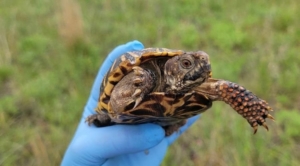
Nitrile gloves are an absolute necessity for the work and research we perform for various reasons though! Did you know that turtles can carry and shed Salmonella spp.? While these bacteria aren’t known to make turtles sick, they can be present on them and in their habitat since it is shed in their feces. Historically, Salmonella outbreaks from turtles were significant enough amongst children for the FDA to enact a federal ban (21 CFR 1240.62) on the sale of turtles with shells less than 4 inches long. Apparently, when they are smaller than 4 inches long, children are more likely to put them in their mouths! This, along with poor hygienic practices after handling turtles, led to oral transmission of the salmonella carried by the turtles.
Though outbreaks of Salmonella infections from turtles tend to be associated with those in the pet trade industry, research has been conducted to better understand how common they are in free-ranging turtles. As the Box Turtle Team, we appreciate a study published in 2021 from this lab finding a low prevalence of Salmonella spp. in free-ranging eastern box turtles in Illinois and Tennessee populations. Additionally, a 2010 study conducted in part by the Illinois Natural History Survey, detected Salmonella in 11% of the red-eared sliders they sampled from 9 ponds in a sector of Illinois. Even though the prevalence was found to be low in certain free-ranging Illinois populations, the likelihood of transmitting Salmonella can be further reduced with the use of gloves.
While gloves help protect the people wearing them, they also play an important role in protecting the turtles too! Without their proper use, people can potentially pose a threat to individuals and populations by transferring pathogens from one individual to another during handling. As a result, we change gloves between each turtle assessment. While some pathogens are more communicable than others within a population, our goal is to survey and monitor them without being a contributor or accelerator to their spread.
Disinfection/Sterilization:
Our team and volunteers do a fantastic job of changing gloves between turtles while in the field! It easily becomes automatic in practice. A little more deliberate attention is required when considering other means of transmission aside from handling though. Inanimate objects or tools that can passively transmit infectious agents are called fomites. This is where disinfection/sterilization becomes a key aspect of biosecurity! In addition to changing gloves between turtles, we are diligent with disinfecting or sterilizing reusable objects and tools that are used by more than one individual. Examples include the scales, the doppler device for capturing heart rates, the probes for examinations, and even our boots!
In a controlled research environment, there might be shoes or clothes that, while the might still get disinfected, never leave a room or facility. This is to limit what might enter, as well as what might leave. However, it is not realistic for individuals who do field work to have site-specific footwear and clothing for every place they visit. In order to prevent potentially tracking a pathogen present in one environment into another that was otherwise unaffected, we disinfect our boots after each field site visit.
Effectively accomplishing this requires understanding which disinfectants effectively inactivate a pathogen at specific concentrations and exposure times. For the Wildlife Epidemiology Lab, it is applicable for the managed care of research animals, medical intervention, the laboratory, and the field. A lack of or ineffective disinfection can affect multiple aspects of our work, including the spread of disease and sample contamination in the lab, which results in unreliable data.
Much more could be said about the importance and types of biosecurity. It might not be the most invigorating topic, and it may even make the work more tedious, but it is a necessary responsibility for veterinarians. The consequences of inadequate biosecurity can impact animal, human, environmental, and even economic health. Acknowledging the interconnectedness allows us to approach veterinary medicine more dynamically. While this practice impacts the turtles we work with now, it prepares us to apply biosecurity principles to benefit the world as future veterinarians.
References:
Doden G, Gartlan B, Klein K, Maddox CW, Adamovicz LA, Allender MC. PREVALENCE AND ANTIMICROBIAL RESISTANCE PATTERNS OF SALMONELLA SPP. IN TWO FREE-RANGING POPULATIONS OF EASTERN BOX TURTLES (TERRAPENE CAROLINA CAROLINA). J Zoo Wildl Med. 2021;52(3):863-871. doi:10.1638/2020-0061
Pet turtles: A source of Germs | FDA. U.S. Food and Drug Administration. (n.d.). https://www.fda.gov/animal-veterinary/animal-health-literacy/pet-turtles-source-germs
Readel, A. M. (2010). Prevalence of Salmonella in intestinal mucosal samples from free-ranging Red-eared Sliders (Trachemys scripta elegans) in Illinois. Herpetological Conservation and Biology., 5(2), 207–213.
