Every fall and spring, just like how thousands of students use the American highway system to return to home or school, hundreds of species of birds use a system of “flyways” to migrate according to the seasons. A flyway is an intricate pathway connecting all the regions birds use, including breeding, non-breeding, and staging areas. The American flyways can be roughly broken up into four distinct regions: the Atlantic Flyway, the Mississippi Flyway, the Central Flyway, and the Pacific Flyway. Flyways are complex and their borders are often hard to outline (parts of all the American flyways converge in Panama), but the birds that use them travel astonishing distances each year as part of their fascinating life cycles. Explore the flyways below and meet some of the charismatic species that use them!
The Atlantic Flyway
The Atlantic Flyway extends across the Eastern seaboard and contains iconic locations such as Chesapeake Bay, the Florida Everglades, and the Caribbean islands. The ecosystems in this flyway are incredibly diverse. From broadleaf forests and shrublands to coastal salt marshes, birds of all kinds depend on the natural resources across the region.
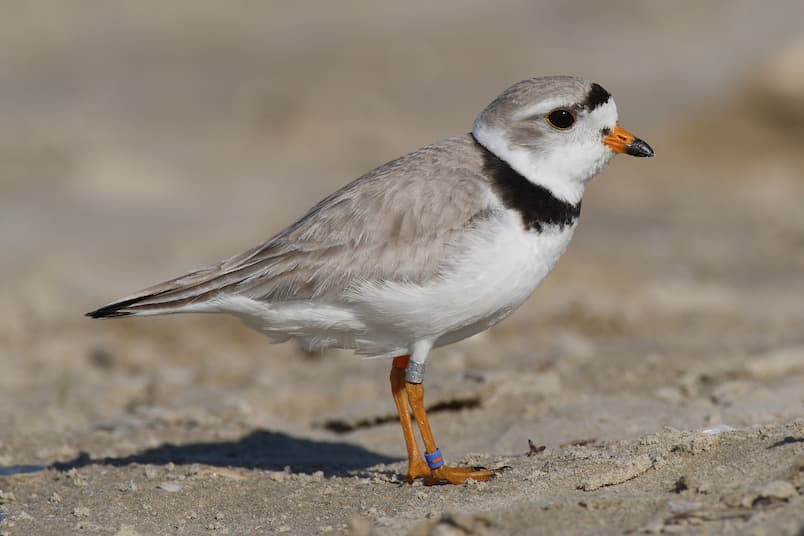
Piping plovers (Charadrius melodus) are regionally threatened or endangered and live on beaches, flats, and sandbars in coastal, Great Lakes, and Mississippi river waters. They are exclusively found in North America and are subject to the pressures of habitat loss and human disturbance. The birds are shy, preferring natural beaches without humans nearby. Conservation efforts have focused on protecting existing habitat and creating new habitat by dividing beaches to foster quieter, undisturbed habitat while still preserving recreational opportunities for people. As of 2020, their population numbers have been increasing. A pair actually nested on Montrose Beach in Chicago in 2019, the first time a nesting pair was seen in the area in half a century, and three birds were recently released by the Fish and Wildlife Service on that same beach this past July 2023.
The Mississippi Flyway
The Mississippi flyway follows the Mississippi river from its headwaters in Minnesota to its outlet into the Gulf of Mexico and across the gulf into South America. The migrating birds depend on the many prairies, wetlands, and forests found in the Mississippi river basin. The topography of this region is so flat that migrating birds do not need to adjust their height or direction to avoid geographical features like they do in the other flyways.
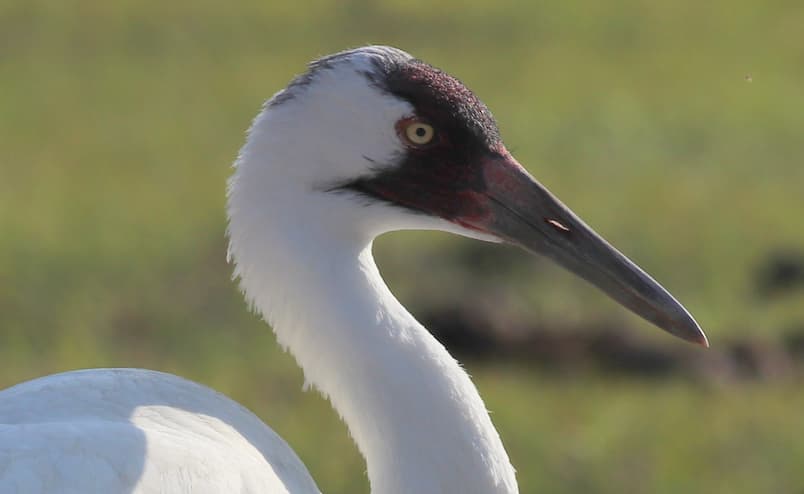
The endangered whooping crane (Grus americana) utilizes the Mississippi flyway to travel from nesting grounds in Wisconsin, Iowa, Illinois, and other Midwest states south to wintering grounds in Texas, Louisiana, and Florida. The population reached a low of 15 individuals in 1942 and was estimated to be between 50 and 249 mature individuals in 2020. Migration patterns are a learned behavior in this species, posing unique challenges when trying to create new populations. To counteract this, researchers trained young cranes to follow an ultralight aircraft which was then flown across the United States from Ontario and Wisconsin down to wintering sites in Florida.
The Central Flyway
This flyway stretches from the Arctic to the Gulf of Mexico and connects the Rocky Mountains, the Southwest deserts, the great plains, and countless wetlands, grasslands, highlands, and desert ecosystems. The topography and varying climate causes migratory birds to take less direct routes to avoid the more inhospitable areas.
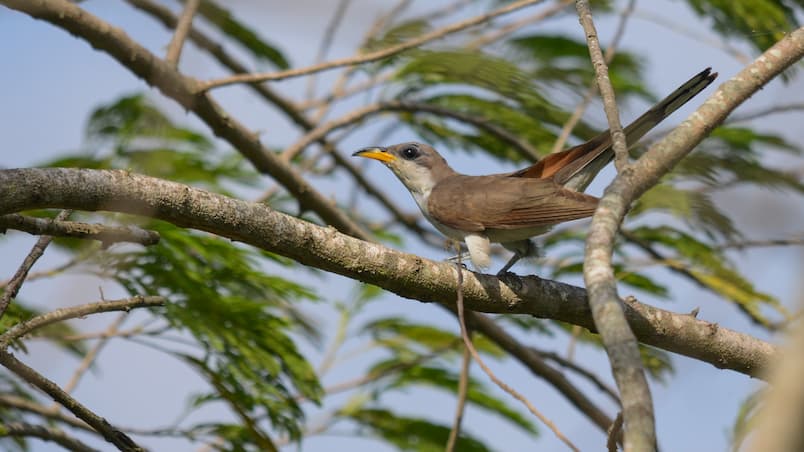
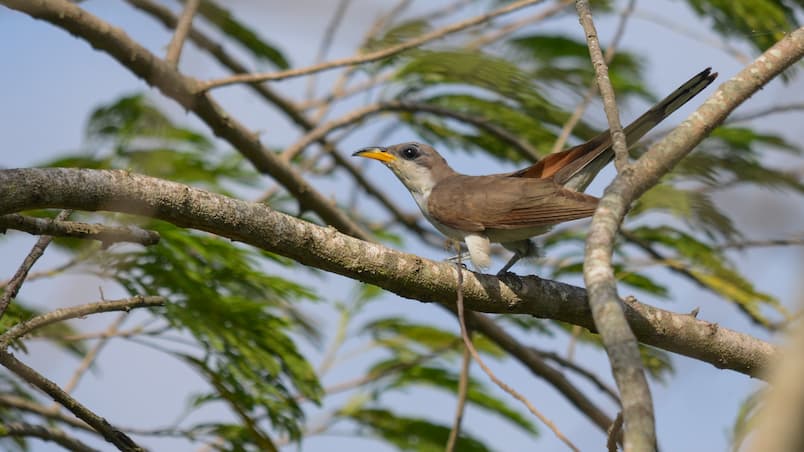
When they hear the word “cuckoo” most people think of the European cuckoo, which is famously featured in cuckoo clocks made in the Black Forest region of Germany, but the cuckoo family of birds has members residing across the world, including North America. The yellow-billed cuckoo (Coccyzus americanus) can be found across much of the central and eastern parts of the United States, preferring riparian habitats (the edges of rivers, lakes, streams, and other bodies of water). Cuckoos are known for their strange and diverse calls, and the yellow-billed is no exception with at least six defined vocalizations including coos, knocks, kawlps, and croaks. Yellow-billed cuckoos are currently listed as a species of least concern but have been experiencing decline over the past few decades and are considered endangered in certain states. They have mostly disappeared from the westernmost states of the central flyway, as droughts and the building and use of dams have greatly degraded the available riparian habitat.
The Pacific Flyway
The Pacific Flyway includes Alaska, Washington, Oregon, California, and Hawaii and supports the migration of more than a billion birds across rainforests, coastal marshes, scrublands, deserts, mountains, and more. A larger network of state and federally protected lands in this region also provides more habitat for these species, lending to the abundance of wildlife seen throughout.
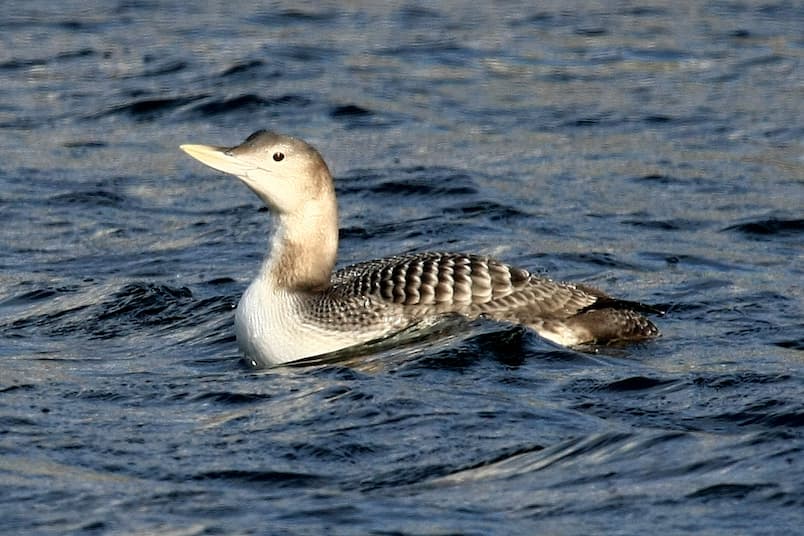
The yellow-billed loon (Gavia adamsii) is the largest member of the loon family which also includes the common loon, a rare but exciting visitor to the Wildlife Medical Clinic. Yellow-billed loons spend their summers in the high arctic tundra, fishing and breeding on the pristine lakes and rivers found throughout. They winter along the southern coast of Alaska and, rarely, along Washington, Oregon, and California. This species is extremely susceptible to pollution from oil and gas drilling and transport, as they depend on clean water and abundant sources of fish.
Loons have solid bones just like penguins and ostriches, but, unlike penguins and ostriches, loons are still capable of flight. The solid bones greatly decrease their buoyancy and aid in swimming, making them some of the best diving birds on the planet. These solid bones also mean that loons are heavy and awkward out of the water. Unlike other waterfowl such as ducks, loons are only capable of taking off from and landing in water, as they need a long wind-up directly into the wind to gain the lift they need. The increase in paved surfaces and the heat mirages they generate means that loons often mistake roadways as waterways and land on them. Without any water, they are then unable to take off again.
Just like all life on Earth, the flyways that migratory birds use are complex, beautiful, and not-entirely understood. In time we will unlock the secrets of the flyways, but it is important that we also protect the birds who depend on them. If you are still curious or would like to learn more about the flyways, you can find more information on them at www.Audubon.org/birds/flyways.
Written by Tyson, Class of 2026
References:
BirdLife International. 2020. Charadrius melodus. The IUCN Red List of Threatened Species 2020: e.T22693811A182083944. https://dx.doi.org/10.2305/IUCN.UK.2020- 3.RLTS.T22693811A182083944.en
BirdLife International. 2020. Grus americana. The IUCN Red List of Threatened Species 2020: e.T22692156A181242855. https://dx.doi.org/10.2305/IUCN.UK.2020-3.RLTS.T22692156A181242855.en.
Captive-reared Great Lakes piping plovers released at Montrose Beach | U.S. Fish & Wildlife Service. (2023, July 13). FWS.Gov. https://www.fws.gov/press-release/2023-07/captive-reared-great-lakes-piping-plovers-released-montrose-beach-help
Elliott-Smith, E., & Haig, S. M. (2020). Piping Plover (Charadrius melodus), version 1.0. Birds of the World. https://doi.org/10.2173/bow.pipplo.01
Hughes, J. M. (2020). Yellow-billed Cuckoo (Coccyzus americanus), version 1.0. Birds of the World. https://doi.org/10.2173/bow.yebcuc.01
Life Adaptations—Gates Of The Arctic National Park & Preserve (U.S. National Park Service). Retrieved August 12, 2023, from https://www.nps.gov/gaar/learn/nature/common-loon-3.htm
Piping Plover | Audubon Field Guide. (n.d.). Retrieved July 8, 2023, from https://www.audubon.org/field-guide/bird/piping-plover
Piping Plovers Nest in Chicago for the First Time in Over Half a Century | Audubon. (2019, June 28). https://www.audubon.org/news/piping-plovers-nest-chicago-first-time-over-half-century
The Flyways | Audubon. (n.d.). Retrieved July 8, 2023, from https://www.audubon.org/birds/flyways
Urbanek, R. P., & Lewis, J. C. (2020). Whooping Crane (Grus americana), version 1.0. Birds of the World. https://doi.org/10.2173/bow.whocra.01
Whooping Crane | Audubon Field Guide. (n.d.). Retrieved July 8, 2023, from https://www.audubon.org/field-guide/bird/whooping-crane
Yellow-billed Cuckoo | Audubon Field Guide. (n.d.). Retrieved July 22, 2023, from https://www.audubon.org/field-guide/bird/yellow-billed-cuckoo
Yellow-billed Cuckoo Overview, All About Birds, Cornell Lab of Ornithology. (n.d.). Retrieved August 12, 2023, from https://www.allaboutbirds.org/guide/Yellow-billed_Cuckoo/overview