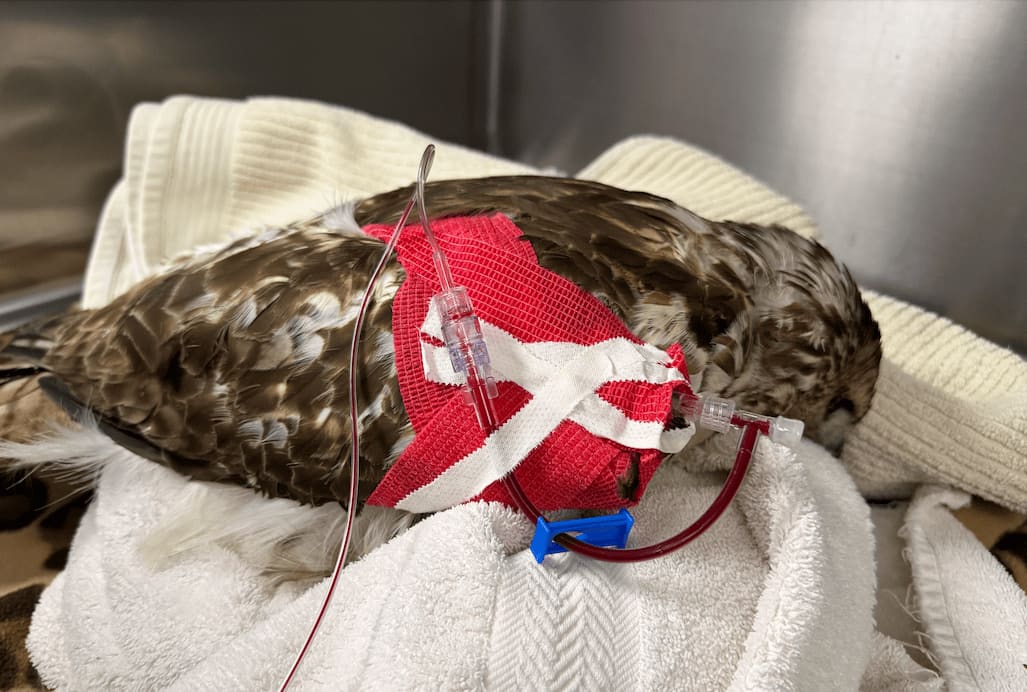
On February 5, 2026, a juvenile Red-Tailed Hawk presented to the Wildlife Medical Clinic emaciated and with a depressed mentation, not able to hold itself up or stand properly. Due to the clinical signs at the initial exam, we placed an intraosseous catheter – this means it was placed directly into a bone in the patient’s wing. This allowed us to give the patient fluids to help stabilize the patient. Placing catheters in blood vessels in birds is not always feasible or safe; however, placing a catheter in the bone allows for quick, easy vascular access, and decreases risks with catheters in blood vessels (pulling out the catheters in the vessels can lead to significant bleeding). Through the intraosseous catheter, we began fluids and supplemented them with potassium and dextrose. Birds in the emaciated condition this patient was in have not eaten enough in a long time and therefore have no glucose for energy metabolism. This patient was confirmed to have low blood sugar which we corrected with dextrose (sugar) supplementation. The potassium was supplemented as that electrolyte is also decreased due to muscle wasting and lack of intake from the prolonged malnutrition.
Initial Exam
At the initial exam while fluids were being given, we took a blood sample to assess the patient’s anemia and protein levels. The packed cell volume (red blood cell count) was 14% (normal 30-45%) indicating anemia and the total solids level (which is similar to protein levels) was 0.4 mg/dL (normal 4-6 mg/dL). The total solids that low indicated how critical this patient was. We also ran a blood chemistry to assess electrolytes to determine if there were other abnormalities we needed to correct. Due to the severity of the anemia (low red blood cell count) and the absence of protein in the blood (hypoproteinemia) it was decided to do an emergency blood transfusion the same evening to give the patient a chance to survive overnight.
Blood Donor
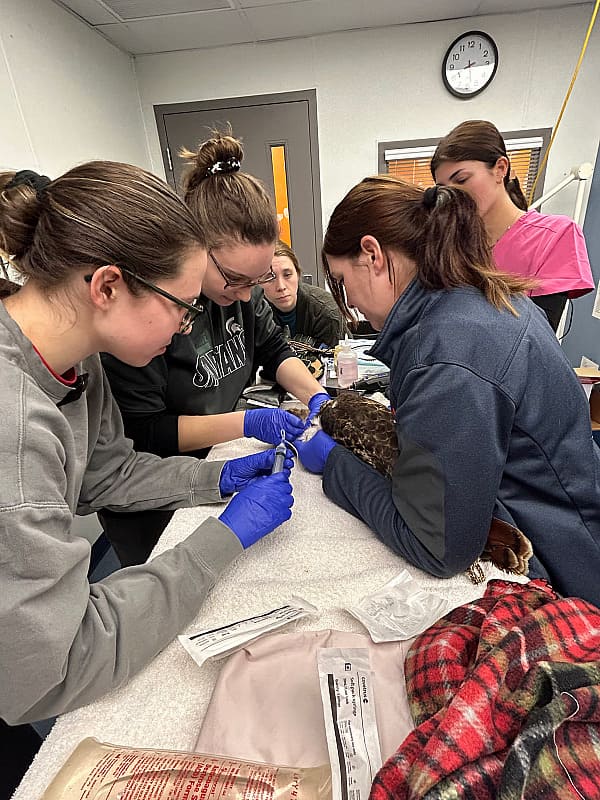
Our ambassador animals serve many functions, including the education of volunteers, students, and the public through our educational events. An additional benefit to having
ambassador animals is that they can serve as a healthy population of species we also see in the Wildlife Medical Clinic. Therefore, if a patient needs an emergent blood transfusion as this
patient was, we were able to have our ambassador Red Tailed Hawk, Ruby, donate blood. With the training work we have done with Ruby, we were able to quickly collect blood for the donation in a low-stress way that was based on an established training relationship. Ruby recovered well from her blood donation procedure. If we did not have ambassador animals to serve as blood donors, then locating a donor for the blood transfusion may have taken longer and may not have been a direct species match to our patient, potentially affecting patient outcome.
Continued Care
The patient received the blood donation and more fluids that evening of presentation. Towards the end of the transfusion the patient was able to hold just their head up and was picking at the catheter, so we placed a hood to decrease visual stimuli and finish the infusion. We had a guarded prognosis overnight due to the severity of the hypoproteinemia and anemia.However, the patient survived the night! We continued fluids the next day and the patient was able to stand on their own. With the improved mentation we placed the hood over the patients’ eyes again to ensure the catheter would stay in place for the duration of the fluids. We offered skinned mice to see if the patient would eat and the patient had an appetite. We discontinued fluids in the catheter at the end of the day and removed it (February 6th). We continued the next few days to run additional diagnostics, give supplemental fluids, and slowly feed increasing amounts of food. We found that this patient also had a very small chronic retinal lesion in the left eye (unlikely to impact vision) and internal GI parasites. The radiographs (X-rays) we took were normal and we found no fractures. We started the patient on a preventative anti-fungal medication and addressed the parasites. Young raptors are more susceptible to fungal infection and risks increase when indoors.
Road To Recovery
On February 12th we repeated bloodwork which showed an increase in the PCV to 29%
(red blood cell count) which was a positive trend, and total solids to 4.4 indicating a little over a
10-fold increase in total solids from intake! The patient has continued to gain weight and
improve clinical signs. We will continue to rehabilitate and treat this red-tailed hawk until they
are able to be transferred to one of our wildlife rehabilitation partners for reconditioning for
release. Due to the ability to give an emergent blood transfusion from our healthy ambassador
animals, this patient was able to survive from an extremely critical condition. Even with the
emergency blood transfusion this patient has survived against the odds stacked against it. This
case is unique and highlights the medical benefits of having healthy ambassador animals that
can possibly save lives, just like Ruby did with this patient.
Written by: Roxanne L., Class of 2027