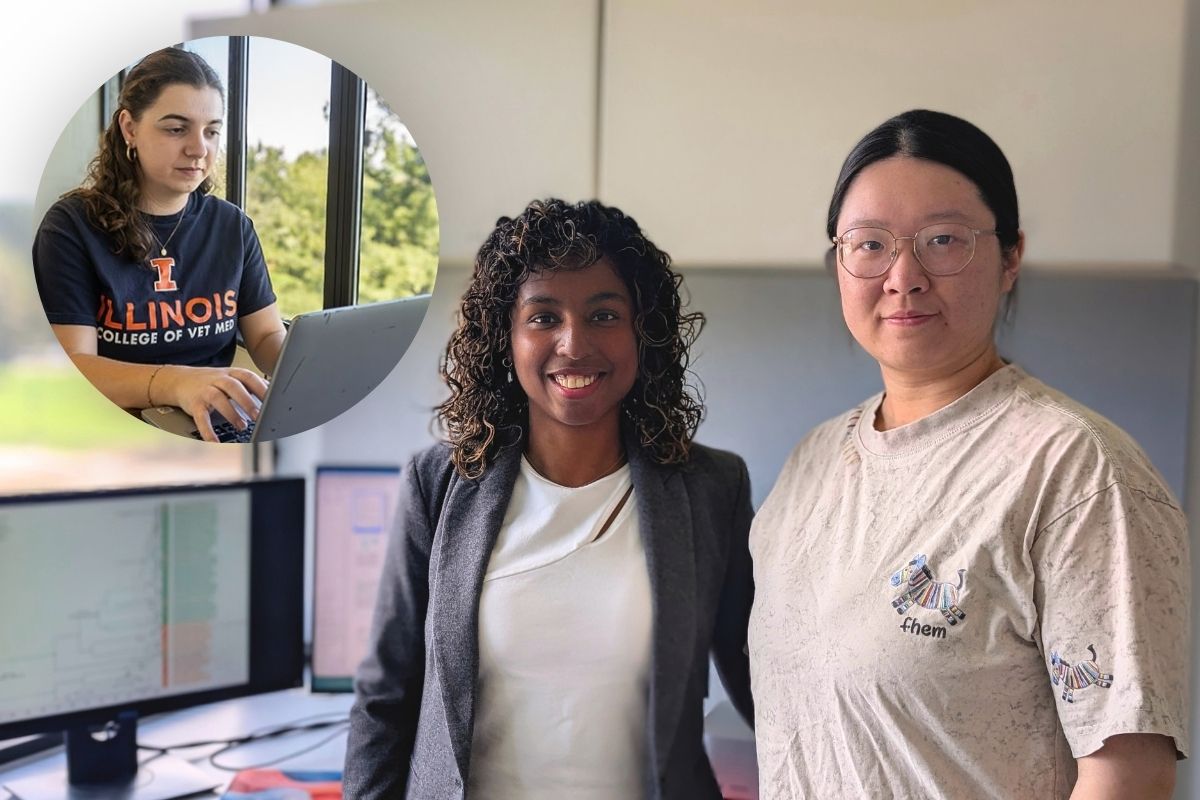
Master of Veterinary Science students Genevieve Stickelmaier and Xiongying Zheng joined Dr. Nidia Sequeira Trovao’s research to investigate the evolutionary history of Patoea piersonii, a bacterium first identified aboard the International Space Station and later associated with human infections on Earth.
At the University of Illinois College of Veterinary Medicine, Dr. Sequeira Trovao studies how infectious pathogens evolve, spread, and move across the human-animal interface. Her research uses genomic data and advanced computational tools to reconstruct the evolutionary history and transmission of emerging and re-emerging pathogens.
This work is grounded in One Health—the recognition that human, animal, and environmental health are interconnected. By examining how pathogens change over time and move through different hosts and environments, researchers can gain insights that may ultimately inform veterinary and public health interventions.
For their MVS capstone experience, Genevieve and Xiongying contributed to this research through the study of an especially unusual organism: P. piersonii.
Meet the Research Team
Faculty Investigator: Dr. Nidia Sequeira Trovao
Title: Assistant Professor
Department: Pathobiology
Research Focus: Genomic epidemiology, phylodynamics, pathogen evolution, zoonotic spillover, and One Health
Graduate Scholars: Genevieve Stickelmaier and Xiongying Zheng
Degree Program: Master of Veterinary Science
Capstone Research: Phylodynamics of Pantoea piersonii on Earth and aboard the International Space Station
Research Mission
Dr. Sequeira Trovao’s research focuses on molecular epidemiology and phylodynamics, the study of how pathogens evolve and spread through populations over time.
Using genomic and computational tools, her research examines questions such as when different pathogen lineages emerged, how closely related strains are, and how infectious agents may move between hosts or environments.
The P. piersonii project applies those approaches to a bacterium with an unusual history. Identified aboard the International Space Station and later associated with human infections on Earth, the organism raises questions about its evolutionary history, adaptation, and potential movement across environments.
Understanding those relationships may also support future research into antimicrobial resistance and possible animal reservoirs.
The Graduate Scholars’ Contribution
Genevieve and Xiongying contributed to the computational work needed to reconstruct the evolutionary history of P. piersonii.
A major first step was identifying and removing genetic recombination—instances where genetic material is mixed in ways that can make evolutionary relationships more difficult to interpret. Both students worked with Recombination Detection Program 5, or RDP5, to identify and remove significant recombination signals in the gene datasets and prepare them for further analysis.
Genevieve and Xiongying each worked through more than 400 genetic datasets from a larger collection of approximately 7,000 gene datasets, and used IQ-TREE to construct maximum-likelihood phylogenetic trees. Their work contributed to the broader effort to examine how different P. piersonii strains are related and how the bacterium may have evolved across environments.
Xiongying pursued the next analytical step employing a Bayesian phylodynamic framework called BEAST, which can be used to estimate evolutionary rates and the timing of origin across P. piersonii genes. That portion of the work was still underway at the conclusion of Xiongying’s capstone experience.
Together, their contributions supported the larger effort to reconstruct the evolutionary history and transmission dynamics of this unusual bacterium.
Why This Research Matters
Infectious diseases do not stop at the boundaries between human, animal, and environmental health.
P. piersonii has demonstrated multidrug resistance, making questions about its evolution and potential reservoirs especially important. Understanding how strains are related may eventually help researchers investigate where the bacterium resides, how it changes over time, and how it may move among environments or hosts.
The project also illustrates the growing importance of bioinformatics and genomic epidemiology in veterinary medicine.
Large genetic datasets allow researchers to investigate disease evolution and transmission in ways that are not possible through traditional laboratory approaches alone. By combining biological questions with computational analysis, researchers can build a more complete picture of how emerging pathogens behave.
For Dr. Sequeira Trovao’s research program, that work contributes to a broader One Health goal: using genomic information to better understand pathogens at the human-animal interface.
Graduate Experience
Although Genevieve and Xiongying worked on the same larger research effort, each came away from the experience with a different perspective.
For Genevieve, the project meant stepping into an area of research that was completely new. Learning to use genomic analysis programs, working with genetic data, and developing basic coding and bioinformatics skills pushed her beyond her previous experience. She also gained an appreciation for collaboration and for approaching unfamiliar problems with curiosity rather than hesitation. For Genevieve, taking on an unfamiliar research problem reinforced the value of being open to new ideas, new technologies, and new ways of thinking about animal health research.
For Xiongying, the experience highlighted the scale and persistence required in computational research. Working with large datasets meant troubleshooting software limitations, rerunning analyses, documenting errors, and learning how much careful data handling is required before meaningful scientific conclusions can be drawn.
Both students gained firsthand experience with the growing role of computational tools in modern biomedical and veterinary research.
For Xiongying, the project also strengthened an interest in antimicrobial resistance and in understanding how antibiotic-resistant bacteria may affect both animal and human health. The long-term goal of the research may also help support future studies seeking to characterize potential animal reservoirs of P. piersonii.
Together, their experiences demonstrate how graduate students can contribute different pieces of a larger faculty-led research effort while developing skills that extend well beyond a single project.
Beyond the Classroom
Stories of learning, discovery, and impact from the Master of Veterinary Science.