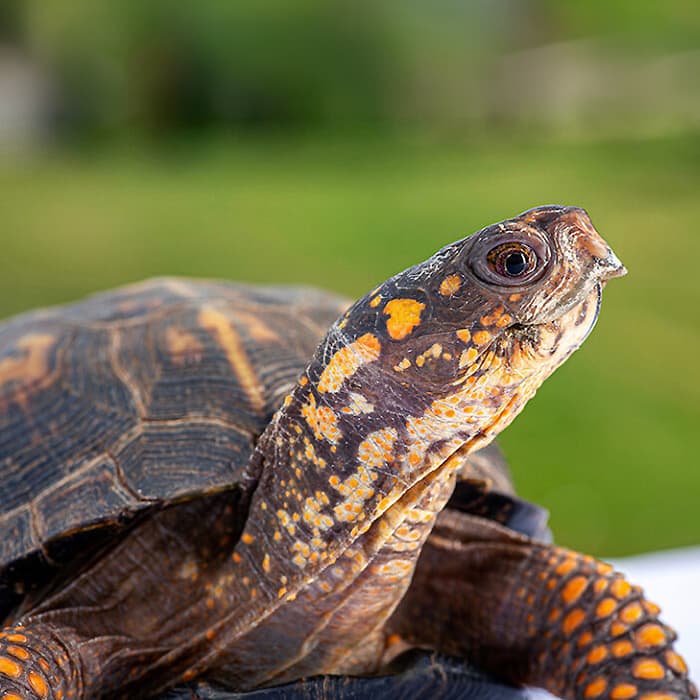
The eastern box turtle is by far one of the most commonly received turtles that the Wildlife Medical Clinic treats in its facility. Whether it be from an injury, illness, or anything in between, this turtle is one that the public finds often in our area and brings to the clinic when they are in need of help. While the eastern box turtle is named as a “turtle” they actually seemed to have missed the memo and instead spend a great deal of their time on land similar to a tortoise! They will enjoy a nice soak however, especially in the hotter summer season by burying themselves in some nice mud or by just going straight into shallow water.
Identifying Features of Eastern Box Turtles
The easiest way to know if you’re looking at an eastern box is by taking a look at the shell. They are known for their yellowish-orange speckled, high-domed carapace. The carapace is the fancy way of specifying the top part shell; the bottom part is called the plastron. Conveniently, their scaly, thick skin is actually a similar pattern too; it has an overall dark brown/black “background” with vibrant shades of yellow, orange, or red speckles. These turtles are relatively small, only reaching a size of about four to seven inches. Like many other turtles (and tortoises), eastern box turtles do not have teeth nor a bony jaw, alternatively, they have a jaw made up of a keratinized beak similar to that of a bird!
Common Causes for Intake
There are many reasons someone might bring the eastern box turtle to our clinic. One reason could be that they accidentally hit one with their vehicle. Unfortunately, this is a very common occurrence as we continue to develop more land for agriculture and urbanization. So if you are driving through a road surrounded by more forested land, be aware of the road and drive the speed limit; if you are able to safely slow down, and/or go around the turtle this would be ideal for all parties involved. Oftentimes, female turtles are hit while searching for sites to lay their eggs. However, all sexes and ages are susceptible to vehicle collisions while migrating between food and water sources. Additionally, obstacles such as train track, curbs, and extensive debris pose challenges for the eastern box turtle trying to cross roads.
Another reason we may see them at the WMC is for trauma caused by domestic animals! So keeping a watchful eye and especially keeping your pets leashed is very important, not just for these turtles but other wildlife as well! Eastern box turtles may also be poisonous if other animals consume them since they are known for eating and snacking on poisonous mushrooms which then gets stored in their tissue as toxins. While their bodies can handle these toxins, the bodies of other animals may not fare as well.
How to Safely Move a Box Turtle
In the instance that you do come across an eastern box turtle that must absolutely be moved and/or brought in to be seen at the WMC, there are a few steps that you should keep in mind so as to avoid mishandling the turtle. If you just need to move them, move them in the direction they were travelling and move them just enough to get them out of harms way. They should not be moved from the area where they are found unless they are injured or ill. If you need to transport them to a licensed rehabilitator, please note the exact location the animal was found as that will be needed when it is time to release the animal back into the wild.
For handling, you can slowly and safely lift them using both hands, reaching between their front and back legs by placing your thumbs on the top shell (the carapace) and your fingers under the shell (on the plastron), almost like holding a hamburger. Avoid reaching in front of them or near the rear of them as to avoid having your fingers pinched when they close their shell. You should also avoid the front to reduce your chances of being bitten. Keep them relatively low to the ground as you are moving them in case they squirm and need to be set down or on the off chance that your grip is not tight enough and they fall, that way they are not falling very far. Alternatively, should you wish not to handle them with your hands, you can use a flat object (like a shovel or lid) to gently slide under them and transport them that way, still very low to the ground.
Next, place them in a well ventilated box or container that is large enough for them to comfortably turn around in, then make your way over to the WMC or another licensed rehabilitator as soon as possible. It is very important not to hold on to wildlife longer than absolutely necessary as this can cause stress and delay necessary treatment, hindering their chances of survival and release back into the wild.
Written By: Rachel L., class of 2027.