Intake
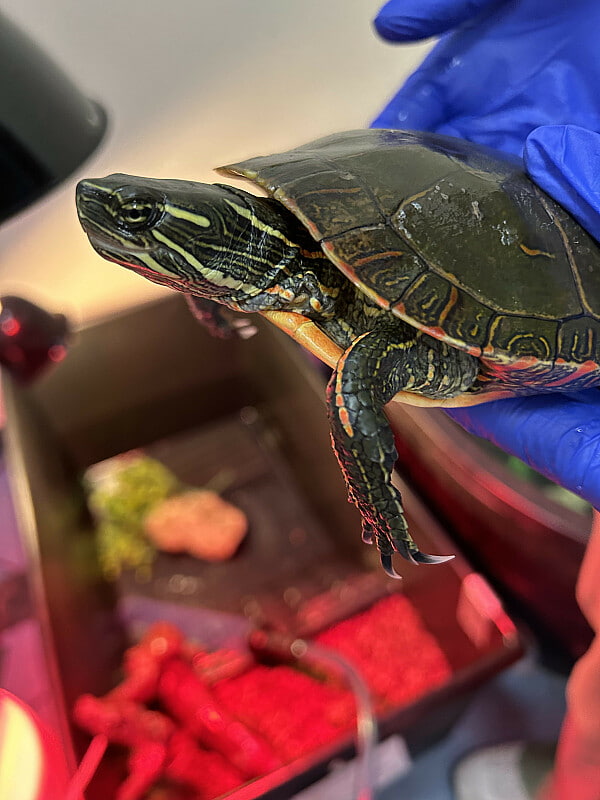
At the beginning of October, the Wildlife Medical Clinic welcomed a Painted Turtle brought in by a licensed wildlife rehabilitator from Illinois. Sadly, this patient had been the victim of a common — and often underestimated — threat to our native turtle populations: vehicle collision.
Many people are surprised to learn that when a turtle is hit by a car, the damage often goes far beyond what’s visible on the surface. A common misconception is that shell injuries aren’t serious. Unfortunately, this isn’t the case.
Shell Damage Is Skeletal Damage
A turtle’s shell isn’t just a protective outer layer — it’s a vital part of their skeletal system. Their ribs and spine are fused directly to the shell, which means that any cracks or fractures are often accompanied by internal trauma.
Our Painted Turtle patient arrived with multiple shell fractures, affecting the carapace (top shell), plastron (bottom shell), and bridge (the sides of the shell that connect top and bottom). These injuries alone were concerning — but we knew there could be more going on beneath the surface.
Imaging Reveals Deeper Injuries
To assess the extent of internal trauma, we performed radiographs (x-rays). Unfortunately, the images revealed fractures to multiple bones of the pectoral girdle of both forelimbs. The pectoral girdle are bones near the shoulder that are essential for forelimb function. These types of internal injuries significantly complicate recovery and reduce the likelihood of successful release.
How Did We Approach This Tough Situation?
Reptiles like turtles have slow metabolic rates, meaning healing takes much longer than in mammals — often over a year for serious injuries. Surgical repair of the bones of the pectoral girdle is not feasible in turtles, though minor injuries can heal with time and rest. In this patient’s case, its injuries were catastrophic, impacting both forelimbs, and unlikely to result in a functional outcome for either forelimb. This species of aquatic turtle requires function of at least 3 of 4 limbs for success in the wild post-release. Additionally, severe trauma to the pectoral girdle is often accompanied by extensive trauma to the lungs, the cranial aspect of which are adjacent to these bony structures. While we evaluated options, we ensured the turtle had a quiet enclosure, pain management, and food.
A Difficult Final Decision
After much consideration, our veterinary team made the difficult decision to pursue humane euthanasia. While our clinic regularly treats turtles with shell and limb injuries — many of which go on to be successfully released — the severity of this patient’s internal injuries, paired with her lack of appetite and movement, made recovery highly unlikely.
Our goal is always to prioritize quality of life, and in this case, euthanasia was the most compassionate and medically appropriate choice.
What Can You Do?
During the fall, turtles often cross roads in search of overwintering sites. You
can help protect them by:
- Slowing down and staying alert near wetlands, forests, or creeks
- Contact a licensed wildlife rehabilitator if you find a turtle that appears injured — even if it seems like it’s okay. Prompt medical attention can make a life-saving difference.
Thank you for supporting our work and helping protect native wildlife through awareness, compassion, and action!
Written by: Natalie L., Class of 2028
Works Cited:
Hirasawa T., Nagashima H., Kuratani S. The endoskeletal origin of the turtle carapace. Nat Commun. 2013;4:2107. Retrieved October 17, 2025, from https://pmc.ncbi.nlm.nih.gov/articles/PMC3715867/
Jackson DC. Hibernating without oxygen: physiological adaptations of the painted turtle. J Physiol. 2002 Sep 15;543(Pt 3):731-7. Retrieved October 17,2025, from https://pmc.ncbi.nlm.nih.gov/articles/PMC2290531/
Virginia Zoo in Norfolk. Where did the turtles go for the winter? 2023 October 20. Retrieved October 17, 2025, from https://virginiazoo.org/where-did-the-turtles-go-for-the-winter