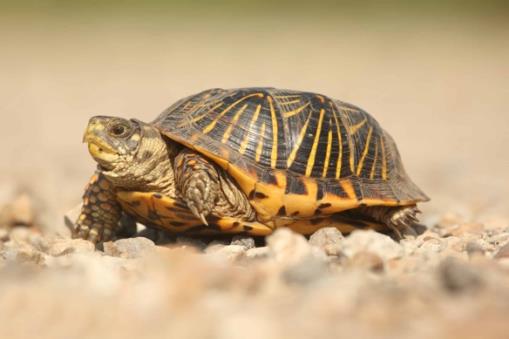
The Eastern Box Turtle (Terrapene carolina carolina) is one of six subspecies of the Common Box Turtle and is found in the eastern United States. Eastern Box Turtles are mainly terrestrial turtles that live in areas of high vegetation and are close to small rivers or streams. Box turtles get their name from their hinged bottom shell, or plastron. This allows the turtle to completely close its shell around its body in dangerous or threatening situations. The plastron of an Eastern Box Turtle is dark brown, while their top shell, or carapace, can be bright yellow or orange. This coloring, and their four toes, is a helpful identifier of Eastern Box Turtles when they’re compared to other Box Turtle species. This coloring also allows the Eastern Box Turtle to camouflage among the damp earth, fallen leaves, and fallen vegetation in the highly moist and vegetative areas where they reside.
Intake
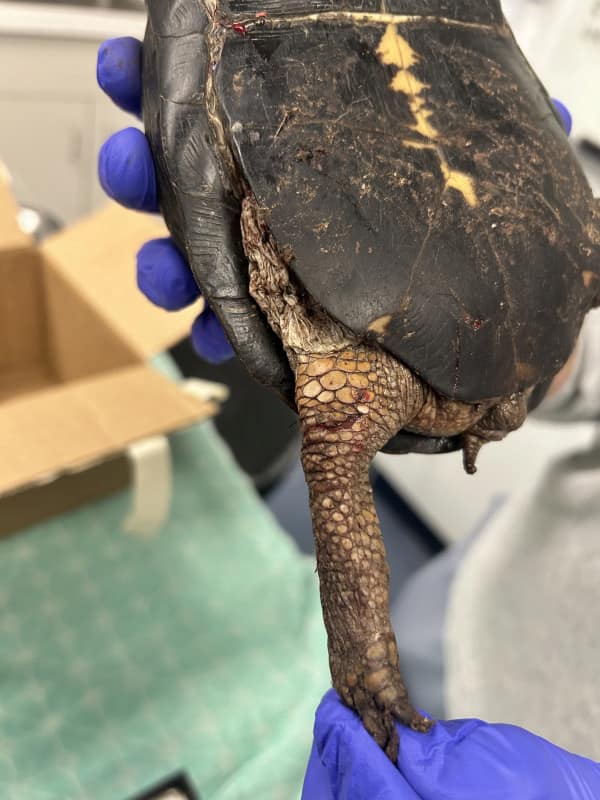
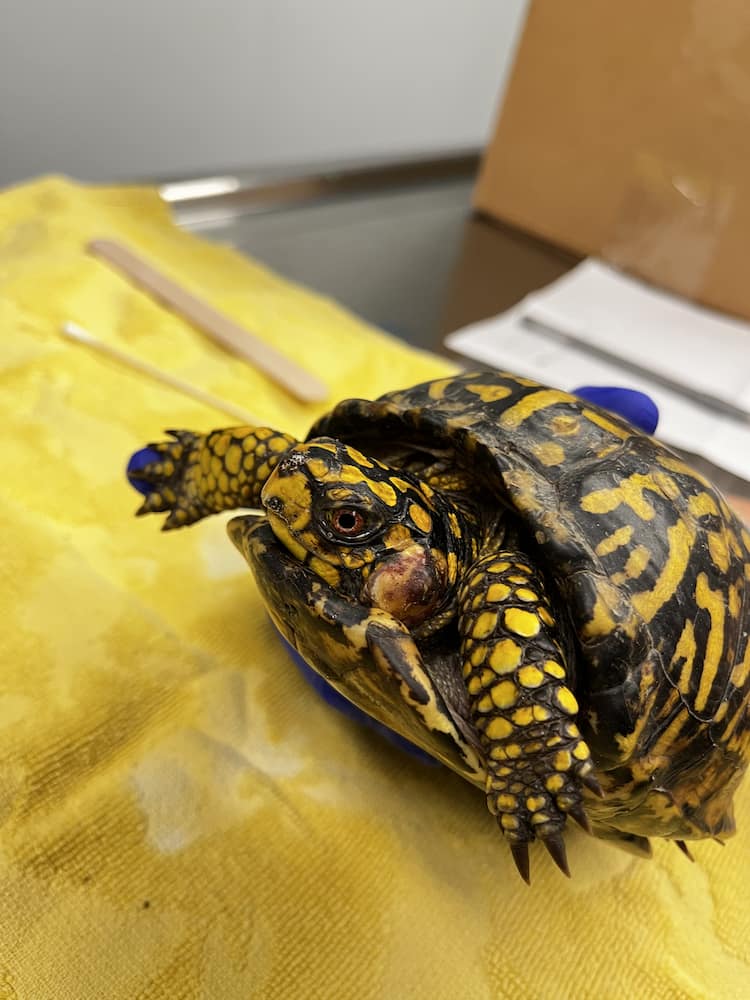
Eastern Box Turtle (TECA) 25-2096 is an adult female (as determined by her flat plastron and longer, thinner, curved rear claws) that presented to the Wildlife Medical Clinic on September 25 after being hit by a car. Upon intake, 2096 was alert, active, moderately dehydrated, and intent on wreaking havoc in the clinic, as she emerged out of her transport box mid-examination. 2096 had a superficial laceration across her right knee that did not appear infected and had a small abrasion at the midpoint of her right vertebral scute on her carapace.
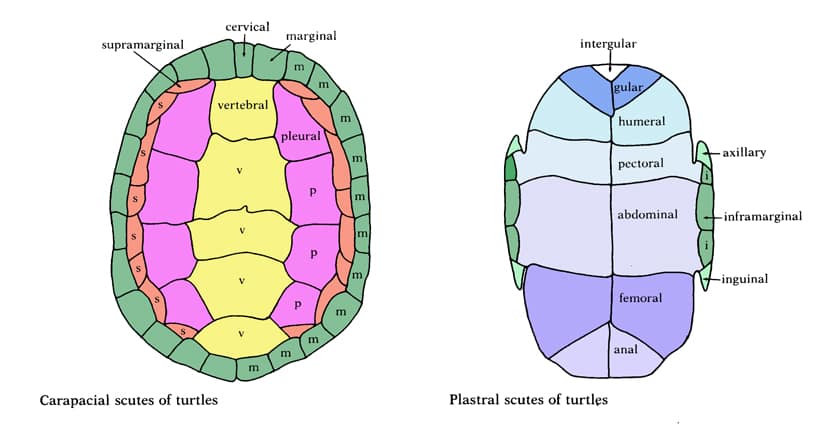
On her plastron, which was the area of highest concern, there was a superficial, actively bleeding fracture at the level of her right marginal scute that, although not very wide, did extend all the way to her right femoral scute. She also had superficial fractures of her right anal scutes. Due to these injuries, initial treatments included subcutaneous (below the skin) fluids and an injection of hydromorphone, an opioid medication that is known to be helpful with alleviating pain from shell fractures. Vetericyn spray (an antimicrobial wound spray) was also sprayed over the laceration on the right knee to discourage infection and encourage healing.
Radiographs and Treatment
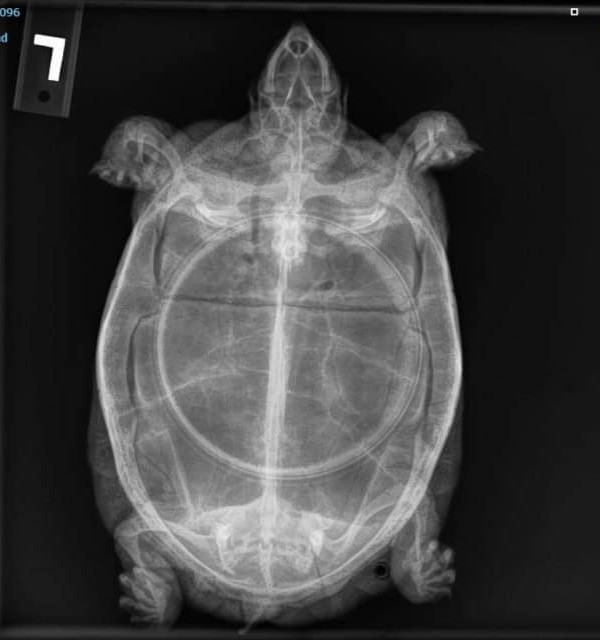
Not too long after her initial exam, radiographs were taken of TECA 25-2096 to determine the severity of her fractures. Three specific views were taken. There was a dorsoventral image, which looks down at 2096 from above, a left lateral image, taken from the right side of 2096, and a craniocaudal image, taken from in front of 2096 as if she was looking into a mirror. These three views are some of the most common views for turtles, allowing visualization of many important body parts and organs that cannot be visualized normally. The most beneficial view in 2096’s case was the dorsoventral view, which confirmed the fractures found on exam, and revealed two small fractures on the lateral most aspect of the right inguinal scute and a transverse fracture of the left inguinal scute. However, even with these numerous fractures, they were all minimally displaced and very superficial, meaning release was in the cards for 2096’s future. Post radiographs, the vetericyn spray was continued over the right hind limb laceration to encourage healing there, but the hydromorphone was switched to meloxicam (an anti-inflammatory) as the superficial fractures did not call for such strong pain medication.
Release
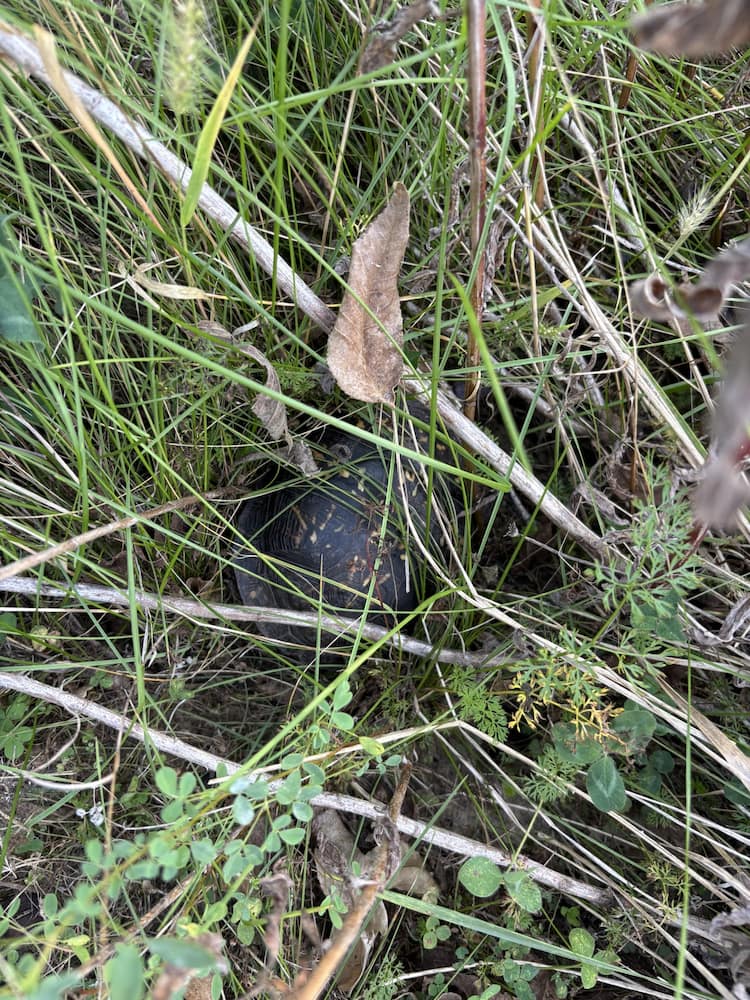
After nine days in the clinic, TECA 25-2096 was released into her habitat where she had been found in Tilton, Illinois. She was situated in an area of significant vegetation that bordered a small lake and was farther away from the road. Upon release, 2096 was eager to return to her home and quickly made her way into an area of high vegetation that allowed her to camouflage and hide within her new environment.
Works Cited
Eastern box turtle. Smithsonian’s National Zoo and Conservation Biology Institute. (2018, April 17). https://nationalzoo.si.edu/animals/eastern-box-turtle
Written By: Kat R., Class of 2028