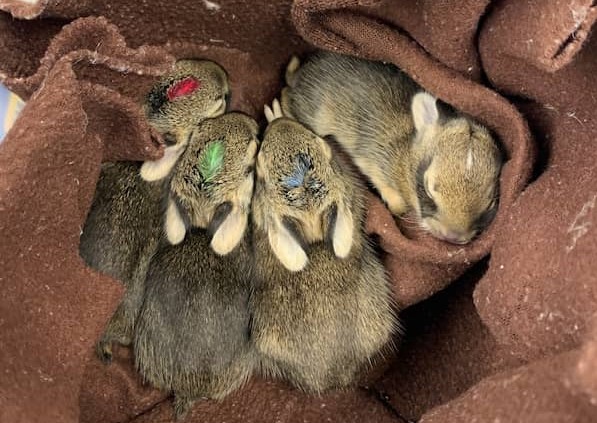
We are in the midst of the most wonderful time of year for the Eastern Cottontail Rabbit
(Sylvilagus floridanus). Spring comes with plentiful food and nourishment to support the
birth of many new young rabbits. The rabbit breeding season begins around early
March and continues into September. Since rabbits have such a short gestation period,
28 days, one rabbit can have upwards of three litters per year. An average litter has
anywhere from two to seven baby rabbits, also known as kits.
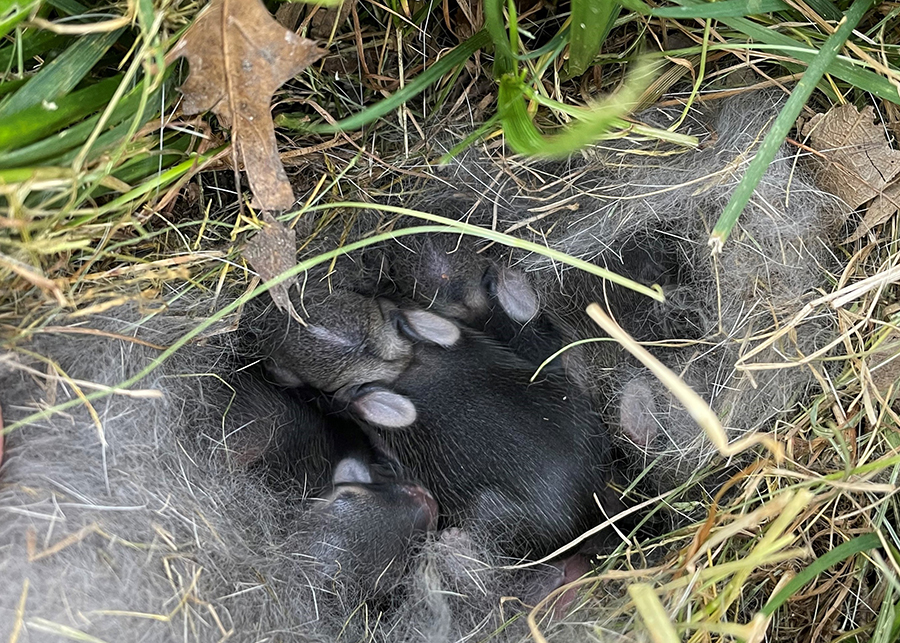
The cottontail rabbit gives birth in shallow, grassy depressions in the ground. The
mother rabbit will return only twice per day to feed her young, usually around dawn and
dusk. Outside of feedings, the mother will often put some distance between herself and
her young so as not to attract predators to her babies. The timeline from newborn to
self-sufficient is truly short with rabbits.
- The kits are born blind and with little hair.
- Their eyes will begin to open about four days after being born.
- By twelve to sixteen days old they will begin to adventure out of their nest.
- As early as four or five weeks old, young rabbits will start to fend for themselves.
- They may begin to sexually reproduce as early as three to four months of age.
Unfortunately, many young kits do not survive to adulthood, partially due to the high risk
of predation. The average lifespan of a wild cottontail rabbit is about one to three years.

It is quite common for rabbits to make their nest in residential yards. The best thing you
can do if you find baby rabbits in your yard is leave them alone! It is a common
misconception that the mother will not return to feed her babies if they smell that a
human has touched them. Unless it has been confirmed that the mother is injured or
deceased, young kits have their best chance of survival when left in the wild for their
mom to care for them.
Dog owners often have concerns for a dog getting to the babies, and there are a couple
easy solutions for this. You can create a protective shield for the nest by placing a
laundry basket or small pen around the nest with a hole just big enough for the mother
rabbit to fit through. Alternatively, a weighted basket can be placed over the nest during
the day and removed at night for mom to return. If all else fails, leash-walking your dog
for potty time is another feasible option. As previously mentioned, the young rabbits
should be ready to move out of the nest within four to five weeks, so it is a temporary
inconvenience that makes a world of difference to the kits’ survival.
Celebrate the Spring season with some fun facts about the Eastern Cottontail Rabbit

1. The Eastern Cottontail Rabbit (Sylvilagus floridanus) is a different species than
the common domestic rabbit (Oryctolagus cuniculus), and therefore, they are
unable to reproduce with each other.
○ It is important to note that the wild rabbit can transmit the fatal virus,
known as Rabbit Hemorrhagic Disease Virus Type 2, to domestic rabbits,
so they should not be allowed to mingle.
2. Eastern Cottontails are generally a solitary species but if found in a group, they
would be called a “fluffle.”
3. To escape predators, the Eastern Cottontail Rabbit can run as fast as 29km/hr.,
or 19mph.
4. Rabbits are usually non-vocal, but they can emit a grunt or scream if they are in
true danger.
5. Rabbits are crepuscular beings, meaning they are most active at dawn and dusk.
6. Eastern Cottontail Rabbits will sometimes do a courtship dance in which they will
leap up into the air and race under one another.
7. An adult cottontail rabbit can weigh up to 2.5lbs. Female rabbits are typically
larger than male rabbits.
8. Eastern Cottontail rabbits do not hibernate. During the winter, rabbits usually
survive on twigs and branches or any seedlings they can find. They take a break
from mating to preserve their energy as food sources are limited
This blog post was written by second year Alli