Faculty Research Spotlight
Featuring Master of Veterinary Science Graduate Scholar Andrea Rangel
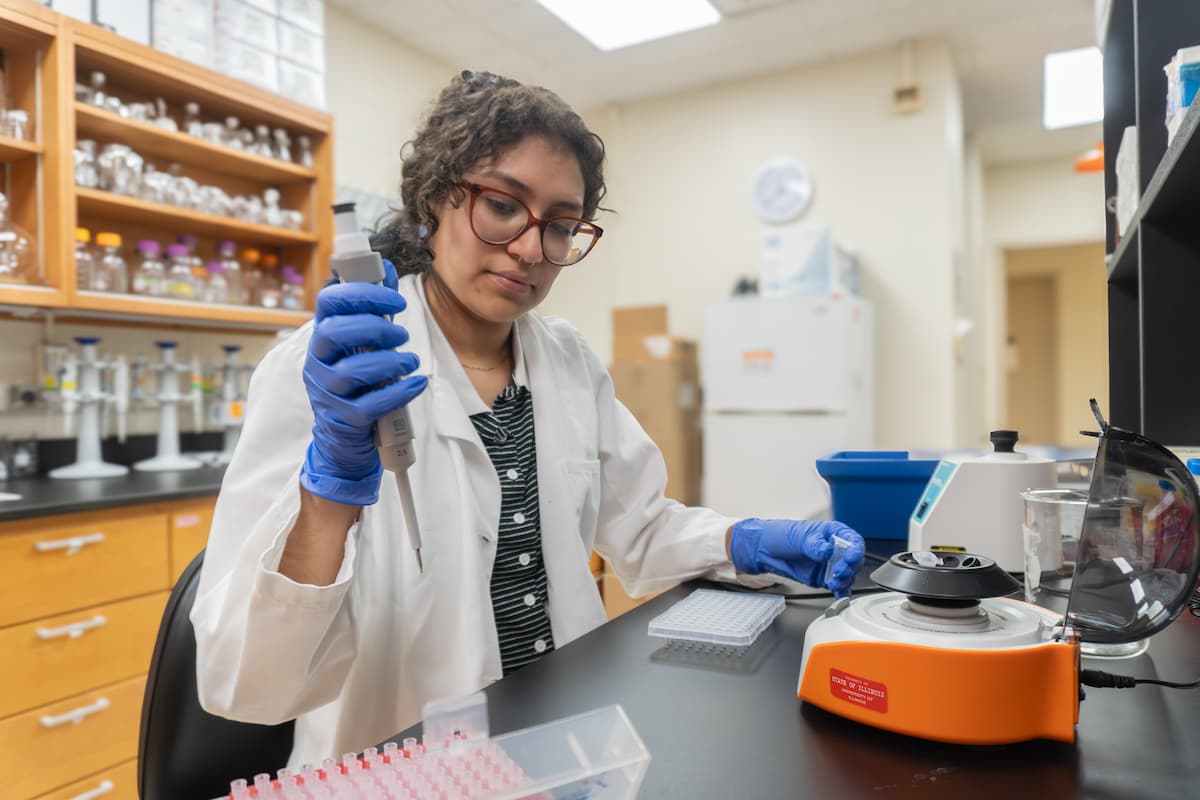
Could Everyday Chemicals Affect Reproductive Health?
Master of Veterinary Science student Andrea Rangel joined Dr. Ayelet Ziv-Gal’s research laboratory to investigate one of today’s most important questions in reproductive toxicology.Female infertility affects millions of women worldwide, yet scientists are still discovering how everyday environmental exposures may influence reproductive health.
From cosmetics and personal care products to processed foods and pharmaceuticals, people encounter countless synthetic chemicals every day. While many of these compounds have long been considered safe, researchers continue to investigate whether repeated, low-level exposure may affect the body’s most sensitive biological systems.
At the University of Illinois College of Veterinary Medicine, Dr. Ayelet Ziv-Gal leads research to better understand those connections. Her laboratory investigates how environmental chemicals influence the ovary, the oviduct, and overall female reproductive health, with the goal of developing new approaches to prevent or reduce chemically induced infertility.
As part of her Master of Veterinary Science capstone, Andrea Rangel joined Dr. Ziv-Gal’s research team to contribute to this ongoing work.
Research Spotlight: The Ziv-Gal Laboratory
Faculty Investigator: Dr. Ayelet Ziv-Gal
Title: Assistant Professor
Department: Department of Comparative Biosciences
Research mission: Investigating how environmental chemicals influence ovarian development, hormone production, and female reproductive health.
Current Mission: Understanding how parabens and other environmental chemicals affect reproductive health and fertility.
Andrea’s Research Contribution
Andrea’s capstone project, ‘How Propylparaben Exposure Affects the Ovary,’ examined whether maternal exposure to propylparaben altered genes involved in sex-steroid hormone production and estrogen signaling. Working in Dr. Ziv-Gal’s laboratory, Andrea used real-time quantitative polymerase chain reaction (qPCR) to measure gene expression in offspring. While genes involved in sex-steroid hormone production did not show clear changes, her findings suggested reduced expression of one estrogen receptor (Esr2), contributing to ongoing research on how environmental chemicals may influence female fertility and long-term reproductive health.
Why This Research Matters
Environmental chemicals are part of everyday life, yet many remain poorly understood. Research from the Ziv-Gal Laboratory helps scientists better understand reproductive risks and supports advances in human health, animal health, and wildlife conservation.
Learning Through Research
Working alongside Dr. Ziv-Gal’s research team strengthened Andrea’s laboratory skills, data analysis abilities, and science communication. The experience reinforced her interest in veterinary school and a career at the intersection of reproductive biology, toxicology, and conservation.
“I want to combine these two realms.”
Andrea Rangel
Beyond the Classroom
Stories of learning, discovery, and impact from the Master of Veterinary Science.