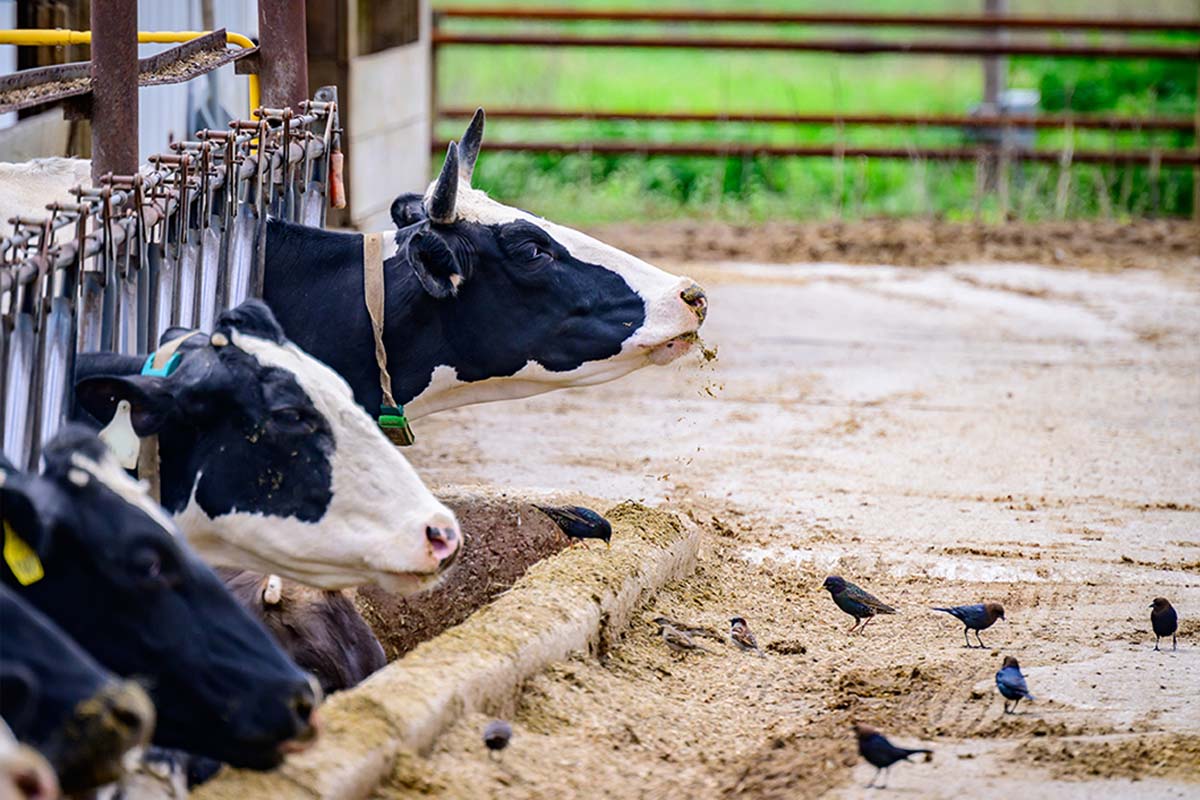
Every trip through the milking parlor generates information. Milk flow, milking time, conductivity, production, and other measures create a steady stream of data that can help dairy producers understand what is happening within their herd.
Master of Veterinary Science student Kylie Wieczorek joined Derek Nolan’s work in dairy production to explore how those data could help answer a practical animal health question: Can the condition of a cow’s teat ends tell us something about her milking performance and udder health?
At the University of Illinois, Nolan works with dairy producers to provide tools that support informed management decisions and improve milk quality. His extension and teaching work emphasizes connecting knowledge about the dairy cow with the realities of the dairy production system.
Kylie’s capstone put that approach into practice using cows and production data from the University of Illinois Dairy Research Unit.
Meet the Research Team
Faculty Investigator: Derek T. Nolan
Title: Teaching Associate Professor, Extension Faculty Specialist
Department: Animal Sciences
Research Focus: Dairy production, milk quality, and data-informed herd management
Graduate Scholars: Kylie Wieczorek
Degree Program: Master of Veterinary Science
Capstone Research: Relationship between teat end condition, milking performance and udder health in lactating dairy cattle
Research Mission
Helping dairy producers make informed decisions requires turning information collected on the farm into knowledge they can use.
Nolan’s work focuses on providing dairy producers with practical tools to improve milk quality and achieve their management goals. That means looking at the dairy cow as part of a larger production system and helping producers understand how the information available to them can support better decisions.
Udder health is one area where those decisions matter.
A healthy teat end is one of a dairy cow’s natural defenses against mastitis and other udder health problems. Damage or excessive keratin buildup can interfere with normal milking and may increase susceptibility to infection.
Teat end scoring gives producers a practical way to evaluate teat condition, but exactly how those scores relate to measurable milking performance is not fully understood.
That became the focus of Kylie’s capstone.
Kylie’s Contribution
Kylie evaluated 91 lactating Holstein cows at the University of Illinois Dairy Research Unit over multiple time points between February and April 2026.
Each teat was individually scored on a four-point scale based on the amount of keratin buildup present. The individual scores were then averaged to create an overall teat end score for each cow.
Kylie paired those observations with data generated in the milking parlor, including milk flow rate, milking duration, conductivity, milk production, and days in milk.
The original research plan also called for examining somatic cell count, mastitis risk, and additional herd data. But as Kylie began working with the records, she discovered that the available data could not fully support the analysis as originally designed.
So the project changed.
Rather than forcing the original research question, Kylie and Nolan shifted the analysis toward the parlor performance data that were available and reliable.
That adaptation became an important part of the research itself.
What Did the Data Show?
Most of the production measures Kylie examined—including milk yield, days in milk, conductivity and milking duration—did not show a statistically significant relationship with teat end score.
One measure, however, stood out.
The analysis showed a tendency toward an association between teat end condition and milk flow rate. Although the relationship was not strongly significant, the finding suggests that teat end condition may have a connection to milking efficiency and provides a question worth investigating further.
The project also revealed limitations in relying on a single measurement to understand udder health.
Monthly somatic cell count testing may not capture short-term or subclinical changes, while incomplete mastitis records can make disease patterns difficult to interpret. The relatively small study population also limited the ability to detect stronger relationships.
Rather than producing a simple answer, the project pointed toward a more important idea: understanding herd health may require bringing multiple sources of information together.
Why This Research Matters
Modern dairy farms generate an enormous amount of information. The challenge is determining which pieces of that information are meaningful—and how they should be interpreted together.
Kylie’s project suggests that measures such as milk flow rate, conductivity, and milking duration may provide additional context when evaluating udder health rather than relying on somatic cell count alone.
That is where research connects directly with dairy management.
Understanding relationships among cow health, milking performance, and parlor data could eventually help producers recognize changes earlier, evaluate their milking systems, and make more informed herd-level decisions.
Future work could include repeated data collection over longer periods, closer alignment between teat scoring and somatic cell count sampling, and consideration of additional factors such as udder conformation and milking system variables.
The goal is not simply to collect more data. It is to determine which data can help producers make better decisions for their cows and their operations.
Graduate Experience
For Kylie, one of the most important lessons came from something that did not go according to plan.
Her original research question had to evolve when the available herd data did not support the analysis she expected to conduct. Working through that challenge required troubleshooting, reassessing assumptions and finding another scientifically meaningful way forward.
That experience showed her that production animal research is rarely a straight line.
Working with real farm data also strengthened Kylie’s interest in production animal medicine and herd-level management. She gained experience collecting and analyzing data, applying statistical methods, and interpreting results within the context of an actual dairy operation.
Most importantly, she saw how research can translate into practical decisions that affect animal health, milk quality and overall herd performance.
Her experience reflects the kind of problem-solving required in production medicine: work with the information available, ask what it is really telling you, and use it to make the next decision better.
Beyond the Classroom
Stories of learning, discovery, and impact from the Master of Veterinary Science.