
The University of Illinois Wildlife Medical Clinic is here to help our community by caring for sick, injured, or orphaned Illinois native wildlife. We rely on your goodwill and informed decision-making for our success!
Please use this page as a resource to help determine when to assist wildlife.

How will I know if a wild animal needs my help?
People are constantly finding wild animals. But just because they were found, doesn’t mean the animals need help.
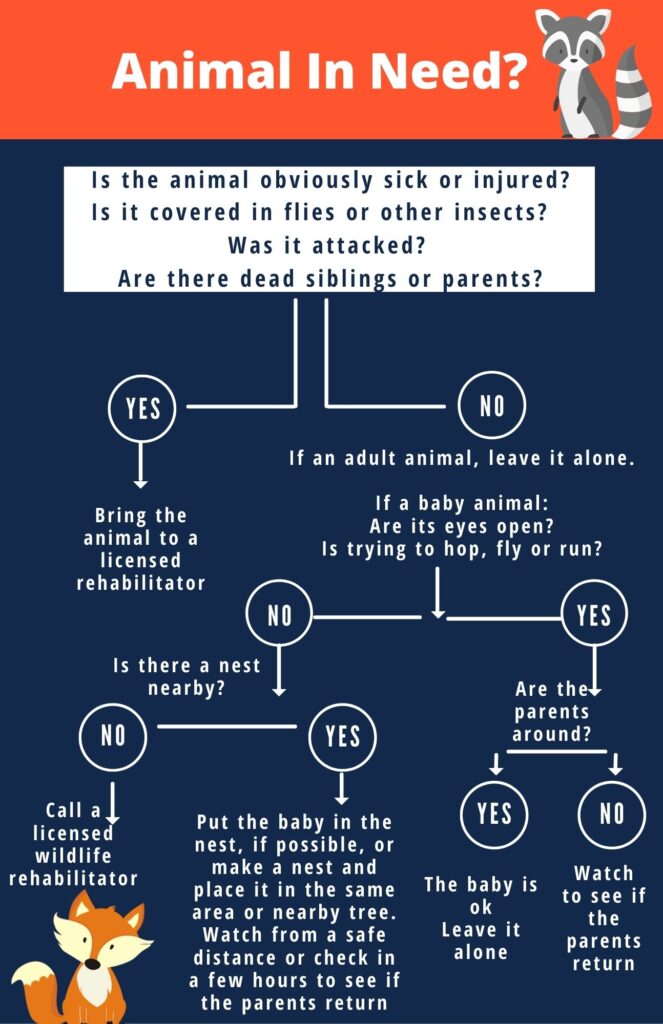
This flowchart will help you determine whether an animal needs help. Below the flowchart we list more detailed guidelines for several common Illinois species.
Considerations Before Trapping an Animal
It is illegal to possess, trap, destroy, or relocate a wild animal without a permit. If you have found an animal that needs care or have a conflict with a wild animal, contact a licensed wildlife rehabilitator in your area for help.
For a list of licensed rehabilitators in Illinois, visit the Department of Natural Resources website and search by county.
If you need assistance removing wildlife that is in danger or causing damage to your home, you can hire a Wildlife Control Operator.
Transporting an Animal in Need
Injured, sick, and orphaned wild animals must be trapped for transport to a licensed rehabilitator.
- Use caution: Do not approach a wild animal unless you are comfortable doing so, know how to handle it, and understand its defenses. All wild animals can be dangerous, even those that appear harmless or severely debilitated. An animal that bites someone may need to be euthanized for rabies testing, so take proper precautions for the safety of both you and the animal.
- Protect yourself: If the animal is small enough and safe to handle, an inexperienced person can use gloves and a towel, blanket, net, or box to catch the animal and place it in a secure container. It is important to keep the animal in a warm, dark, and quiet place to reduce the stress of capture.
- Do not feed: Feeding an injured, sick, or orphaned animal can cause severe and even life-threatening complications. Instead, bring the animal to a rehabilitator as soon as possible so it can be properly examined and treated.
- Get help: If the animal is too large, active or dangerous to handle, call a rehabilitator for help.
Will wild animals abandon their babies if touched by a human?
NO! It is NOT true that a wild mother will abandon her babies after they have been touched by humans; she will take them back!
Most baby animals are not actually in need, like many members of the public tend to think. Unless the baby is visually ill or injured, or you saw the mother get killed, oftentimes you can leave the baby where it is; we assure you that mom is properly taking care of her young!
Guidelines for Helping Select Species
Bats
Due to the risk of rabies transmission and Illinois state law, the Wildlife Medical Clinic is unable to accept bats. If you find a bat that is sick, injured, or orphaned, or are worried about rabies exposure in a human or domestic animal, notify the Department of Public Health or Animal Control in your county for direction.
For information on bats in your home, please consult Rabies and Public Health.
Procedures for bat encounters:
- Do not attempt to touch the bat with your bare hands. Bats can carry the rabies virus in their saliva, which they spread over their body during grooming. They also have extremely small teeth that do not leave marks on your skin if you are bitten.
- If you touch a bat with your bare hands, even if you did not get bitten, notify your public health department or physician immediately. You should also notify the public health department or your physician if a bat was found in a room with a pet, child, sleeping person, or non-verbal person.
- If you have found a bat and need to capture it, use very thick gloves or welding gloves to protect yourself. Pin the bat against the wall with a box or can with a lid.
- Do NOT release a bat that may have resulted in a human or domestic animal rabies exposure as your animal control or public health departments may request rabies virus testing.
Birds: Raptors, Waterfowl, and Songbirds
Sick or Injured Raptor
Assess the bird from a safe distance before trying to handle it. Because of their talons, these birds can be difficult and dangerous to handle without proper training or equipment.
If you feel comfortable catching the bird, use a large blanket or box to cover it. With a blanket, make sure to keep the bird’s head covered. Grasp the legs above the feet, if possible, wearing thick welding gloves to protect your hands. Alternatively, sometimes a very debilitated raptor can be gently pushed into a box or pet carrier with a broom.
Once you have the bird safely contained, transport it to a licensed rehabilitator as soon as possible.
If the bird is too large or dangerous to handle, call a licensed rehabilitator or local animal control agency for help.
Sick or Injured Waterfowl
ALWAYS WEAR GOOGLES when dealing with these species. Some of them—especially herons, egrets, cranes, and others with a long, pointy bill—defend themselves by pecking at the eyes of their attacker (including humans) with their bill.
Waterfowl can transmit Highly Pathogenic Avian Influenza (HPAI), or bird flu, to humans. We do not recommend the public attempt handling waterfowl such as geese, ducks, or swans. See the Illinois Department of Public Health for more information on HPAI.
Songbirds or Other Very Small Birds
Assess the bird from a safe distance before trying to handle it. If you feel comfortable catching the bird, use a small towel, pillowcase, or box to cover it. With the towel, cover the bird’s head and gently hold the wings against its body. Put the bird in a secure, dark container and transport it to a licensed rehabilitator as soon as possible.
- A bird hit my window! What should I do?
Window collisions can cause serious injuries to birds that may not always be immediately apparent, particularly to the brain, spinal cord, eyes, and shoulders. A bird that has struck a window needs to be transferred to a wildlife rehabilitator such as the Wildlife Medical Clinic as soon as possible.
Use a small towel or pillowcase to place the bird into a secure box, keep the box in a dark, quiet area, and do not offer the bird any food or water.Most importantly, prevent future bird window collisions with window decals, curtains, or screens. See the American Bird Conservancy for more tips on how to make your windows safer for birds. - There is a bird trapped inside a building! What should I do?
The best way to get a bird out of a building is to turn the lights off and open as many windows and doors as possible. Birds will fly toward the light and will often leave on their own with this technique. Chasing a flighted bird around a building will stress the bird and can even have life-threatening consequences for it. - I found a baby bird on the ground without feathers. What should I do?
Look for a nest in the area. If you find and can access the nest, return the baby to it.
If you cannot access the nest, make a replacement nest out of a plastic tub with holes in the bottom for drainage or a wicker basket and natural bedding, like dried grasses. Make sure the nest is snug around the nestling to prevent splay leg. Place the new nest in a secure, protected area as near as possible to the original nest.In either case, watch the baby from a safe distance to see if the parents return. If the baby appears sick, injured, or you find dead siblings or a dead parent in the area, bring the bird to a licensed rehabilitator. - I found a healthy, feathered baby bird on the ground. What should I do?
Young birds naturally leave the nest before they are fully flighted; they are called fledglings. These birds may spend time on the ground or on branches for several days before they are able to fly. This is a normal process, and these birds should not be rescued unless they are obviously sick, injured, or there are dead siblings or a dead parent in the area.If the baby is in danger from a car, domestic animals, or people, you can move the baby to a safer nearby area. These birds are still reliant on their parents for food and protection, so make sure the baby stays in an area where the parents will still be able to see and access it. - I found a Canada goose gosling alone.
If you find a lone gosling that appears to be healthy, try to find a pond or park containing goose families with goslings of a similar size. Distract the parents long enough to place the new gosling with the others and observe from a far-off distance. The parents should accept the new gosling as one of their own.Rarely, the adults may try to push out or attack the newcomer, in which case the gosling should be collected back up. The same process can be attempted with another goose family. If the gosling continues to be rejected by families, bring the gosling to a wildlife rehabilitator.Remember: These efforts need to be done quickly after finding the gosling or the gosling will start to imprint on humans, which would prevent the gosling from having a successful life in the wild.
Deer
Fawns are often found alone and mistaken for orphans. A mother will frequently leave her offspring hidden in some tall grass while she forages for food. This practice serves to attract less attention to the fawn, therefore decreasing the chances that a predator will find the baby.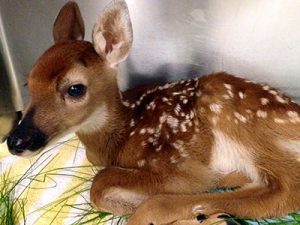
Healthy fawns left alone are typically quiet and hiding and may be alone for as long as 12 hours.
You can tell a fawn is orphaned when it is constantly crying; covered in flies, ticks, or maggots; has a dirty rear; appears emaciated (sunken eyes, dry nose); wanders aimlessly; has visible injuries; or you see a dead mother nearby.
- I found a fawn that is truly orphaned.
Use care. Deer can die easily from stress and capture, even days after the event. Fawns that try to bolt can easily break their legs or back. You could also be injured if you are kicked.Wrap the fawn in a blanket and keep it in a quiet dark area. Covering its eyes can help keep it calm.
Call or bring it to your local wildlife hospital or rehabilitation facility immediately.
Do not keep, pet, or coddle the fawn. It is illegal to keep a fawn without a permit. Fawns can become habituated to people very easily, which is dangerous to their survival as they age. - I found an injured adult deer.
DO NOT try to move it. Adults are very strong and can be aggressive; they could also be hurt even more if someone who is not trained attempts to pick them up or move them.
The Wildlife Medical Clinic is able to accept fawns ONLY if they are under 40 pounds and still have white spots.For severely injured sub-adult or adult deer, contact your local law enforcement agency or animal control.
Foxes and Coyotes, and Bobcats
Fox kits and coyote pups that appear healthy are not likely to be orphaned. Young foxes and young coyotes sometimes appear alone as they begin to come out of their dens to explore, play, and develop survival skills, but parents are usually nearby. If you are concerned about a young animal, keep an eye on it from a distance for 24 hours.
If the animal is sick or injured, call a local wildlife clinic or rehabilitation facility. Do not handle it unless absolutely necessary.
If you must handle the animal, always wear protective gloves. Do not attempt to care for the animal yourself. Young wildlife have special nutritional and caretaking needs that require a trained professional. Not only is it illegal to keep a wild animal, but cubs raised by humans do not adapt well to captivity or survive in the wild. Wild animals never make good pets.
If you see a sick or injured adult fox, coyote, bobcat, or other large predator, keep an eye on it from a distance and contact your local animal control agency immediately.
Groundhogs and Beavers
Never attempt to touch a sick or injured adult groundhog or beaver. These animals see humans as predators and will act defensively if they feel they are in danger. They have extremely strong jaws and sharp teeth, and their bites HURT!
If you find one that needs assistance, call your local wildlife rehabilitator or animal control for assistance. Keep an eye on the animal from a distance until help arrives.
Opossums
A lone baby opossum that is less than 6 inches long, not including the tail, is considered an orphan and should be brought to a licensed wildlife rehabilitator. Uninjured healthy young opossums that are longer than 6 inches from the tip of their nose to the base of their tail should be left alone, as this is the age that they naturally become independent.
If you find a dead opossum, always check for babies in the pouch. The deceased mother can be transported with her joeys in her pouch to a wildlife rehabilitator.
Rabbits (Eastern Cottontails)
Mother rabbits only visit their nests twice a day, usually at dawn and dusk. If you find a nest and want to know if the mother is still around, place yarn, ribbon, or flour in a recognizable 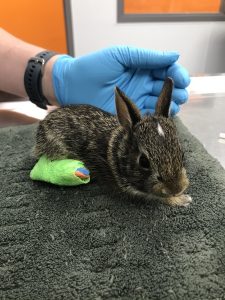 pattern around the nest. If the material has been disturbed after 12 to 24 hours, then the mother is tending to the nest.
To protect a cottontail nest against dogs or other pets, cut a couple holes (at least 3 to 4 inches in diameter) in a laundry basket and place it upside-down over the nest. Use a brick or rock to weigh the basket down. This protects the nest while still allowing the mother to tend to her offspring.
Cottontails naturally leave the nest when they are about 4 weeks old and about the size of a tennis ball. One this size or larger that has upright ears and is healthy, uninjured, and has not had an encounter with a cat or other predator, should not be captured. It is capable of surviving independently.
If you determine a cottontail is injured or truly orphaned, keep the cottontail warm and quiet. Place it in a dark, quiet box with soft material. Use a low-set heating pad (insulated) or a warm rice sock (in a separate sock/cloth) for warmth.
Do NOT feed or give water. Inappropriate food/water can be fatal. Limit handling time and bring the animal to a licensed wildlife rehabilitator as soon as possible.
Cottontails can carry the tularemia bacteria, which can infect humans. This bacteria can cause flu-like symptoms, even pneumonia; severe cases can lead to death. To prevent infection, wear light gloves when handling cottontails and wash your hands with soap and water afterwards.
Raccoons
DO NOT approach or touch adult raccoons.
Raccoons can be extremely dangerous and transmit many infectious diseases to humans and pets. Only trained professionals should handle them.
Raccoons that exhibit abnormal behavior such as circling, lethargy, tremors, or disorientation may have canine distemper virus or rabies. Call animal control immediately if you see these behaviors.
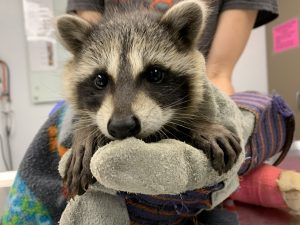
Raccoons have strong maternal instincts and rarely orphan their young. If you find a den of healthy baby raccoons, please leave them be; their mother is likely to return. If you find a raccoon kit that is obviously ill or injured, contact a rehabilitator.
- I need to relocate raccoons nesting under my house.
DO NOT attempt to capture and relocate the babies yourself. Place lights and a radio in the nesting site. These disruptions will typically encourage the mother to relocate her young herself. Once she has removed all the babies, seal up the entrance so they cannot return.
Reptiles and Amphibians
Snakes
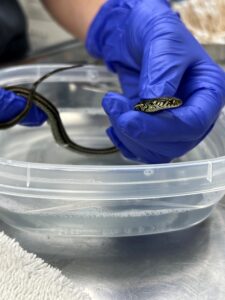 Snakes are cold-blooded and require a heat source to maintain body temperature. During the cold months, snakes go into a hibernation state called brumation. Any snake found during the winter, especially when there is snow cover, has compromised health and should be brought to your local wildlife clinic or rehabilitation facility for treatment.
Caution must be exercised when dealing with snakes, as there are venomous species in Illinois. All, with the exception of the Eastern Massasauga, live in the southern third of the state.
Turtles
Turtles are often the victims of vehicular trauma. In addition to being hit by a car, turtles may need care if they have abnormal or asymmetric swellings on their head; eroded or discolored shell; or nasal or oral discharge. If you find an ill or injured turtle, bring it to a licensed wildlife rehabilitator as soon as possible.
Mother turtles leave the area after laying her eggs and the babies live independently from the time they hatch. If you find a young turtle with no injuries or abnormalities, leave it alone.
NEVER attempt to relocate a turtle. Turtles have strong homing instincts and distinct home ranges, so moving them causes extreme stress, disorientation, and a high risk of death as they try to find their way back. Relocating them can also introduce diseases into new populations, disrupting local ecosystems.
However, if you see an uninjured turtle attempting to cross a road, you should move the turtle to the side of the road in the direction it was facing, if it is safe for you to do so.
Native wild turtles should never be kept as pets. They have complex needs and removing them from the wild reduces breeding populations.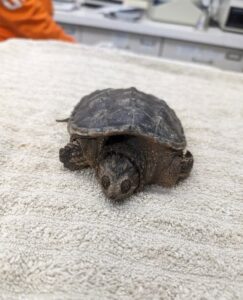
Skunks
Never handle skunks, regardless of age. While not all skunks carry rabies, skunks are a common rabies vector species in Illinois.
Due to Illinois state law, the Wildlife Medical Clinic is unable to accept skunks. If you notice a skunk that needs medical attention, please call your local animal control or state wildlife agency.
- I have skunks nesting under my house.
DO NOT attempt to capture and relocate the babies yourself. Ideally, wait until the babies have grown and left and then seal up the entrance so they cannot return. If you need to encourage them to leave sooner, place lights and a radio in the nesting site. These disruptions will typically encourage the mother to relocate her young herself. Once she has removed all the babies, seal up the entrance so they cannot return.
Squirrels
If you find a baby squirrel that has fallen out of the tree, you can place the baby back into the nest, if possible. If that is not possible, put the
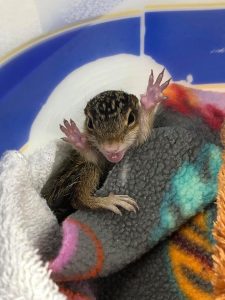
baby in a box or basket elevated off the ground at the base of the nearest tree.
Female squirrels typically have a back-up nest, so even if a nest was destroyed, the babies can often be reunited with their mother and she will carry them to another nest.
Keep people and animals away from the baby and give the mother at least 6 to 8 daylight hours to claim it. If unclaimed by nighttime, the baby squirrel can be housed overnight in a warm, quiet location until reuniting can be attempted during the day.
If the baby is cold, put a warm water bottle or warm rice sock in the box, using a small cloth to make a barrier between the heat source and the baby to prevent burns.
Adult squirrels have a very dangerous bite. Reach out to your local animal control or wildlife rehabilitator for assistance before attempting to capture an adult squirrel.