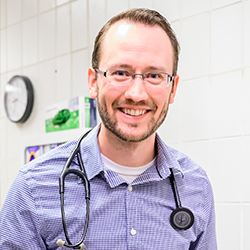
Assistant Professor
Dr. Matthew Berry is a board-certified veterinary medical oncologist and clinician-scientist who joined the faculty at the University of Illinois Urbana-Champaign (U. of I.) in 2023. His clinical and research interests focus on addressing practical questions in everyday oncologic practice and advancing the clinical application of novel immunotherapy platforms. Dr. Berry is an active member of the oncology clinical trials team, where he serves as a principal investigator on multiple studies. In his clinical teaching, he emphasizes a general practice-oriented approach, helping students develop diagnostic and treatment plans that align with real-world clinical decision-making, including when to pursue additional testing, when to refer, and how to guide pet owner discussions regarding specialty oncology care.
Cytology Workshop with Dr. Joanna Schmit (2 Hours)
This interactive workshop, led by Drs. Berry and Schmit, is designed to help general practitioners confidently use cytology to guide real-time clinical decision-making.
- The first hour will focus on slide preparation and specimen adequacy, where participants will practice the U of I oncology approach to creating multiple slides from a single aspirate while minimizing cellular damage. Emphasis will be placed on recognizing diagnostic versus non-diagnostic samples and how initial cytologic screening can influence immediate clinical decisions.
- The second hour will consist of case-based discussion using digital slides, allowing participants to differentiate inflammatory versus neoplastic processes, recognize key cytologic features, and apply a structured framework to determine when to treat, pursue additional diagnostics, or stage and submit for interpretation. Group discussion will reinforce a practical, repeatable approach that can be immediately applied in everyday practice.
Note: If you are interested in this session, we encourage you to bring a laptop or tablet to allow easy viewing of slide images.
Mast Cell Tumors: Practical Diagnosis, Treatment, and Grading
This session, led by Dr. Berry, will provide practical updates on the diagnosis and management of canine mast cell tumors, with a focus on clinical decision-making in general practice. The first portion will review key diagnostic considerations, clinical features, and staging strategies, including guidance on when it is appropriate to proceed with excision without full staging. The second portion will focus on intra-tumoral therapy (focus on Stelfonta), including case selection, expected outcomes, and management of post-treatment sites. The final portion will review histologic grading for cutaneous versus subcutaneous tumors and outline our clinical stance regarding cytologic grading. Case-based discussions will be incorporated throughout to provide a practical framework for diagnosis, treatment, and referral decisions.
Canine Lymphoma: Molecular Diagnostics, Treatment Updates, & Antibodies
This session, led by Dr. Berry, will provide practical updates on the diagnosis and management of canine lymphoma, with a focus on what is most relevant to general practice. The first portion will review the diagnostic approach to lymphoma, with emphasis on the clinical utility of PARR and flow cytometry. The second portion will highlight current treatment updates, including the use of Laverdia and Tanovea. The final portion will introduce monoclonal antibody-based therapies targeting CD19 and CD20, with emphasis on their re-emerging role and potential applications in clinical practice. Case-based discussion will be used throughout to reinforce practical application in diagnosis, treatment planning, and referral.