
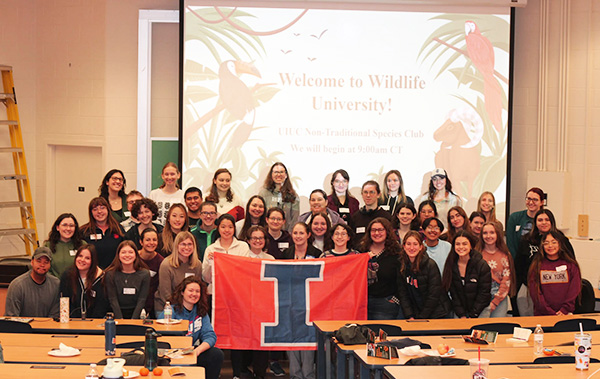
The Wild Minds Veterinary Symposium (WMVS) is an annual symposium hosted by the Non-Traditional Species (NTS) Club at the University of Illinois College of Veterinary Medicine. This student-organized conference is dedicated to inspiring and educating those interested in zoological/wildlife medicine, research, and conservation. The symposium is open to all students and pre-professionals and will be held in-person with a virtual option.
Schedule
Times are listed in central time zone.
Saturday, January 31, 2026
- 9 a.m. – Registration and Snacks
- 10 a.m. – One Health Discussion of Mississippi River Basin Tragedy and Dolphin Health
Dr. Debra Moore - 11 a.m. – Herptile Handling, Examination, and Clinical Techniques
Dr. Laura Adamovicz - 12 p.m. – Lunch Break
- 1 p.m. – Conservation and Wildlife Medicine in Belize
Dr. Isabelle Paquet-Durand - 2 p.m. – Elasmobranchs 101: Introduction to Medicine of Cartilaginous Fish
Dr. Kelsey Ryan - 3 p.m. – Penguin Medicine and Conservation
Dr. Sam Sander - 4 p.m. – Break
- 4:15 – 5:30 p.m. – Panel Discussion: Career Paths in Wildlife/Zoological Veterinary Medicine
Dr. Sam Sander
Dr. Kelsey Ryan
Dr. Laura Adamovicz
Sunday, February 1, 2026
- 8 a.m. – Reptile Radiology Cases
Dr. Judilee Marrow - 9 a.m. – Establishment of the Wildlife Epidemiology Lab and Reaching your Veterinary Aspirations
Dr. Matthew Allender - 10 a.m. – Great Ape Medicine and Conservation
Dr. Karen Terio - 11 a.m. – Practical Avian Blood Transfusion Medicine
Dr. Stephany Lewis - 12 – 1:30 p.m. – Lunch and Trivia
- 1:40 – 3:40 p.m. – Avian Evisceration Wet Lab (Ticketed In-Person Lab, University of Illinois Students Prioritized – Maximum: 25)
Dr. Stephany Lewis
SPEAKERS
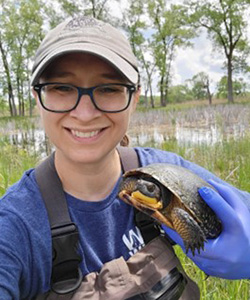
Dr. Laura Adamovicz
Dr. Laura Adamovicz received her BA in Biology and Biochemistry from St. Mary’s College of Maryland in 2008 and her DVM from the University of Virginia-Maryland Regional College of Veterinary Medicine in 2012. She completed internships in small animal medicine and surgery at VCA Veterinary Referral Associates, and exotic animal medicine and surgery at NC State College of Veterinary Medicine. She earned a PhD in Epidemiology at the University of Illinois in 2019 focusing on modeling the health of free-ranging herptiles. After completing her PhD, Dr. Adamovicz remained at the University of Illinois first as a postdoctoral researcher and subsequently Research Scientist for the Wildlife Epidemiology section of the University of Illinois’s Veterinary Diagnostic Laboratory. Recently, Dr. Adamovicz has transitioned to the role of Clinical Assistant Professor in the Department of Veterinary Clinical Medicine, and she also serves as the Co-Director for the Wildlife Epidemiology Laboratory. Dr. Adamovicz has authored numerous publications, books, and is an active member of the WDA, ARAV, AAWV, and AAVLD. Her research focuses on understanding health and disease in reptiles and amphibians, enhancing diagnostic medicine in these taxa, and finding ways to support healthy, sustainable wildlife populations. Through partnerships with multiple academic, zoologic, and conservation organizations, her work touches on the health of multiple species including invertebrates, fish, amphibians, reptiles, birds, elephants, pangolins, and orcas.
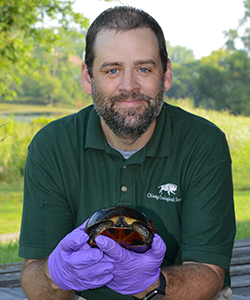
Dr. Matthew Allender
Dr. Matthew Allender received his Bachelors of Science degree in Ecology, Ethology, and Evolution prior to completing veterinary school at the University of Illinois in 2004. He was in small animal practice for two years while completing a Masters of Science focusing on Conservation Medicine. Dr. Allender then went on to complete a three-year residency in Zoological Medicine at the University of Tennessee and Knoxville Zoo before finally returning to the University of Illinois to join the faculty in 2009. Concurrently, he completed a PhD in Wildlife Epidemiology investigating ranavirus in free-ranging chelonians in the U.S. Since that time, he has taught, provided clinical service, and performed research in the epidemiology of infectious and non-infectious diseases of free-ranging and managed wildlife. Currently, Dr. Allender is in a joint position as the Director of the Wildlife Epidemiology Lab at the University of Illinois and Director of Conservation Medicine and Science at Brookfield Zoo Chicago. He has authored/co-authored over 200 peer-reviewed articles and 250 national presentations on wildlife and zoological medicine.
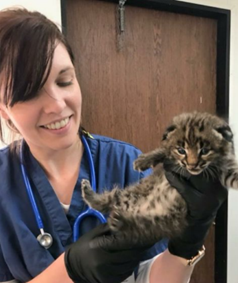
Dr. Stephany Lewis
Originally from New Jersey, Dr. Stephany Lewis has been involved in wildlife rehabilitation since 2009. She received her DVM from Tufts University in 2015 and completed an internship in small animal medicine and surgery at Michigan State University. She then completed a 1-year internship in wildlife and conservation medicine at Tufts Wildlife Clinic in 2017. She has worked as the full-time staff veterinarian at California Wildlife Center and Ojai Raptor Center and is currently Clinical Assistant Professor and Director of the Wildlife Medical Clinic at the University of Illinois College of Veterinary Medicine. Dr. Lewis is a Certified Wildlife Rehabilitator by the International Wildlife Rehabilitation Council. In 2023 she became board certified in Avian Practice by the American Board of Veterinary Practitioners.
Within wildlife and zoo med, Dr. Lewis’s special interests are wildlife rehabilitation, avian orthopedics, anticoagulant rodenticide toxicosis, and anxiolytics. When she’s not at work, chances are that Dr. Lewis is at home or at the barn with her 4 dogs, 6 chickens, and a horse!
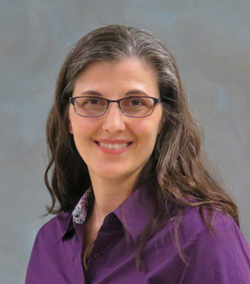 Dr. Judilee Marrow
From San Diego, California, Dr. Judilee Marrow had always been interested in zoological species and wanted to become a zoo veterinarian. While she was a vet student at the University of Illinois, she was involved in the Wildlife Medical Clinic, summer research on wildlife, and offsite zoo rotations. After graduation, she completed a rotating internship in Chicago, a zoo specialty internship at Kansas State University, and her residency training at the Smithsonian’s National Zoo in Washington, D.C. Upon becoming board certified, she worked as a solo vet at a small AZA zoo in Michigan before moving to the Houston Zoo in 2016. In 2022, she was excited to come back to University of Illinois to focus on teaching and research, while continuing to practice zoological medicine.
In her free time, Dr. Marrow enjoys baking and gardening. A word of wisdom from Dr. Marrow is, “I am a strong believer that in life things happen for a reason. Sometimes it is hard to see what that path is but stick with it! It is amazing on the other side.”
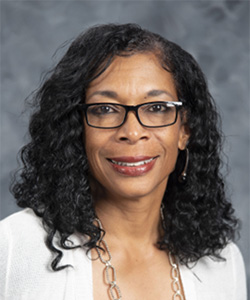 Dr. Debra Moore
Dr. Debra Moore is an Assistant Clinical Professor in the Department of Pathobiology and Population Medicine at Mississippi State University, where she plays a leading role in the Gulf Coast Aquatic Health Lab. She provides critical veterinary care for stranded sea turtles, leads necropsies, guides rehabilitation and release efforts, and more. Dr. Moore earned her DVM from Tuskegee University in 1987, after completing her BS in Animal & Poultry Sciences there in 1981. Before joining academia, she ran a mixed-animal veterinary practice and worked closely with marine species in her role as consulting veterinarian for the Institute for Marine Mammal Studies (IMMS), where she managed health care for dolphins, sea turtles, sea lions, and more. In her academic role, Dr. Moore is also a deeply committed mentor, supervising veterinary students during their externships at IMMS and supporting their research through the Veterinary Medical Scholars Research Program. Her research includes examining environmental contaminants, such as microplastics and PFAS, in marine species, bridging animal health, conservation, and one-health principles.
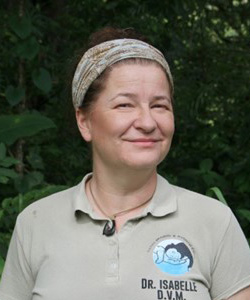 Dr. Isabelle Paquet-Durand
Dr. Isabelle Paquet-Durand is a wildlife veterinarian, educator, and conservation leader with over three decades of experience working throughout Latin America, the Caribbean, Europe, and the United States. She is the Co-Founder and Director of the Belize Wildlife and Referral Clinic (BWRC), where she has led national efforts in wildlife rescue, rehabilitation, and conservation medicine since 2011. With a PhD in Parasitology, Epidemiology, and Public Health and a DVM from the School of Veterinary Medicine in Hanover, Germany, she specializes in wildlife diseases, zoonotic pathogens, parasitology, distance anesthesia, orthopedic and soft tissue surgery, and the rehabilitation of neotropical species.
A Certified Wildlife Rehabilitator and long-time educator, Dr. Paquet-Durand has spent 25 years training veterinary students, wildlife professionals, and community partners. She lectures for Purdue University’s Wildlife Medicine and Conservation Certificate Program and collaborates with institutions such as the University of Minnesota, Texas A&M, and Mercy College. Her work extends beyond clinical care to national capacity building, including service on Belize’s Jaguar and Avian Working Groups, the National One Health Committee, and the Veterinary Surgeons Board of Belize. She has also supported major conservation initiatives such as the Scarlet Macaw in-situ program and Hickatee turtle conservation.
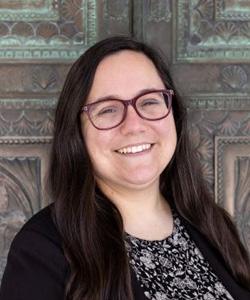 Dr. Kelsey Ryan
Dr. Kelsey Ryan (Trumpp) is currently an associate veterinarian at Shedd Aquarium in Chicago, Illinois. Prior to joining the Animal Health team at Shedd in August of 2025, she completed a Zoological Medicine & Surgery Residency through the University of Georgia, Zoo Atlanta, and Georgia Aquarium. While at UGA Dr. Ryan also earned a Master of Science degree in Comparative Biomedical Sciences. Prior to her residency Dr. Ryan completed Small Animal Rotating and Zoological Medicine Internships at the University of Illinois. She graduated with her DVM from Purdue University in 2019.
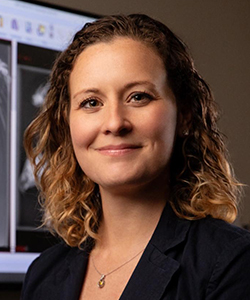 Dr. Samantha Sander
Originally from Illinois, Dr. Sander completed her undergraduate and vet school degrees here at the University of Illinois. She completed her zoo med residency at the Smithsonian’s National Zoological Park in Washington, D.C. and later served as an associate veterinarian at the Maryland Zoo in Baltimore. She later joined our school faculty in 2018. Since returning to her alma mater, Dr. Sander has held many positions and currently serves as a Zoo Med Clinical Professor and Head of the Zoo Ambulatory Service as well as a veterinary advisor for the African Penguin SSP and Penguin TAG, and USDA vet on record for the Scovill, Miller Park, and Peoria Zoos.
As you may be able to tell by her work, Dr. Sander’s favorite special interests within zoo med are penguins. Nonetheless, her favorite wild animal is the cheetah! If Vet Med ever held a talent show, Dr. Sander’s talent would consist of reciting song lyrics.
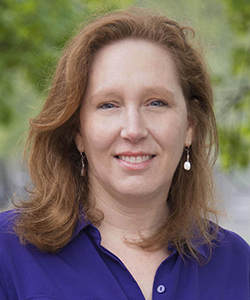 Dr. Karen Terio
Dr. Karen Terio earned her DVM from Tufts University, PhD from the University of California and completed a residency in anatomic pathology in a joint program between the University of California, Davis and San Diego Zoo. She became a Diplomate of the American College of Veterinary Pathologists in 2002. She is currently a full professor and Chief of Staff with the University of Illinois, College of Veterinary Medicine, Zoological Pathology Program (ZPP) and Interim Assistant Director of the University of Illinois Veterinary Diagnostic Laboratory. With colleagues at ZPP, she provides comprehensive pathology diagnostic services to zoological institutions as well as to local, national and international wildlife agencies and conservation programs. She is co-editor of the textbook “Pathology of Wildlife and Zoo Animals” published by Elsevier Academic Press the first edition of which received the 2019 PROSE award for a Textbook in the Biological and Life Sciences.
Registration
The early registration deadline is Friday, January 16, 2026. Registrations after this date will be charged the full registration fee.
Registration will close on Friday, February 23, at 5 p.m. (central time). Early registration is recommended.
Registration Rates:
- Early-Bird Rates (on or before January 16):
- NTS Member Registrant: $35
- Non-NTS Registrant: $45
- Standard Rates (after January 16):
- NTS Member Registrant: $50
- Non-NTS Registrant: $65
- $20 – Wet lab (In-person only, University of Illinois Students Prioritized – Maximum: 25 Participants)
Cancellation Policy
Written cancellation should be sent to illini.nts@gmail.com by January 16, 2026. A $10 cancellation fee will apply for cancellations that include a ticket to the wet lab. Registrations are transferable. After the cancellation deadline, refunds will not be made. We reserve the right to cancel sessions and to change speakers, if necessary. In the event of cancellation, all registrants will receive a full refund. The University is not responsible for expenses in the event of a cancellation or date change.
Questions, email the University of Illinois Non-Traditional Species Club at illini.nts@gmail.com.