Eastern Box Turtle 25-611
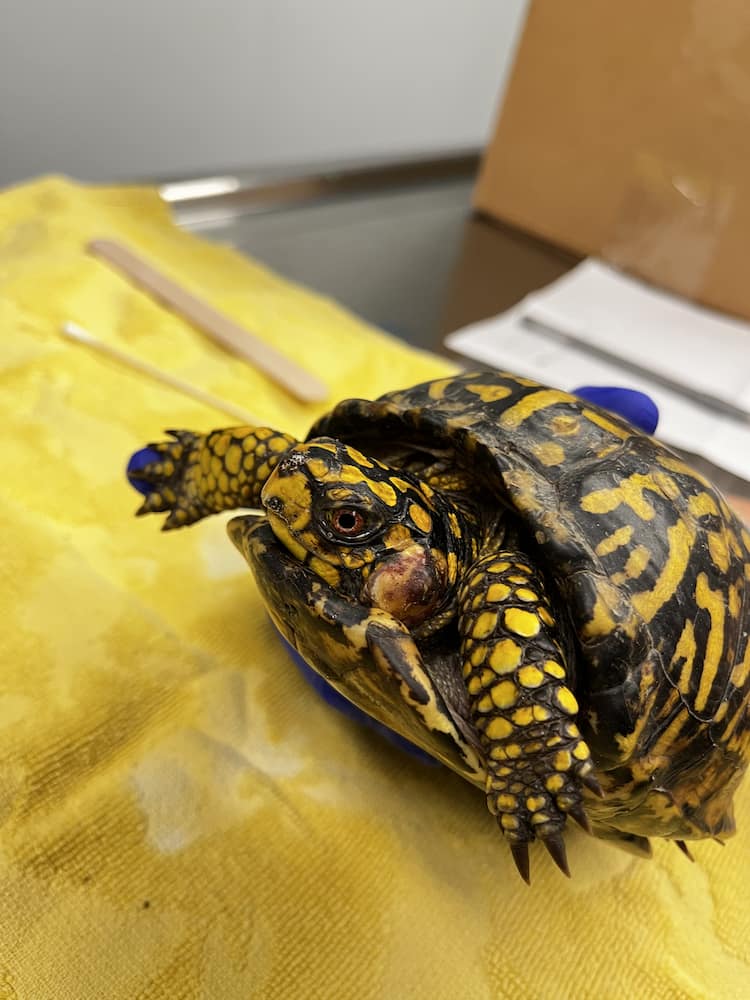
Meet 25-611, a male eastern box turtle. He came to us with an aural abscess–an issue commonly seen with turtles of multiple species, as well as some early warning signs of respiratory issues. Fun fact: the word “aural” means related to the ears, though it is pronounced almost identically to “oral”, which can cause confusion.
After spending a bit of time with us, it became obvious that this turtle was dealing with a serious respiratory infection. He was intermittently struggling to breathe, and symptoms were exacerbated when he was not at rest. Further evaluation was conducted with radiographs of his lungs, which showed signs of pneumonia.
Before we could fix his ear, we had to address his respiratory infection. He was started on a protocol of antibiotics and pain medication. After about two weeks on medication, we saw some improvement. However, discharge was seen coming from his left nare and eye, which indicated there was a blockage on that side called a rhinolith. Once he was stable enough for anesthesia, we were able to surgically remove the rhinolith along with the aural abscess.
So What’s Up with Aural Abscesses?
Aural abscesses in turtles happen when the turtle doesn’t get enough Vitamin A over a long period of time. Both wild and captive turtles get their Vitamin A from what they eat, but wild turtles don’t get vitamin supplements the way a pet might. When they develop a Vitamin A deficiency, their skin and mucus membranes near the ear start to change. The tissue overgrows and transforms into big clumps of dead cells that eventually become infected, interfere with the tympanum (the eardrum), and can even erode bone.
Once an aural abscess forms, it isn’t considered an emergency on its own, but it does require surgery to fix. Ongoing care is also needed to manage pain, treat any remaining infection, and possibly provide nutritional support.
Not Out of the Woods…
Luckily, 25-611’s aural abscess wasn’t particularly severe or complicated, and his surgery went well. Unfortunately, the surgery did not resolve all his issues. For a while, it looked like he was better. With his ear fixed and healing, his nose unplugged, and support from antibiotics, he gained weight and was breathing more normally.
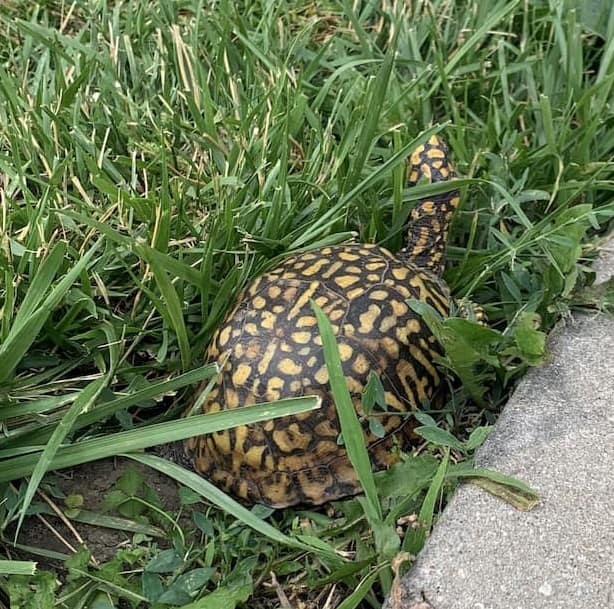
In August, after two months, his lungs looked clear on imaging and his clinical signs had improved so much that he was taken off of medication entirely. Two weeks later, he was given one final check and appeared to have completely recovered from his pneumonia, so he was approved for release. Unfortunately, on the very same day that we planned to release him back to his home, his respiratory signs returned.
Strangely, though, they were a bit different this time. His x-ray images still showed that he was free of pneumonia, but his breathing would still intermittently be heavy, especially after exercise. We placed him back on two different antibiotics, and also pursued more aggressive diagnostics. We performed a lung wash, where a small amount of fluid is used to collect a liquid sample of whatever germs may be in the lungs. We also did a test for several important turtle pathogens. None of these provided any answers.
25-611 improved greatly and was off antibiotics, but release was not an option regardless as it was too late in the season and he would need to be overwintered and released in the spring when temperatures warmed up. We decided to proceed with high resolution CT imaging to confirm the pneumonia had cleared up and just to make sure there wasn’t anything that simple x-rays might have missed. Nothing new was found on the CT scan so we continued with the supportive care and closely monitored him over the winter months.
Approved for Release
Over the winter, 25-611 continued to improve and his appetite and weight increased and no further respiratory issues were noted. We just needed the temperatures to increase and stay consistent so 25-611 could be released back into the wild. After nearly a year in our care, patient 25-611 had a clean bill of health, was in great body condition, and the weather was finally suitable for release back into the wild!
Written By: Alex W., Class of 2028