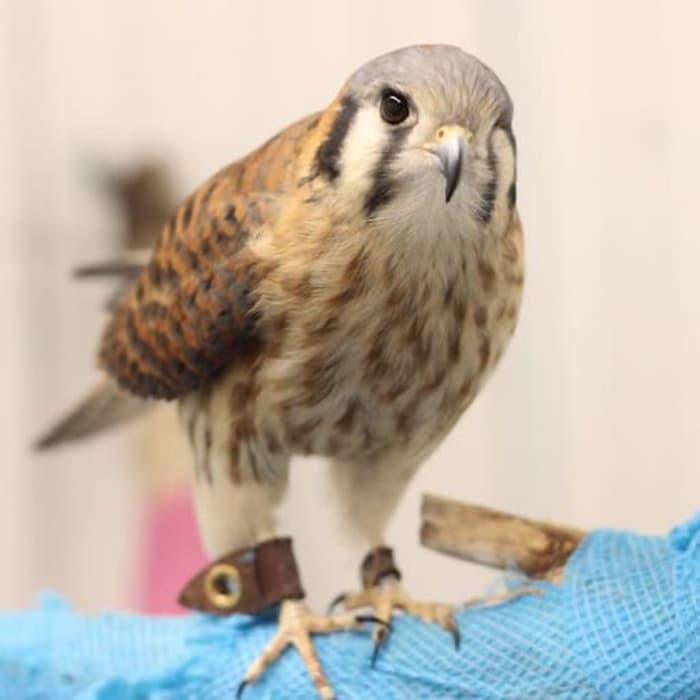
Species: American kestrel (Falco sparverius)
Intake Date: Summer 2012
Thistle was our resident American Kestrel (Falco sparverius), found in Allerton, Ill. She was presented to the Wildlife Medical Clinic as a juvenile with a corneal perforation injury in her left eye during the summer of 2012. Veterinarians attempted to save her left eye, but the injury unfortunately rendered her blind in that eye—leaving Thistle with only one working eye. Unlike owls, which rely heavily on their hearing to hunt, falcons (the family which kestrels are a part of) rely on their eyesight to hunt; therefore, Thistle could no longer survive in the wild, so the Wildlife Medical Clinic received permission for Thistle to join our ambassador program. Thistle was extremely curious and interactive; everything was a toy in Thistle’s eyes! She loved watching clinic members, participating in her daily training and enrichment plans, and having new objects put in her enclosure. Thistle was a delight to work with and touched the lives of many students, faculty, staff, and visitors during her eleven years at the Wildlife Medical Clinic and will be greatly missed.
Fun Facts
American Kestrels are the smallest falcons of North America, but don’t let their size fool you—they are extremely fierce hunters! American Kestrels are sexually dimorphic, meaning that you can physically see the differences between males and females. We know that Thistle was a female due to her rusty-red coloring, whereas males typically have much more silvery-blue coloring throughout their feathers. Both sexes have black vertical bars on their face termed “sideburns”, which help deflect the sun’s rays during flight. In addition to having extremely sharp vision, falcons can also see more colors than humans, and can even see the ultraviolet color spectrum!