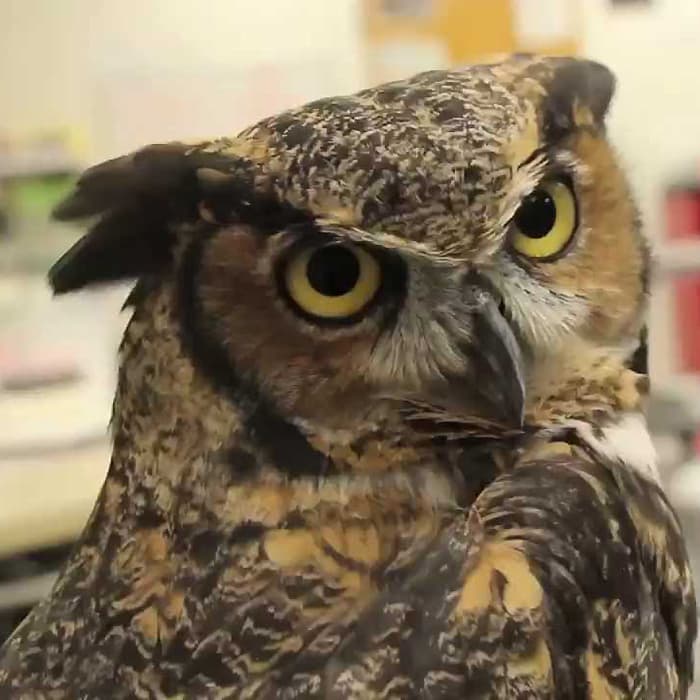
Species: Great horned owl (Bubo virginianus)
Intake Date: April 2003
Nokomis was a wonderful addition to our Education and Outreach Program for 12 years. During his time with us, Nokomis taught a countless number of children and adults about the importance of wildlife and nature. In April 2003, a local wildlife rehabilitator brought a Great-Horned Owl fledgling, who could not fly, to the Wildlife Medical Clinic. Radiographs revealed a broken right humerus, the largest of the wing bones. Shortly after his arrival, Nokomis underwent surgery to repair his fractured wing. Metal pins were inserted into the bone fragments to hold them in place, and an external fixator was placed on the outside of the body in order to stabilize the pins. He was given antibiotics and physical therapy, and recovered well enough to be sent to a wildlife rehabilitator. However, the rehabilitator sent him back to our clinic for two reasons: firstly, because his right wing was still drooping, and secondly, because he had an unusually docile demeanor for a Great-Horned Owl. Normally, Great-Horned Owls are very aggressive; they will clack their beaks and hiss when they feel threatened, and readily use their beaks and talons to defend themselves. As Great-Horned Owls are an incredibly territorial species, they must be aggressive to defend their hunting grounds. However, Nokomis was very docile—quite an unusual occurrence for a Great-Horned Owl. He was very curious from the start and loved to watch everything that happened in the clinic from his perch. He became one of our ambassadors after it was determined that his behavior would not allow him to survive in the wild, and he served as a beautiful ambassador for his species during his time here at the Wildlife Medical Clinic. Unfortunately, Nokomis passed away on March 13, 2015. He will be greatly missed.
Fun Facts
Great-Horned Owls are extremely fierce predators. When clenching their talons, an equivalent to 28 pounds is required to open them! They are covered in extremely soft feathers that not only help camouflage and insulate them, but also help them fly nearly silently when pursuing prey. The ‘ear tufts’ on their head are not ears, and are solely display feathers. Owls rely on their incredible hearing to hunt, and actually have misaligned ears (one ear is higher than the other), which allow the owl to obtain a mental picture of the exact location of its prey before swooping down to catch it.