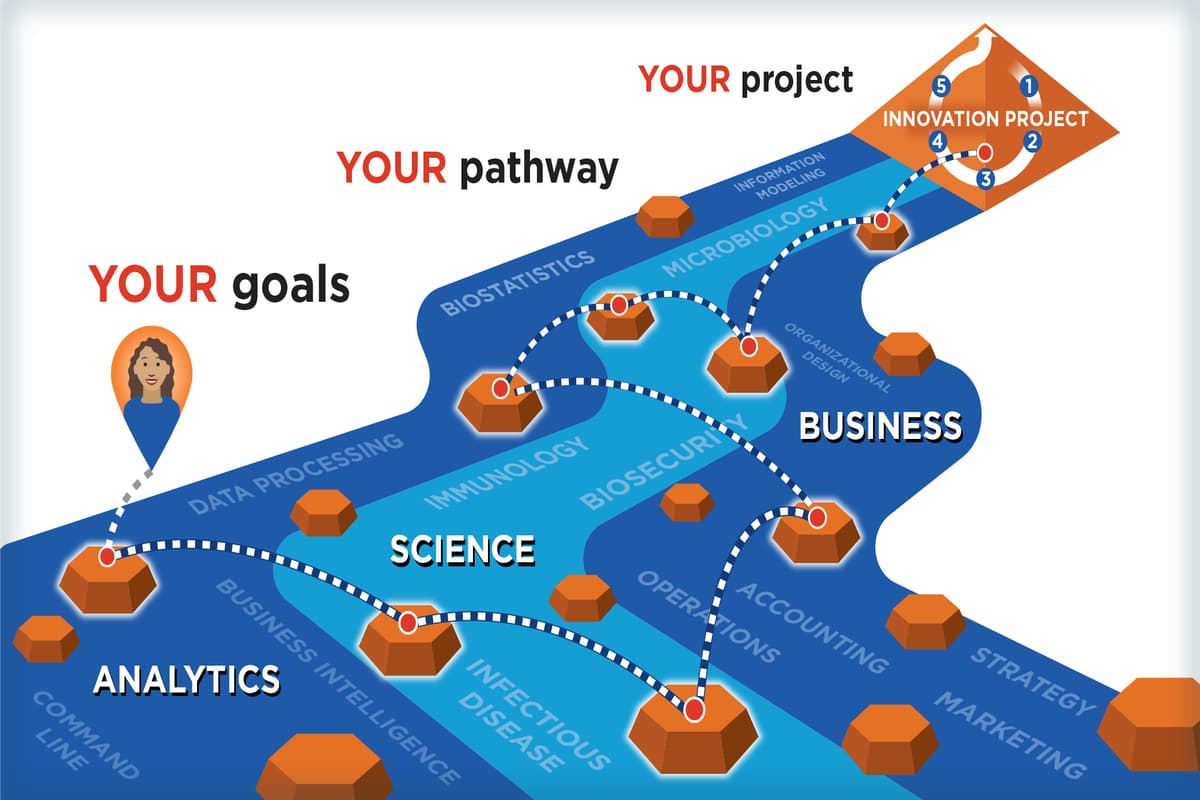
The Master of Veterinary Science degree provides students with a comprehensive and flexible program of interdisciplinary elective courses. The degree is designed to support animal health professionals at career stages in advancing to the next level. An essential component of the MVS curriculum is the Capstone course where students perform extensive research on a real-world problem through a rigorous series of checkpoints.
Dr. Katherine Rutherford, an instructor for the MVS program who has overseen this past Capstone series, spoke on what students should expect and take away from their work in the two-semester-long project: “The Capstone course is an opportunity for students to have a research design challenge that lets them further develop a lot of different skills they have been learning and working on as they’ve moved through the MVS program.” Students begin by choosing a specific problem or challenge and then walk it through a structured, problem-solving tool that helps identify root causes, scope, and possible solutions. The last two iterations of the capstone project were delivered using the human-centered design (HCD) thinking process in collaboration with the University’s Siebel Center for Design. Siebel Center for Design has done a great amount of work integrating HCD into curriculums to create unique opportunities for students to design solutions to complex problems.
The purpose of completing a capstone project is for students to harness their creativity and innovation by integrating theory, practical experience, research, data collection, analytical skills, and critical thinking into solving a real-world problem. Typically, students pursue a Master of Veterinary Science because they want to acquire knowledge and build up skills that help advance their careers. The capstone project is a way for each student to showcase what they learned to help move them forward.
HCD unfolds through multiple phases: understand, synthesize, ideate, prototype, and implement which are done in an iterative process. Students learn how to define the problem, identify the root cause, have empathy for the end-user, and brainstorm solutions. The capstone is a challenge for the students to apply the critical thinking skills developed in the degree program and HCD is the vehicle used to help them through the project. Project final deliverables vary based on the project. While some projects will make it to prototyping and implementation, others will only utilize the first three phases of HCD (understand, synthesize, and ideate).
The Master of Veterinary Science degree program allows for a customized curriculum based on the individual’s knowledge, skills, and abilities. A student who has 25 years of experience in the animal health industry will most likely need a project different than a student who is just entering the workforce.
Students research their problem through literature reviews, stakeholder interviews, sampling, and process mapping before they reach the ideate phase where they explore possible conclusions. Rutherford emphasizes that the Capstone isn’t just about these technical components, but it’s about “getting out there and talking to people… That’s part of the human-centered part of this [design-thinking]. We want to be empathetic and focused on the humans involved in these problems as well.”
After critically evaluating each of their potential solutions from many different criteria, students will measure the feasibility of putting their solution into action and what it may look like for an entity to implement in real life. This helps in narrowing down their solution to be real-world applicable. The result of this process is students developing and transforming their problem-solving skills while applying their knowledge to an issue in veterinary medicine.
Applying problem-solving techniques to design solutions for complex problems is a key learning objective for the MVS degree program. However, it doesn’t stop there. One of the most important skills a professional can develop is the ability to communicate. Throughout the degree program and capstone project, students are challenged to communicate their project concisely and efficiently to stakeholders by distilling the problem into one problem statement, synthesizing the data collected, and proposing solutions through presentations. Several students in the program choose a problem within their workplace for their capstone project while others work in a group to solve a provided problem. The value students receive from the degree program is their confidence in using these skills and tools in the workforce and in their final deliverables to showcase their abilities.
Students working in a group were intentionally organized into teams, all with diverse backgrounds to mimic real-life workplace culture. In organizing students into teams, they could work more efficiently and balance the workload the project demands. Rutherford adds, “You are also going to be much more creative and successful in finding your optimal solution when you’ve got more brains working on a problem.”
“You are also going to be much more creative and successful in finding your optimal solution when you’ve got more brains working on a problem.”
Dr. Kate Rutherford
Andrew Johnson, a student who participated in the Capstone series this past year, began the MVS program immediately after completing his MBA in Accountancy at U of I. His project focused on job satisfaction and the lack of employees in veterinary clinics from his customer base in downstate Illinois.
Andrew works in pharmaceutical sales where he interacts with veterinarians across Illinois. “In my field, we work in teams,” he says. “Whether in person or virtual, via Teams or Zoom, this is just how business is conducted now–in groups.” Time management and communication are his most refined skills from working on the Capstone project.
Much of the project demands students to take control of their own learning experience. In doing so, they learn the value of hitting deadlines, peer reviewing, and working closely with their classmates, both within and outside their assigned teams. “I learned as much from my classmates as I may have learned from instructors”, Andrew says. He adds, “I learned a lot about the way people are practicing medicine and animal husbandry from some of my classmates.” This opportunity to learn from peers provides students with a richer educational experience that goes beyond the scope of the Capstone project itself.
The MVS program, and specifically the Capstone, aims to equip students with a skill set that will best serve them throughout their careers. Students completing this program will learn valuable, problem-solving applications, and communication skills.
To learn more about the Capstone and MVS program, click here.
Return to News and Media