

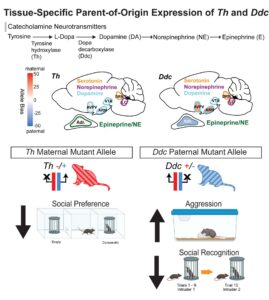
Lab Members Recognized at the 2026 Society for Behavioral Neuroendocrinlogy Annual Meeting
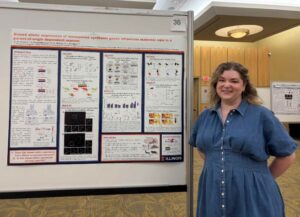
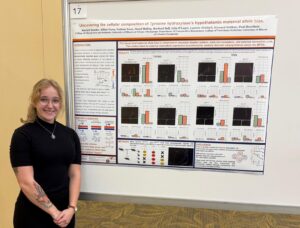
Lab Members Recognized at the 2026 Society for Behavioral Neuroendocrinology Annual Meeting
Congratulations to our lab members for their outstanding contributions at the 30th Annual Meeting of the Society for Behavioral Neuroendocrinology (SBN), held in Niagara Falls, New York, July 8–11, 2026. The annual meeting brings together researchers from around the world to share advances in behavioral neuroendocrinology.
Erin O’Leary, a Neuroscience Graduate Student, received the Best Graduate Abstract and Poster Award for her poster, “Biased Allelic Expression of Monoamine Synthesis Genes Influences Maternal Care in a Parent-of-Origin-Dependent Manner.” This award recognizes the outstanding quality of Erin’s research.
Rachel Bender also presented her research at the meeting with a poster titled “Uncovering the Cellular Composition of Tyrosine Hydroxylase’s Hypothalamic Maternal Allele Bias.” Her work highlights ongoing efforts
We congratulate Erin on this well-deserved recognition and Rachel on a successful inaugural showing at the meeting. We are proud to see the Bonthuis Lab research selected at this international science meeting validating the exceptional quality and impact of our research.
Researchers Receive $2.7M NIH Grant to Investigate Effects of Phthalate Exposure on Neurodevelopment and Autism
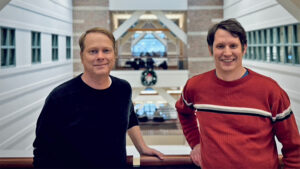
January 8,2026
NIH has awarded $2.7 million to University of Illinois researchers Howard Gritton, Paul Bonthuis, and Jozien Goense to study how environmental exposures influence brain development and autism-related behaviors. Building on preliminary findings from a Beckman Institute seed grant, the project combines neuroimaging and animal models to uncover mechanisms linking phthalate exposure to autism risk. Read more from the published article on College of Veterinary Sciences Comparative Biosciences News
April 2025- Erin O’Leary Publishes Review for Epigenomics
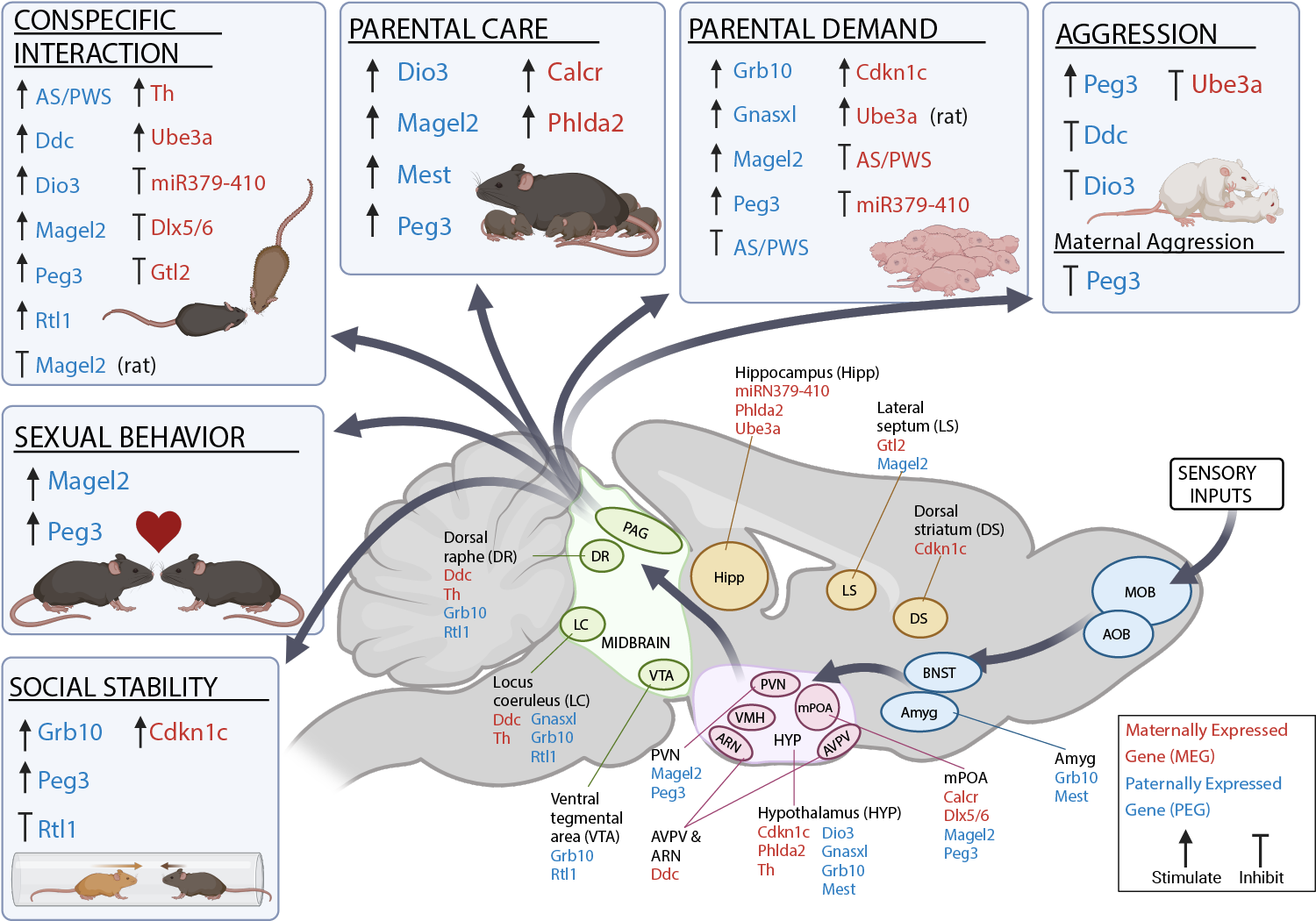
Proud of Erin for the expansive knowledge it takes to concisely write a review on the current and past research in the field of genomic imprinting and social behavior. The review consolidates the evidence that imprinted genes influence social behaviors across major neurodevelopment stages in humans and mouse animal models that include parent–infant interactions, juvenile sociability, and adult aggression, dominance, and sexual behavior. We hope this review will inspire further studies that discover how parents can epigenetically shape the genomic architecture of their offsprings’ genomes to regulate brain development and behavior!
Description: Genomic imprinting is an epigenetic phenomenon in mammals that affects brain development and behavior. Imprinting involves the regulation of allelic expression for some genes in offspring that depends on whether alleles are inherited from mothers compared to fathers, and is thought to provide parental control over offspring social behavior phenotypes. Imprinted gene expression is prevalent in the mammalian brain, and human imprinted gene mutations are associated with neurodevelopmental disorders and neurodivergent social behavior in Prader-Willi Syndrome, Angelman Syndrome, and autism. Here, we provide a review of the evidence that imprinted genes influence social behaviors across major neurodevelopmental stages in humans and mouse animal models that include parent–infant interactions, juvenile sociability, and adult aggression, dominance, and sexual behavior.
Plain Summary: We get two copies of every gene, one from our mom and one from our dad. Usually, both copies are used. However, some genes in mammals only use one of those copies–either the one from mom or the one from dad–while the other one is turned off and not used. These are called imprinted genes, and they are controlled by a process called epigenetics that determines when and wherein the body a gene is used. When a copy of a gene is turned off, the function of the gene can become more susceptible to mutation changes or mistakes in the used copy. This raises questions about why these unique genes exist. This review shares findings that suggest many imprinted genes help regulate social behaviors throughout life. Generally, the genes that come from dad tend to be linked to caring for offspring and social interactions, while those inherited from mom often have the opposite effect.
Publication Link:
https://www.tandfonline.com/doi/full/10.1080/17501911.2025.2491294

August 2024- NSF Grant Seeks to Understand Resilience to Stress
The Bonthuis lab is honored to collaborate and work with UIUC Professors David Zhao (Statistics), Howard Gritton (Comparative Biosciences), Yuri Vlasov (Electrical and Computing Engineering), Sergei Maslow (Center for AI Modeling), Brad Sutton (Bioengineering), Jozien Goenseand (psychology and bioengineering) Georgia Tech Professor Saurabh Sin (biomedical engineering) on investigating what biological mechanisms underlie resilience to severe trauma compared to the prevalence of mental illness. Observations suggests that most individuals who are exposed to high levels of stress and trauma are able to avoid serious mental illness.
We will be working on the first grant that has been awarded to the Kellner Center for Neurogenomics, Behavior, and Society, which is housed in the GNDP research theme at the Carl R Woese Institute for Genomic Biology. The Center is dedicated to studying the connection between our genes, brains, and behavior—and how that impacts our communities.
Using a multidisciplinary approach that combines animal behavior, brain imaging, electrophysiology, and gene expression experiments with machine learning and statistical modeling, our team plans to characterize mechanisms in the brain that could underlie the biological basis of resiliency.
The Bonthuis lab was awarded the NSF Collaborative Research in Computational Neuroscience (CRCNS): Multimodal network interactions for internal state dynamics of resiliency for Innovative Approaches to Science and Engineering Research on Brain Function ($1,210,000).
AWARD NUMBER: 1R01AT013189-01
Summer 2024 -Sarah Kim Awarded Woese Research Scholar
Congrats to Sarah Kim for winning the Carl R. Woese Undergraduate Research Scholar Grant. Over the summer she will carry out research projects studying the effects of stress on individuals and their brains. Specifically, she will be looking at chronic social defeat stress in mice, which imitates stress responses in humans. To do so, she will be isolating RNA from the fear and reward regions in control mice and those under stress to measure changes in gene expression. She will then integrate those patterns with behavioral data to uncover which genes play a role during stress. We are appreciative of the opportunity provided by IGB for undergraduates to do summer research. We are impressed with Sarah’s strong bench skills and research as an uprising sophomore and dedication to the lab.
Read more here:
https://www.igb.illinois.edu/article/woese-research-scholars-announced-2024
May 2024 – Ann-Farah Usman- Awarded Outstanding Oral Presentation:
Ann-Farah Usman presented on Noncanonical Genomic Imprinting of tyrosine hydroxylase (Th) in the Nervous System Affects Social Behaviors at the Undergraduate Research Symposium held at the Illini Union. She was awarded Outstanding Oral Presentation by the Office of Undergraduate Research panel of judges and peers. We are thankful for Ann-Farah’s dedicated effort and enthusiasm in the lab. We wish her the best at University of Chicago as she continues to pursue graduate studies in the field of human genetics.
Read more here:
Erin O’Leary Wins Poster Award
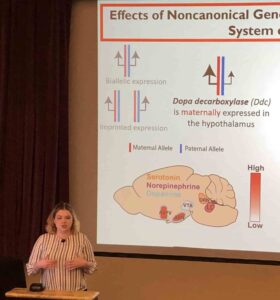 Congratulations to Erin O’Leary, Neuroscience Graduate Student, who won an award of $500 for her lightning talk and poster presentation entitled Effects of Noncanonical Genomic Imprinting in the Brain Monoamine System on Social Dominance at the College of Veterinary Medicine Research Day on April 27th, 2022.
Highest Distinction for Sam Rahman
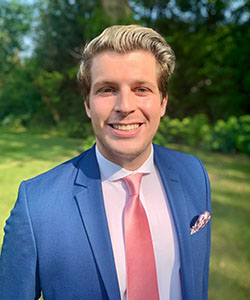 Congratulations to Sam Rahman who was awarded the Highest Distinction for his undergraduate research project and thesis. Sam presented his written thesis and talk, titled A PRACTICAL GUIDE TO DEEPLABCUT AND SIMPLE BEHAVIORAL ANALYSIS, to his distinction committee and colleagues at the VetMed Basic Science building on April 18th, 2022 . Sam’s distinction committee (Professor Justin Rhodes, Psychology; Assist. Professor Jake Hinman, Psychology; and Assist. Professor Paul Bonthuis, Comparative Biosciences) unanimously and without reservation recommended Sam for literally the highest distinction possible for his Individual Plan of Study in the College of Liberal Arts and Sciences. Sam’s future plan is to pursue a PhD in the field of Neuroeconomics.